There were 50 faculty member comprising 30 males and the rest females. No male faculty member knew music, but many of the female faculty members did. The Head of the institution invited six faculty members to a tea party by draw of lots. At the party is was discovered that no members knew music. The conclusion is that:

- Athe party comprised male faculty members onlyCorrect
- Bthe party comprised only those female faculty members who could not give renderings in music
- Cthe party comprised both male and female faculty members
- Dnothing can be said about the gender composition of the party
Explanation
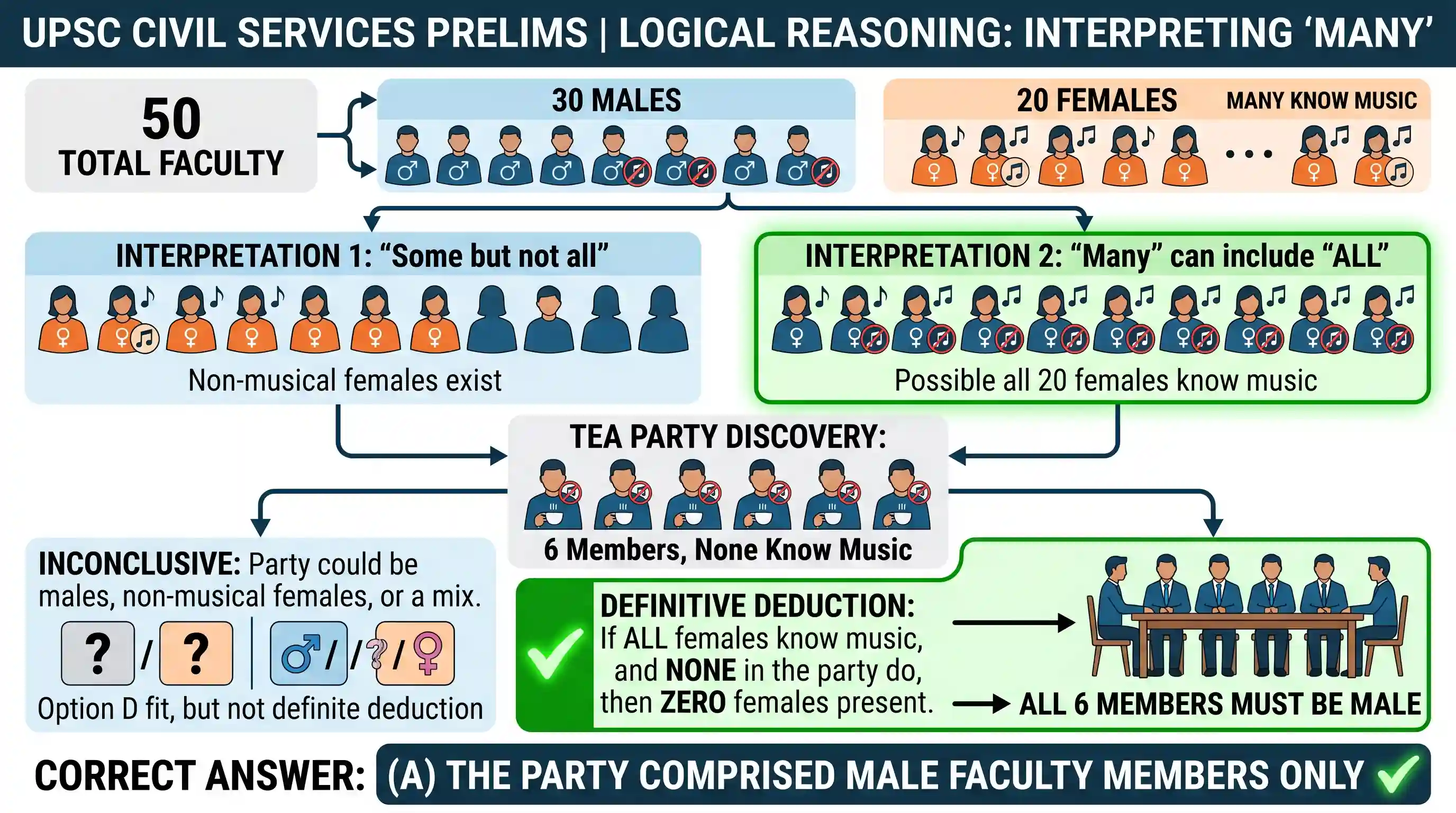
The core of this problem lies in the interpretation of the phrase "many of the female faculty members did [know music]".
Let's break down the information:
-
Total faculty: 50 (30 males, 20 females).
-
Male faculty: No male knew music. (All 30 males are "no-music" individuals).
-
Female faculty: "Many" knew music. This statement is crucial.
- Interpretation 1: "Many" implies "some but not all". In this case, some females knew music (F_music > 0) AND some females did not know music (F_no_music > 0).
- Interpretation 2: "Many" allows for "all". In this case, it's possible that all 20 females knew music (F_music = 20), which means no female faculty member did not know music (F_no_music = 0).
-
Tea party: 6 faculty members were invited.
-
Discovery: No members at the party knew music.
Now let's analyze the conclusion based on the two interpretations of "many":
Scenario A: If "many" implies "some but not all" (F_no_music > 0).
- The "no-music" pool consists of all 30 males AND some number of females (F_no_music).
- Since the 6 party members knew no music, they must have been drawn from this combined "no-music" pool.
- In this scenario, the party could be all males, all "no-music" females (if F_no_music >= 6), or a mix of males and "no-music" females.
- Therefore, "the party comprised male faculty members only" (Option A) would be a possible conclusion, but not a necessary one. Options B and C would also be possible. In this case, Option D ("nothing can be said about the gender composition") would be the most accurate, as we cannot definitively conclude the exact gender composition.
Scenario B: If "many" allows for "all" (F_no_music = 0 is possible).
- If it is possible that all 20 female faculty members knew music, then:
- All 30 males did not know music.
- All 20 females did know music.
- The party had 6 members, and none of them knew music.
- Since all females knew music, and no one at the party knew music, it logically follows that no female could have been at the party.
- Therefore, all 6 members at the party must have been male.
In logical reasoning questions, if a natural language quantifier like "many" is used, and it doesn't explicitly exclude "all" (e.g., "many but not all"), it's generally considered to allow for the possibility of "all". Given that "The conclusion is that:" implies a necessary deduction, we must consider the interpretation that leads to a single, definite conclusion. Scenario B provides such a definite conclusion.
Therefore, assuming "many" does not preclude "all" (i.e., it's possible all 20 females knew music), the only way for no one at the party to know music is if all 6 members were male.
The final answer is A.
Related questions
More UPSC Prelims practice from the same subject and topic.
- Prelims 2016CSATLogical Reasoning
A ate grapes and pineapple; B ate grapes and oranges; C ate oranges, pineapple and apple; D ate grapes, apple and pineapple. After taking fruits, B and C fell sick. In the light of the above facts, it…
- Prelims 2016CSATLogical Reasoning
Consider the following statements. 1. The rate of population growth is increasing in the country 2. The death rate is declining faster in the country compared to birth rate 3. The birth rate is declin…
- Prelims 2016CSATLogical Reasoning
Consider the following statement: "We shall go either for a picnic or for trekking". Which of the following, if true, would falsify this claim?
- Prelims 2016CSATLogical Reasoning
There are five persons in a group - P, Q, R, S and T. The group has one doctor, one lawyer and one artist. P and S are unmarried students. T is a man married to one of the group members. Q is the brot…
- Prelims 2016CSATLogical Reasoning
Consider the following statements: 1. Either A and B are of the same age or A is older than B 2. Either C and D are of the same age or D is older than C 3. B is older than C Which of the following con…
- Prelims 2016CSATLogical Reasoning
The nature of the legal imperatives in any given state corresponds to the effective demands that state encounters, and that these, in their turn, depend, in a general way, upon the manner in which eco…