Consider the following statements: 1. Either A and B are of the same age or A is older than B 2. Either C and D are of the same age or D is older than C 3. B is older than C Which of the following conclusions can be drawn from the above statements?

- AA is older than B
- BB and D are of the same age
- CD is older than C
- DA is older than CCorrect
Explanation
To solve this, let us represent the statements as mathematical inequalities:
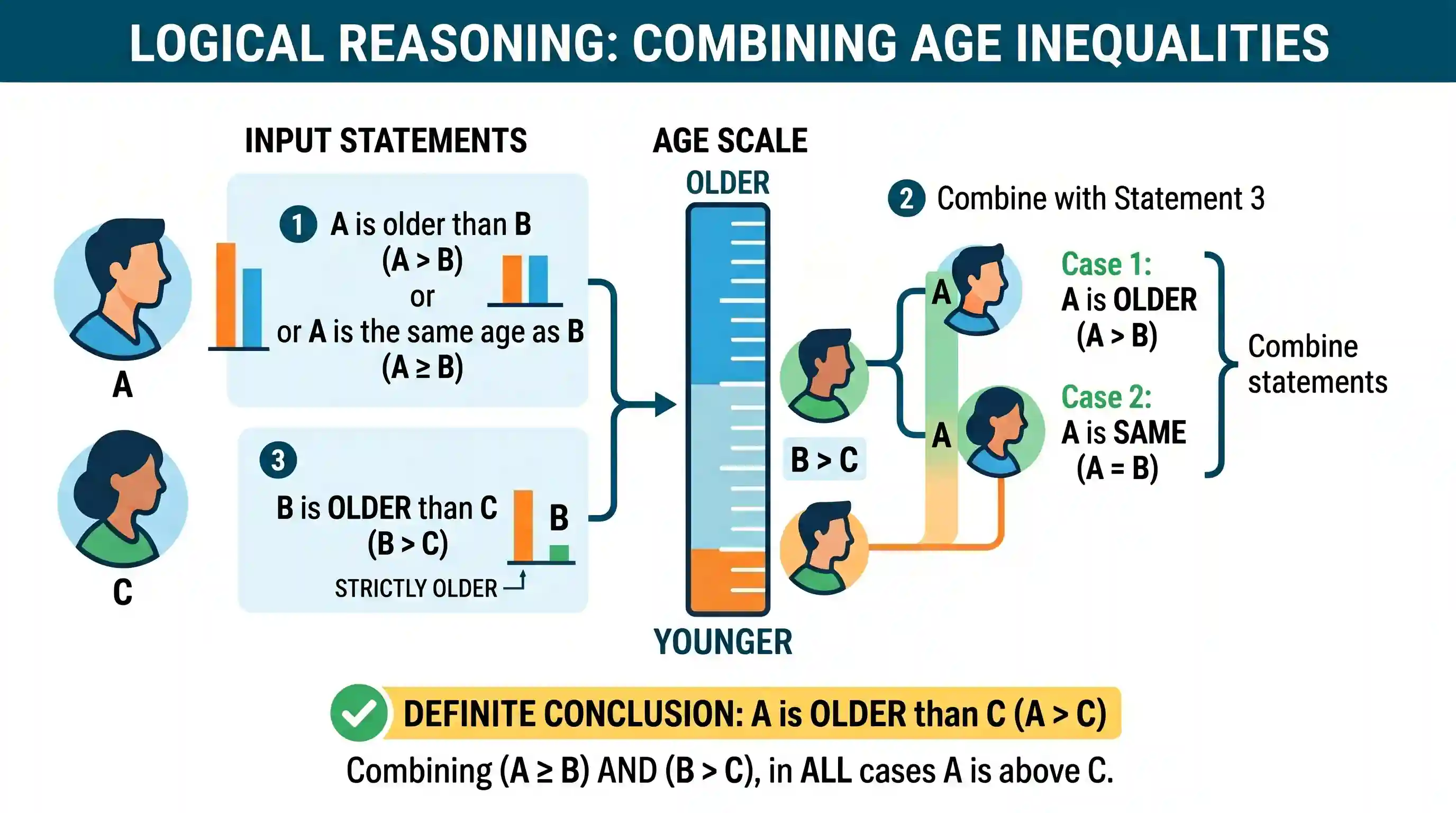
Statement 1: A is greater than or equal to B. Statement 2: D is greater than or equal to C. Statement 3: B is strictly greater than C.
Now, we combine Statement 1 and Statement 3: If A is either older than B or the same age as B, and B is definitely older than C, then A must be older than C.
For example, if A and B are both 20, and C is 18, then A is older than C. If A is 22 and B is 20, then A is still older than C. In every possible scenario, A is older than C.
Conclusion D is correct because it is a logical certainty derived from the given information. Other options like A, B, or C are possibilities but are not necessarily true in every case.
Related questions
More UPSC Prelims practice from the same subject and topic.
- Prelims 2016CSATLogical Reasoning
A ate grapes and pineapple; B ate grapes and oranges; C ate oranges, pineapple and apple; D ate grapes, apple and pineapple. After taking fruits, B and C fell sick. In the light of the above facts, it…
- Prelims 2016CSATLogical Reasoning
Consider the following statements. 1. The rate of population growth is increasing in the country 2. The death rate is declining faster in the country compared to birth rate 3. The birth rate is declin…
- Prelims 2016CSATLogical Reasoning
Consider the following statement: "We shall go either for a picnic or for trekking". Which of the following, if true, would falsify this claim?
- Prelims 2016CSATLogical Reasoning
There were 50 faculty member comprising 30 males and the rest females. No male faculty member knew music, but many of the female faculty members did. The Head of the institution invited six faculty me…
- Prelims 2016CSATLogical Reasoning
There are five persons in a group - P, Q, R, S and T. The group has one doctor, one lawyer and one artist. P and S are unmarried students. T is a man married to one of the group members. Q is the brot…
- Prelims 2016CSATLogical Reasoning
The nature of the legal imperatives in any given state corresponds to the effective demands that state encounters, and that these, in their turn, depend, in a general way, upon the manner in which eco…