If R and S are different integers both divisible by 5, then which of the following is not necessarily true?

- AR - S is divisible by 5
- BR + S is divisible by 10Correct
- CR × S is divisible by 25
- DR 2 + S 2 is divisible by 5
Explanation
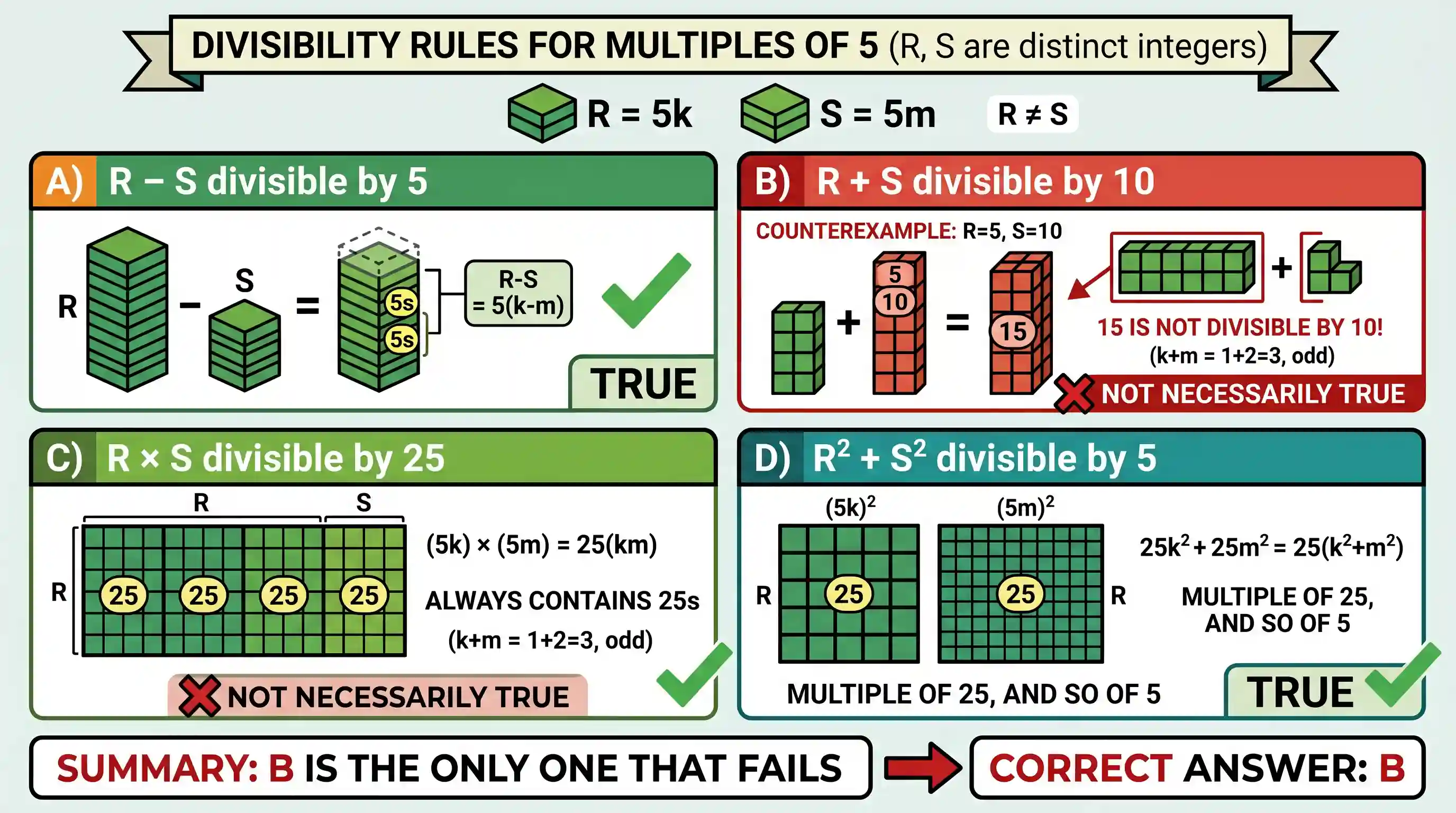
Let R = 5k and S = 5m, where k and m are different integers.
A) R - S is divisible by 5 R - S = 5k - 5m = 5(k - m). Since (k - m) is an integer, R - S is always divisible by 5. This is necessarily true.
B) R + S is divisible by 10 R + S = 5k + 5m = 5(k + m). For this to be divisible by 10, (k + m) must be an even number. This means k and m must either both be even or both be odd. Consider a counterexample: Let R = 5 (so k = 1) and S = 10 (so m = 2). R and S are different integers, both divisible by 5. R + S = 5 + 10 = 15. 15 is not divisible by 10. Therefore, R + S is not necessarily divisible by 10. This is not necessarily true.
C) R × S is divisible by 25 R × S = (5k) × (5m) = 25km. Since km is an integer, R × S is always divisible by 25. This is necessarily true.
D) R^2 + S^2 is divisible by 5 R^2 + S^2 = (5k)^2 + (5m)^2 = 25k^2 + 25m^2 = 25(k^2 + m^2). Since 25(k^2 + m^2) is always divisible by 25, it is also always divisible by 5 (as 25 is a multiple of 5). This is necessarily true.
The only statement that is not necessarily true is B.
Related questions
More UPSC Prelims practice from the same subject and topic.
- Prelims 2016CSATQuantitative Aptitude
There are five hobby clubs in a college — photography, yachting, chess, electronics and gardening. The gardening group meets every second day, the electronics group meets every third day, the chess gr…
- Prelims 2016CSATQuantitative Aptitude
How many numbers are there between 100 and 300 which either begin with or end with 2?
- Prelims 2016CSATQuantitative Aptitude
There are some nectar-filled flowers on a tree and some bees are hovering on it. If one bee lands on each flower, one bee will be left out. If two bees land on each flower, one flower will be left out…
- Prelims 2016CSATQuantitative Aptitude
There is an order of 19000 quantity of a particular product from a customer. The firm produces 1000 quantity of that product per out of which 5% are unfit for sale. In how many days will the order be …
- Prelims 2016CSATQuantitative Aptitude
A class starts at 11:00 am and lasts till 2:27 pm. Four periods of equal duration are held during this interval. After every period, a rest of 5 minutes is given to the students. The exact duration of…
- Prelims 2016CSATQuantitative Aptitude
30g of sugar was mixed in 180 ml water in a vessel A, 40 g of sugar Was mixed in 280 ml of water in vessel B and 20 g of sugar was mixed in 100 ml of water in vessel C. The solution in vessel B is