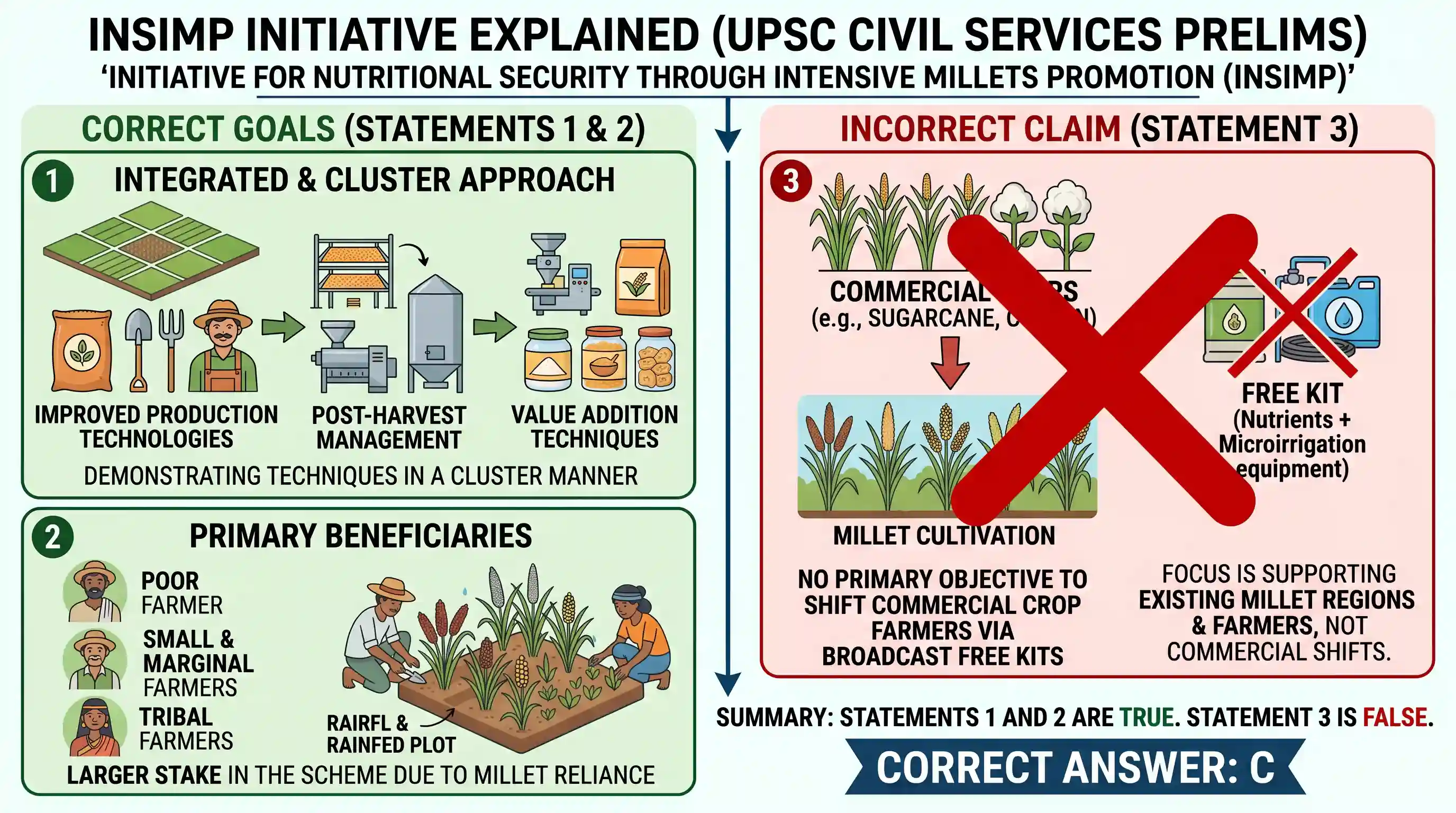
With reference to 'Initiative for Nutritional Security through Intensive Millets Promotion', which of the following statements is/are correct? 1. This initiative aims to demonstrate the improved production and post-harvest technologies, and to demonstrate value addition techniques, in an integrated manner, with cluster approach. 2. Poor, small, marginal and tribal farmers have larger stake in this scheme. 3. An important objective of the scheme is to encourage farmers of commercial crops to shift to millet cultivation by offering them free kits of critical inputs of nutrients and microirrigation equipment. Select the correct answer using the code given below.

- A1 only
- B2 and 3 only
- C1 and 2 onlyCorrect
- D1, 2 and 3
Explanation
The 'Initiative for Nutritional Security through Intensive Millets Promotion (INSIMP)' was a sub-scheme under the Rashtriya Krishi Vikas Yojana (RKVY) launched by the Government of India. Its objectives included:
-
This initiative aims to demonstrate the improved production and post-harvest technologies, and to demonstrate value addition techniques, in an integrated manner, with cluster approach. This statement is correct. The scheme focused on promoting improved cultivation practices, better post-harvest management, and value addition of millets through a cluster-based approach to enhance their marketability and nutritional security.
-
Poor, small, marginal and tribal farmers have larger stake in this scheme. This statement is correct. Millets are often grown in rainfed and marginal areas, making them crucial for the food security and livelihoods of poor, small, marginal, and tribal farmers who constitute a significant portion of millet growers.
-
An important objective of the scheme is to encourage farmers of commercial crops to shift to millet cultivation by offering them free kits of critical inputs of nutrients and microirrigation equipment. This statement is incorrect. While the scheme aimed to promote millet cultivation, its primary focus was on supporting existing millet growers and expanding millet areas, not necessarily on encouraging a direct shift from commercial crops to millets by offering free kits in this manner. The emphasis was on promoting millets for nutritional security and climate resilience, often in areas where they are already traditional crops or suitable due to agro-climatic conditions, rather than a broad incentive for commercial crop farmers to switch.
Therefore, statements 1 and 2 are correct.
Related questions
More UPSC Prelims practice from the same subject and topic.
- Prelims 2016GS1economy
Which of the following is/are the indicator/indicators used by IFPRI to compute the Global Hunger Index Report? 1. Undernourishment 2. Child stunting 3. Child mortality Select the correct answer using…
- Prelims 2016GS1economy
Which one of the following is a purpose of 'UDAY', a scheme of the Government?
- Prelims 2016GS1economy
With reference to 'Pradhan Mantri Fasal Bima Yojana', consider the following statements: 1. Under this scheme, farmers will have to pay a uniform premium of two percent for any crop they cultivate in …
- Prelims 2016GS1economy
Why does the Government of India promote the use of 'Neem-coated Urea' in agriculture?
- Prelims 2016GS1economy
With reference to 'Stand Up India Scheme', which of the following statements is/are correct? 1. Its purpose is to promote entrepreneurship among SC/ST and women entrepreneurs. 2. It provides for refin…
- Prelims 2016GS1economy
'Net metering' is sometimes seen in the news in the context of promoting the