What was the main reason for the split in the Indian National Congress at Surat in 1907?

- AIntroduction of communalism into Indian politics by Lord Minto
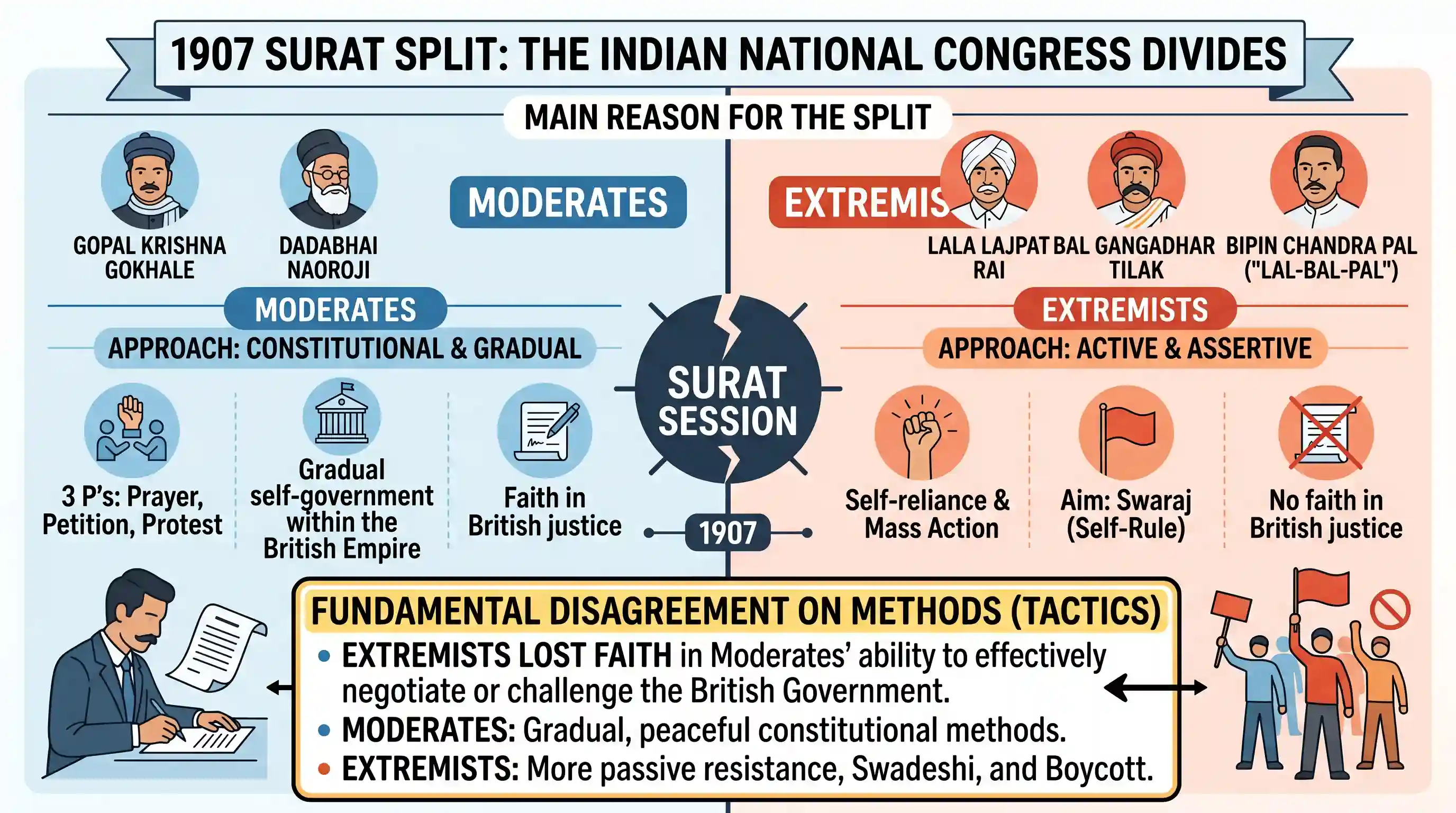
- BExtremists' lack of faith in the capacity of the moderates to negotiate with the British GovernmentCorrect
- CFoundation of Muslim League
- DAurobindo Ghosh's inability to be elected as the President of the Indian National Congress
Explanation
The main reason for the split in the Indian National Congress at Surat in 1907 was the growing ideological divide between the Moderates and the Extremists. The Extremists, led by figures like Bal Gangadhar Tilak, Lala Lajpat Rai, and Bipin Chandra Pal, believed that the Moderates' methods of prayer, petition, and protest were ineffective in achieving Swaraj. They advocated for more assertive methods like Swadeshi, Boycott, and National Education, and had lost faith in the Moderates' ability or willingness to challenge British rule effectively. This fundamental difference in approach and strategy led to the irreconcilable split, not the introduction of communalism, the foundation of the Muslim League (which was a separate development), or Aurobindo Ghosh's election.
Related questions
More UPSC Prelims practice from the same subject and topic.
- Prelims 2016GS1history
The 'Swadeshi' and 'Boycott' were adopted as methods of struggle for the first time during the
- Prelims 2016GS1history
Satya Shodhak Samaj organized
- Prelims 2016GS1history
The Montague-Chelmsford Proposals were related to
- Prelims 2016GS1history
Consider the following: 1. Calcutta Unitarian Committee 2. Tabernacle of New Dispensation 3. Indian Reform Association Keshab Chandra Sen is associated with the establishment of which of the above?
- Prelims 2016GS1history
The plan of Sir Stafford Cripps envisaged that after the Second World War
- Prelims 2016GS1history
Regarding the taxation system of Krishna Deva, the ruler of Vijayanagar, consider the following statements: 1. The tax rate on land was fixed depending on the quality of the land. 2. Private owners of…