The Parliament of India acquires the power to legislate on any item in the State List in the national interest if a resolution to that effect is passed by the

- ALok Sabha by a simple majority of its total membership
- BLok Sabha by a majority of not less than two-thirds of its total membership
- CRajya Sabha by a simple majority of its total membership
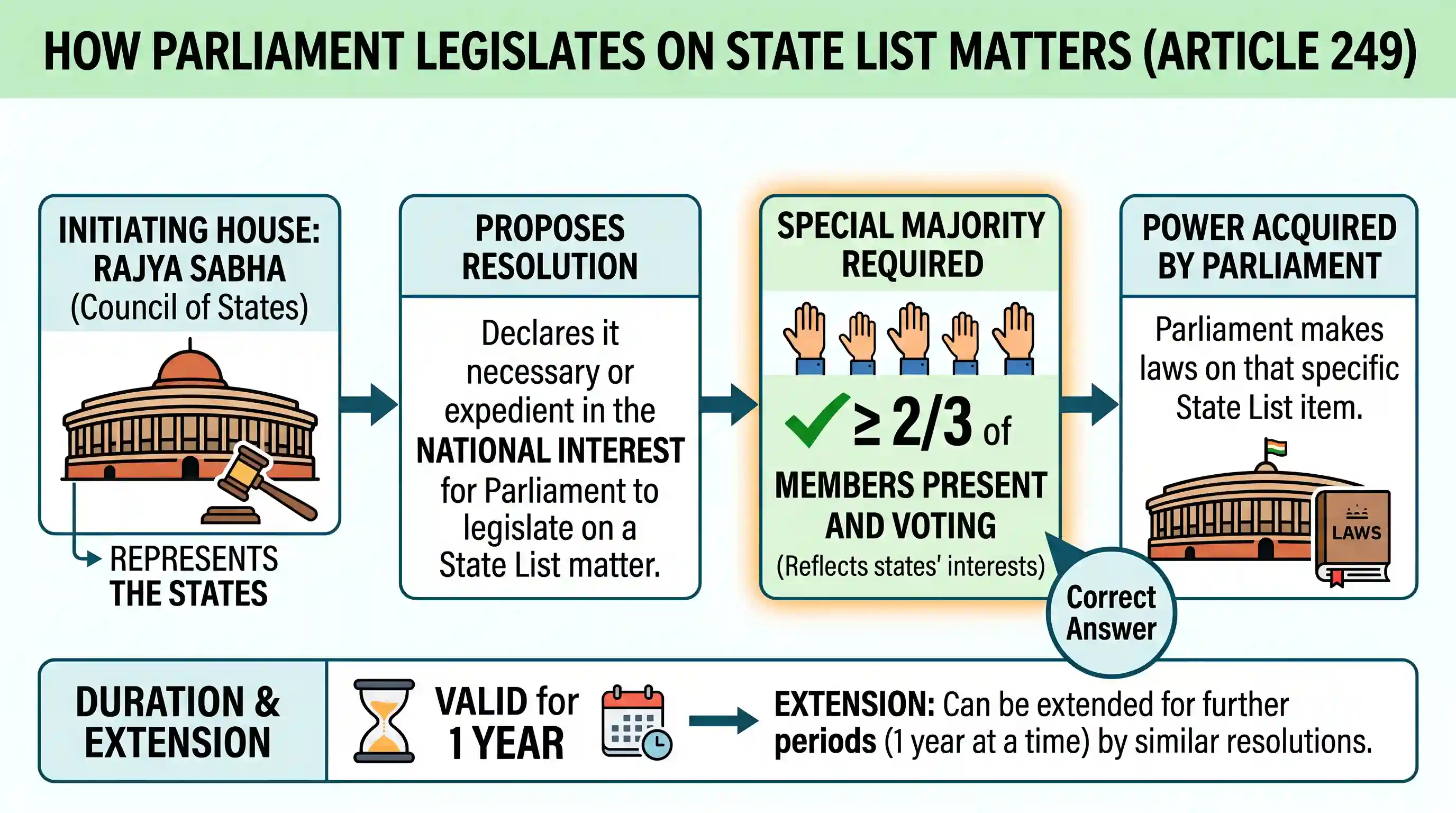
- DRajya Sabha by a majority of not less than two-thirds of its members present and votingCorrect
Explanation
Article 249 of the Indian Constitution empowers the Parliament to legislate on any item enumerated in the State List. This power is exercised when the Rajya Sabha (Council of States) passes a resolution by a majority of not less than two-thirds of its members present and voting. Such a resolution declares that it is necessary or expedient in the national interest for Parliament to make laws with respect to any matter enumerated in the State List. This power is typically for a period of one year but can be extended by further resolutions.
It's important to note that this special power to legislate on the State List in national interest is vested specifically with the Rajya Sabha, reflecting its role in protecting the interests of the states.
Related questions
More UPSC Prelims practice from the same subject and topic.
- Prelims 2016GS1polity-and-governance
Which of the following statements is/are correct? 1. A Bill pending in the Lok Sabha lapses on its prorogation. 2. A Bill pending in the Rajya Sabha, which has not been passed by the Lok Sabha, shall …
- Prelims 2016GS1polity-and-governance
What is/are the importance/importances of the United Nations Convention to Combat Desertification? 1. It aims to promote effective action through innovative national programmes and supportive internat…
- Prelims 2016GS1polity-and-governance
'Rashtriya Garima Abhiyaan' is a national campaign to
- Prelims 2016GS1polity-and-governance
Consider the following pairs: Community sometimes mentioned in the news : In the affairs of 1. Kurd : Bangladesh 2. Madhesi : Nepal 3. Rohingya : Myanmar Which of the pairs given above is/are correctl…
- Prelims 2016GS1polity-and-governance
With reference to 'Organization for the Prohibition of Chemical Weapons (OPCW)', consider the following statements: 1. It is an organization of European Union in working relation with NATO and WHO. 2.…
- Prelims 2016GS1polity-and-governance
Which of the following are the key features of 'National Ganga River Basin Authority (NGRBA)? 1. River basin is the unit of planning and management. 2. It spearheads the river conservation efforts at …