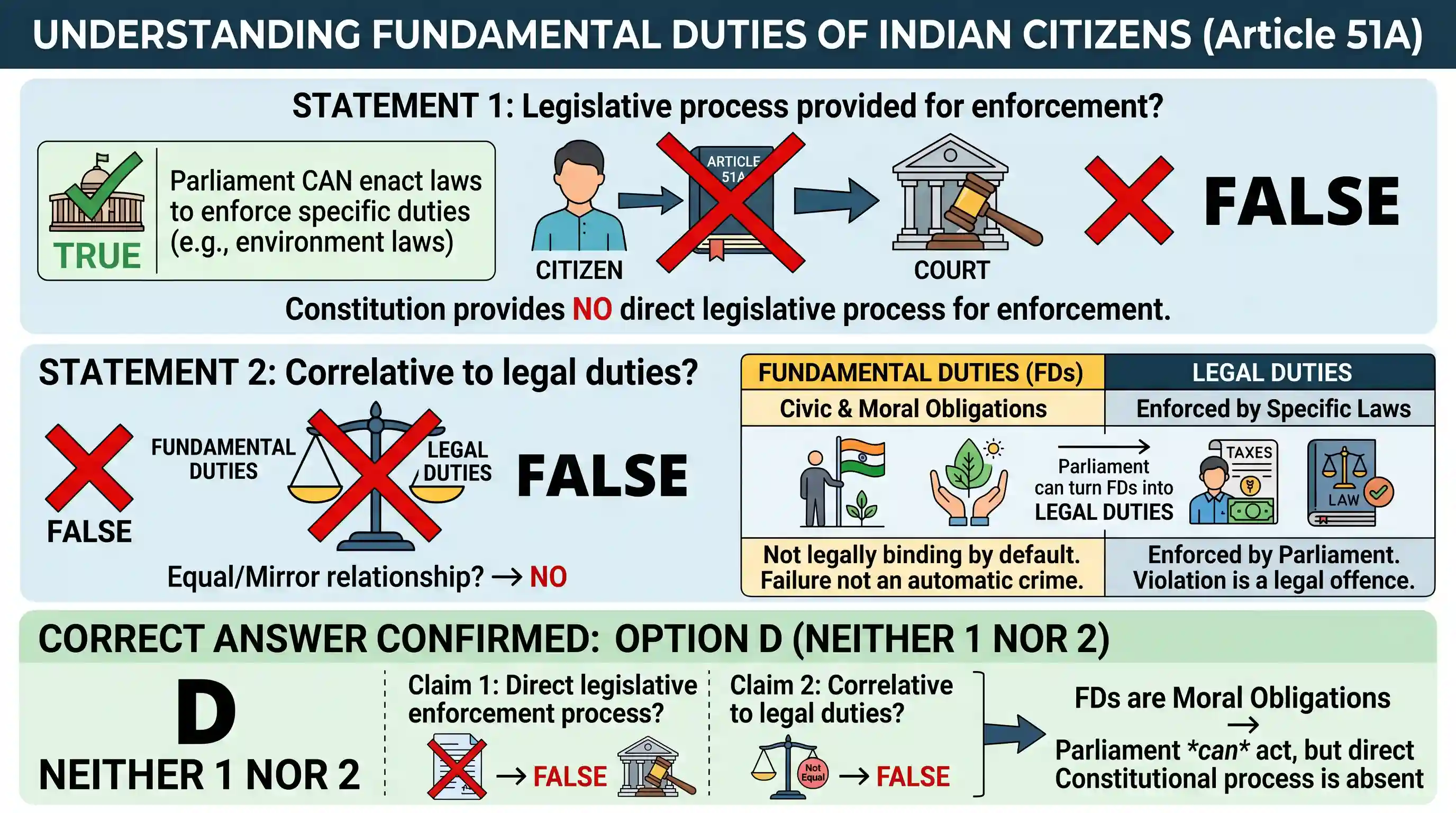
Which of the following statements is/are true of the Fundamental Duties of an Indian citizen? 1. A legislative process has been provided to enforce these duties. 2. They are correlative to legal duties. Select the correct answer using the code given below:

- A1 only
- B2 only
- CBoth 1 and 2
- DNeither 1 nor 2Correct
Explanation
Statement 1 is incorrect. While the Fundamental Duties are part of the Indian Constitution (Article 51A), there is no specific legislative process provided in the Constitution for their direct enforcement. They are not directly enforceable by courts in the same way as Fundamental Rights. However, Parliament can enact laws to enforce specific duties. Statement 2 is incorrect. Fundamental Duties are moral and civic obligations of citizens. They are not correlative to legal duties in the sense that failure to perform a fundamental duty does not automatically invite legal punishment, unless a specific law has been enacted to make it a legal duty (e.g., paying taxes, which is also a legal duty). Fundamental Rights, however, are correlative to the duties of the State.
Related questions
More UPSC Prelims practice from the same subject and topic.
- Prelims 2017GS1polity-and-governance
Which principle among the following was added to the Directive Principles of State Policy by the 42nd Amendment to the Constitution?
- Prelims 2017GS1polity-and-governance
Which one of the following statements is/are correct? A) Rights are claims of the State against the citizens. B) Rights are privileges which are incorporated in the Constitution of a State. C) Rights …
- Prelims 2017GS1polity-and-governance
Consider the following statements: With reference to the Constitution of India, the Directive Principles of State Policy constitute limitations upon 1. legislative function. 2. executive function. Whi…
- Prelims 2017GS1polity-and-governance
Which one of the following objectives is not embodied in the Preamble to the Constitution of India?
- Prelims 2017GS1polity-and-governance
In the context of India, which one of the following is the correct relationship between Rights and Duties?
- Prelims 2017GS1polity-and-governance
The mind of the makers of the Constitution of India is reflected in which of the following?