The Parliament of India exercises control over the functions of the Council of Ministers through 1. Adjournment motion 2. Question hour 3. Supplementary questions Select the correct answer using the code given below:

- A1 only
- B2 and 3 only
- C1 and 3 only
- D1, 2 and 3Correct
Explanation
The Indian Parliament, particularly the Lok Sabha, exercises control over the Council of Ministers through various mechanisms to ensure their accountability:
-
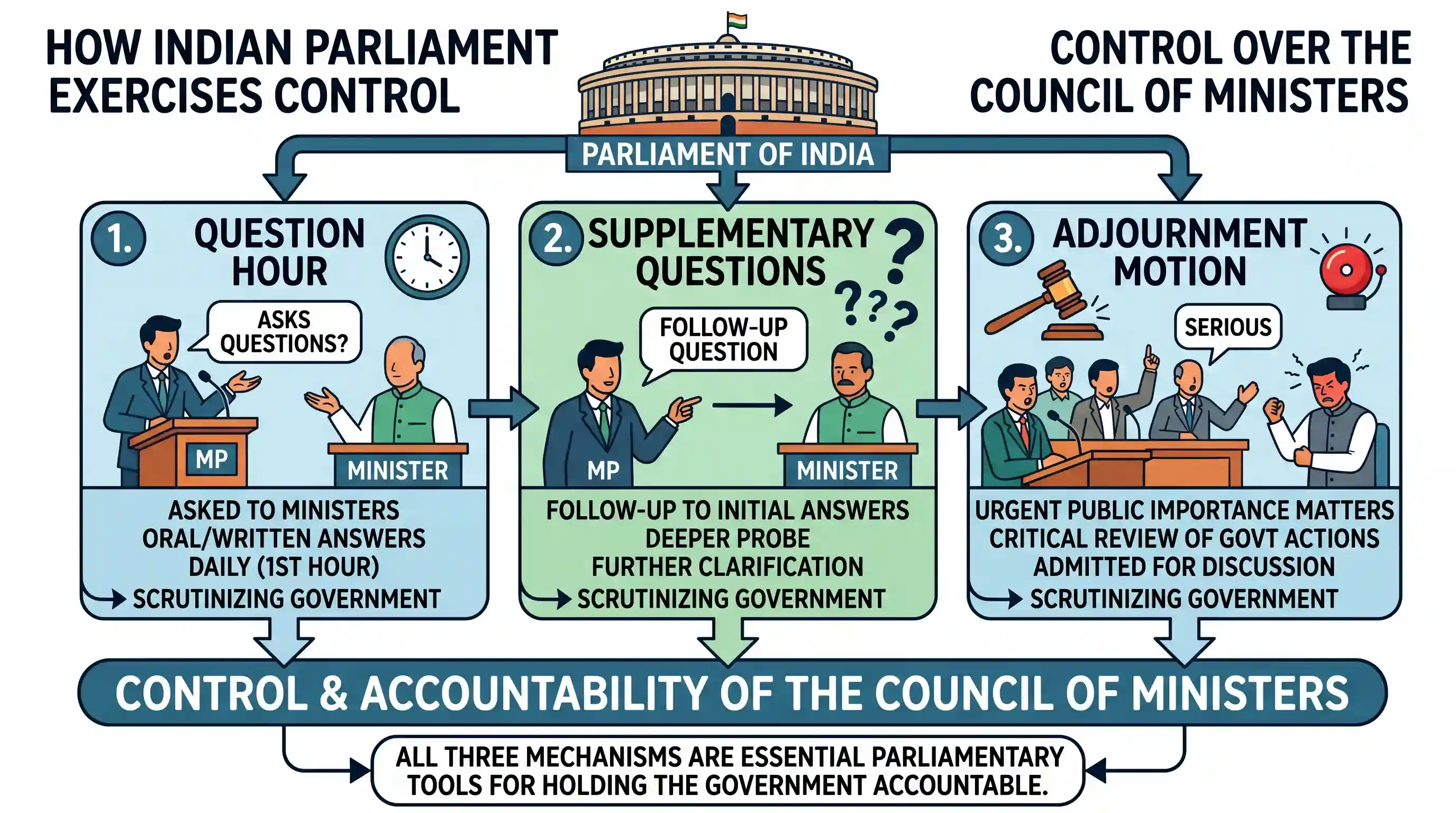
Adjournment motion: This motion is introduced in the Parliament to draw the attention of the House to a definite matter of urgent public importance. If admitted, it leads to a discussion, often critical of the government's actions or inactions, thus holding the Council of Ministers accountable.
-
Question hour: The first hour of every parliamentary sitting is allotted for Question Hour. During this time, Members of Parliament ask questions to ministers on various administrative aspects, and ministers are obliged to answer. This is a crucial mechanism for accountability.
-
Supplementary questions: When a question is asked during the Question Hour, the minister provides an answer. Members of Parliament can then ask supplementary questions arising out of the original answer, seeking further clarification or information. This deepens the scrutiny and reinforces accountability.
All three are effective tools used by the Parliament to control and hold the Council of Ministers responsible.
Related questions
More UPSC Prelims practice from the same subject and topic.
- Prelims 2017GS1polity-and-governance
Local self-government can be best explained as an exercise in
- Prelims 2017GS1polity-and-governance
With reference to the 'Prohibition of Benami Property Transactions Act, 1988 (PBPT Act)', consider the following statements: 1. A property transaction is not treated as a benami transaction if the own…
- Prelims 2017GS1polity-and-governance
Which of the following are the objectives of 'National Nutrition Mission'? 1. To create awareness relating to malnutrition among pregnant women and lactating mothers. 2. To reduce the incidence of ana…
- Prelims 2017GS1polity-and-governance
Who among the following can join the National Pension System (NPS)?
- Prelims 2017GS1polity-and-governance
According to the Wildlife (Protection) Act, 1972, which of the following animals cannot be hunted by any person except under some provisions provided by law? 1. Gharial 2. Indian wild ass 3. Wild buff…
- Prelims 2017GS1polity-and-governance
With reference to 'Quality Council of India (QCI)', consider the following statements: 1. QCI was set up jointly by the Government of India and the Indian Industry. 2. Chairman of QCI is appointed by …