Organic Light Emitting Diodes (OLEDs) are used to create digital display in many devices. What are the advantages of OLED displays over Liquid Crystal displays? 1. OLED displays can be fabricated on flexible plastic substrates. 2. Roll-up displays embedded in clothing can be made using OLEDs. 3. Transparent displays are possible using OLEDs. Select the correct answer using the code given below:

- A1 and 3 only
- B2 only
- C1, 2 and 3Correct
- DNone of the above statements is correct
Explanation
Organic Light Emitting Diodes (OLEDs) offer several significant advantages over traditional Liquid Crystal Displays (LCDs) due to their self-emissive nature and the properties of their organic materials:
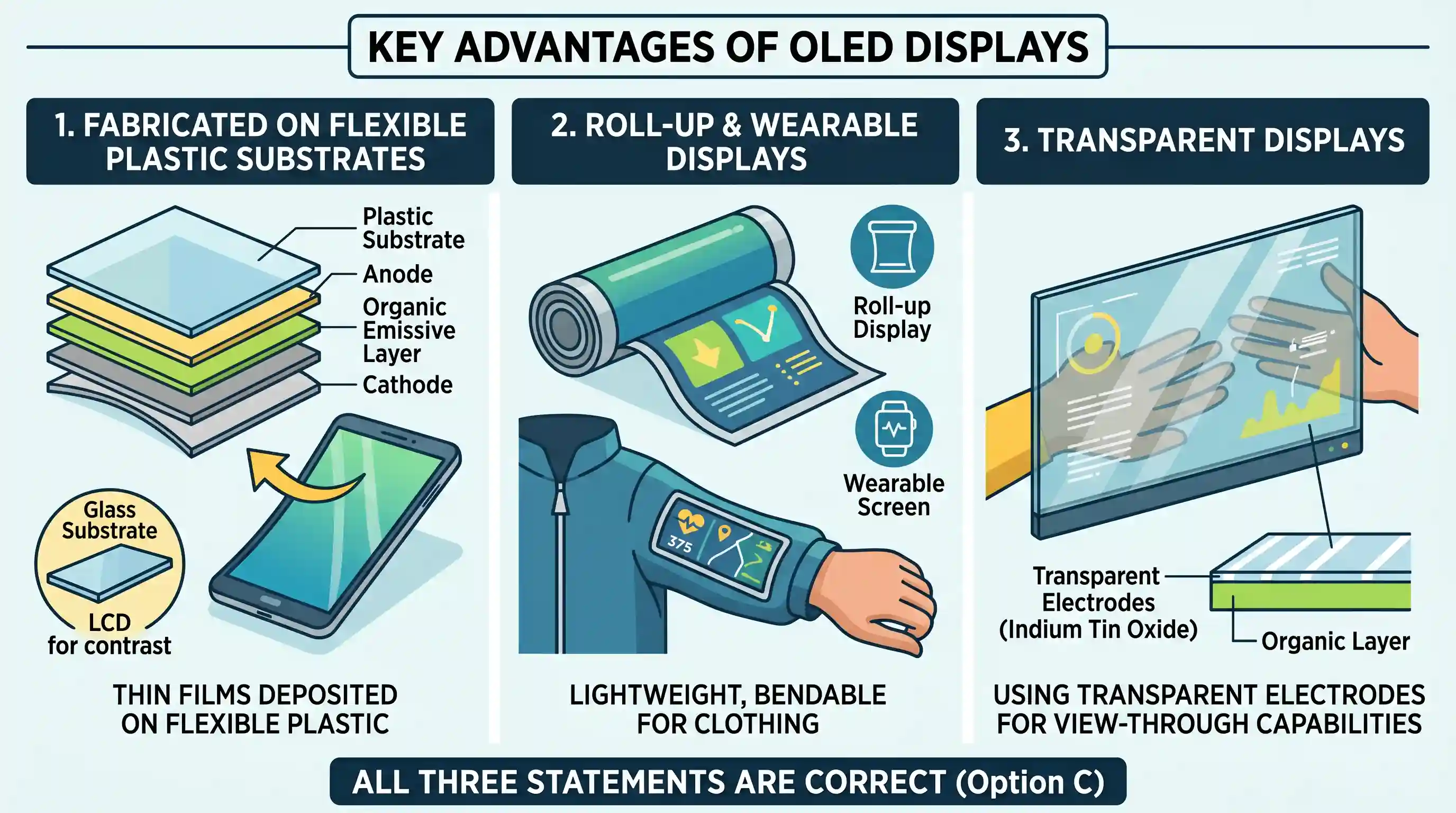
- OLED displays can be fabricated on flexible plastic substrates: This is correct. Because OLEDs are made from thin films of organic materials, they can be deposited on flexible substrates, enabling the creation of bendable and even foldable displays.
- Roll-up displays embedded in clothing can be made using OLEDs: This is correct. The inherent flexibility and thinness of OLED technology make it suitable for innovative applications like roll-up displays or displays integrated directly into textiles and clothing.
- Transparent displays are possible using OLEDs: This is correct. By utilizing transparent electrodes and substrates, OLED technology can be engineered to create transparent displays, where content can be seen on the screen while also allowing viewing through it. All three statements accurately describe advantages or potential applications stemming from the unique characteristics of OLED technology.
Related questions
More UPSC Prelims practice from the same subject and topic.
- Prelims 2017GS1science-and-technology
Which of the following statements is/are correct regarding Smart India Hackathon 2017? 1. It is a centrally sponsored scheme for developing every city of our country into Smart Cities in a decade. 2. …
- Prelims 2017GS1science-and-technology
Consider the following statements: 1. The Nuclear Security Summits are periodically held under the aegis of the United Nations. 2. The International Panel on Fissile Materials is an organ of Internati…
- Prelims 2017GS1science-and-technology
Consider the following statements: 1. In tropical regions, Zika virus disease is transmitted by the same mosquito that transmits dengue. 2. Sexual transmission of Zika virus disease is possible. Which…
- Prelims 2017GS1science-and-technology
With reference to the 'National Intellectual Property Rights Policy', consider the following statements: 1. It reiterates India's commitment to the Doha Development Agenda and the TRIPS Agreement. 2. …
- Prelims 2017GS1science-and-technology
The terms 'Event Horizon', 'Singularity', 'String Theory' and 'Standard Model' are sometimes seen in the news in the context of
- Prelims 2017GS1science-and-technology
With reference to agriculture in India, how can the technique of 'genome sequencing', often seen in the news, be used in the immediate future? 1. Genome sequencing can be used to identify genetic mark…