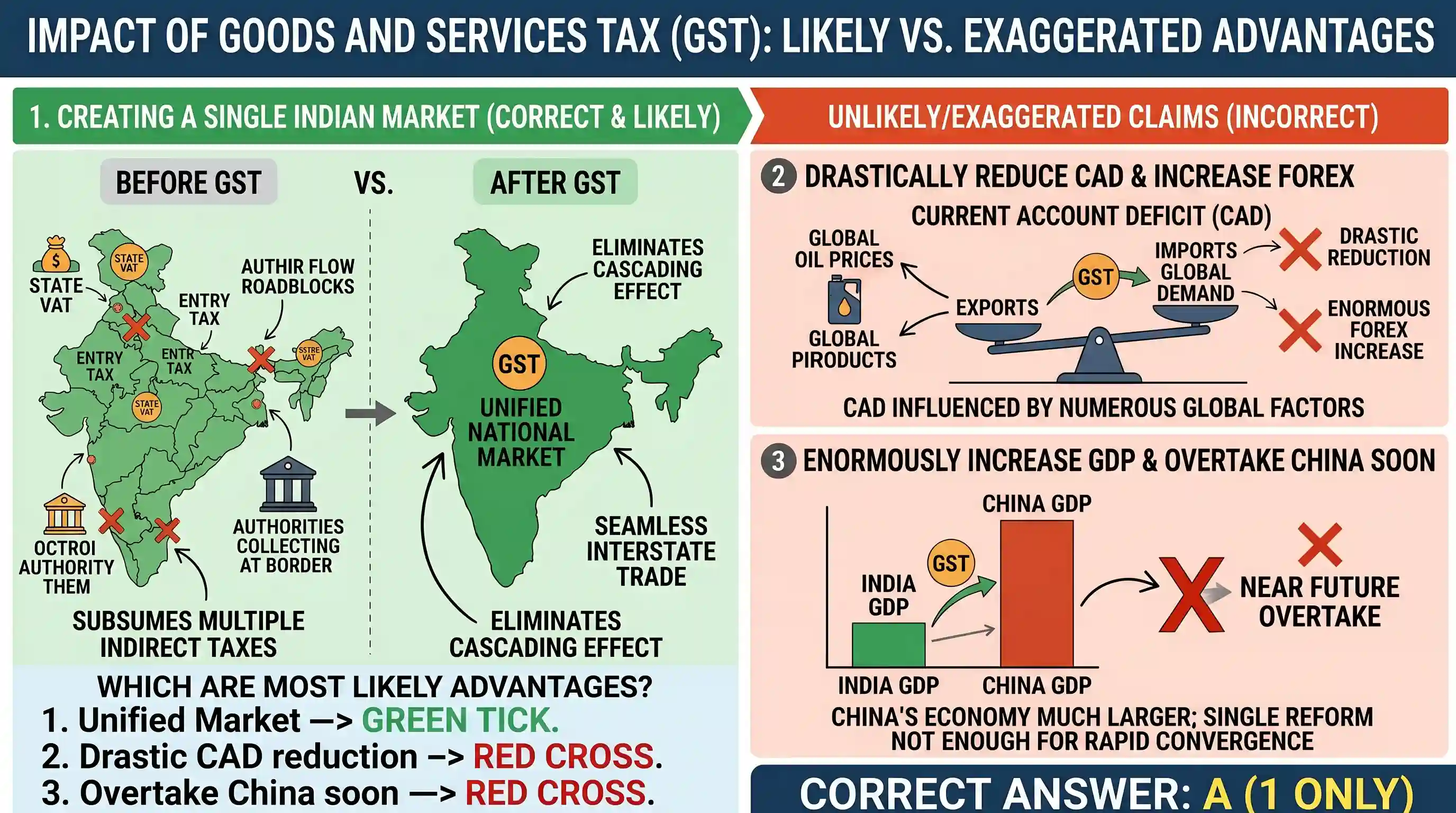
What is/are the most likely advantages of implementing 'Goods and Services Tax (GST)'? 1. It will replace multiple taxes collected by multiple authorities and will thus create a single market in India. 2. It will drastically reduce the 'Current Account Deficit' of India and will enable it to increase its foreign exchange reserves. 3. It will enormously increase the growth and size of economy of India and will enable it to overtake China in the near future. Select the correct answer using the code given below:

- A1 onlyCorrect
- B2 and 3 only
- C1 and 3 only
- D1, 2 and 3
Explanation
Let's evaluate the likely advantages of implementing the Goods and Services Tax (GST) in India:
-
It will replace multiple taxes collected by multiple authorities and will thus create a single market in India. This statement is correct. The primary objective and the most significant advantage of GST is to subsume various central and state indirect taxes (like excise duty, service tax, VAT, etc.) into a single tax. This simplification aims to eliminate cascading effects of taxes, reduce compliance burden, and create a unified national market, making inter-state trade smoother and more efficient.
-
It will drastically reduce the 'Current Account Deficit' of India and will enable it to increase its foreign exchange reserves. This statement is incorrect. While GST is expected to boost economic activity and potentially make Indian exports more competitive by reducing the cost of goods, claiming it will 'drastically reduce' the Current Account Deficit (CAD) or 'enormously' increase foreign exchange reserves is an overstatement. CAD is influenced by a multitude of factors, including global commodity prices (especially crude oil), global demand, and the overall balance of payments, which are not solely determined by a domestic tax reform.
-
It will enormously increase the growth and size of economy of India and will enable it to overtake China in the near future. This statement is incorrect. While GST is projected to positively impact India's GDP growth in the long run by improving efficiency and compliance, the claim that it will 'enormously increase' growth to the extent of enabling India to 'overtake China in the near future' is highly speculative and exaggerated. China's economy is significantly larger, and such a rapid convergence due to a single tax reform is unrealistic.
Thus, only statement 1 accurately describes a most likely and primary advantage of GST.
Related questions
More UPSC Prelims practice from the same subject and topic.
- Prelims 2017GS1economy
Consider the following statements: 1. Tax revenue as a percent of GDP of India has steadily increased in the last decade. 2. Fiscal deficit as a percent of GDP of India has steadily increased in the l…
- Prelims 2017GS1economy
'Recognition of Prior Learning Scheme' is sometimes mentioned in the news with reference to A) Certifying the skills acquired by construction workers through traditional channels. B) Enrolling the per…
- Prelims 2017GS1economy
Which of the following statements is/are correct regarding the Monetary Policy Committee (MPC)? 1. It decides the RBI's benchmark interest rates. 2. It is a 12-member body including the Governor of RB…
- Prelims 2017GS1economy
It is possible to produce algae based biofuels, but what is/are the likely limitation(s) of developing countries in promoting this industry? 1. Production of algae based biofuels is possible in seas o…
- Prelims 2017GS1economy
The term 'Domestic Content Requirement' is sometimes seen in the news with reference to
- Prelims 2017GS1economy
Consider the following statements: 1. The Standard Mark of Bureau of Indian Standards (BIS) is mandatory for automotive tyres and tubes. 2. AGMARK is a quality Certification Mark issued by the Food an…