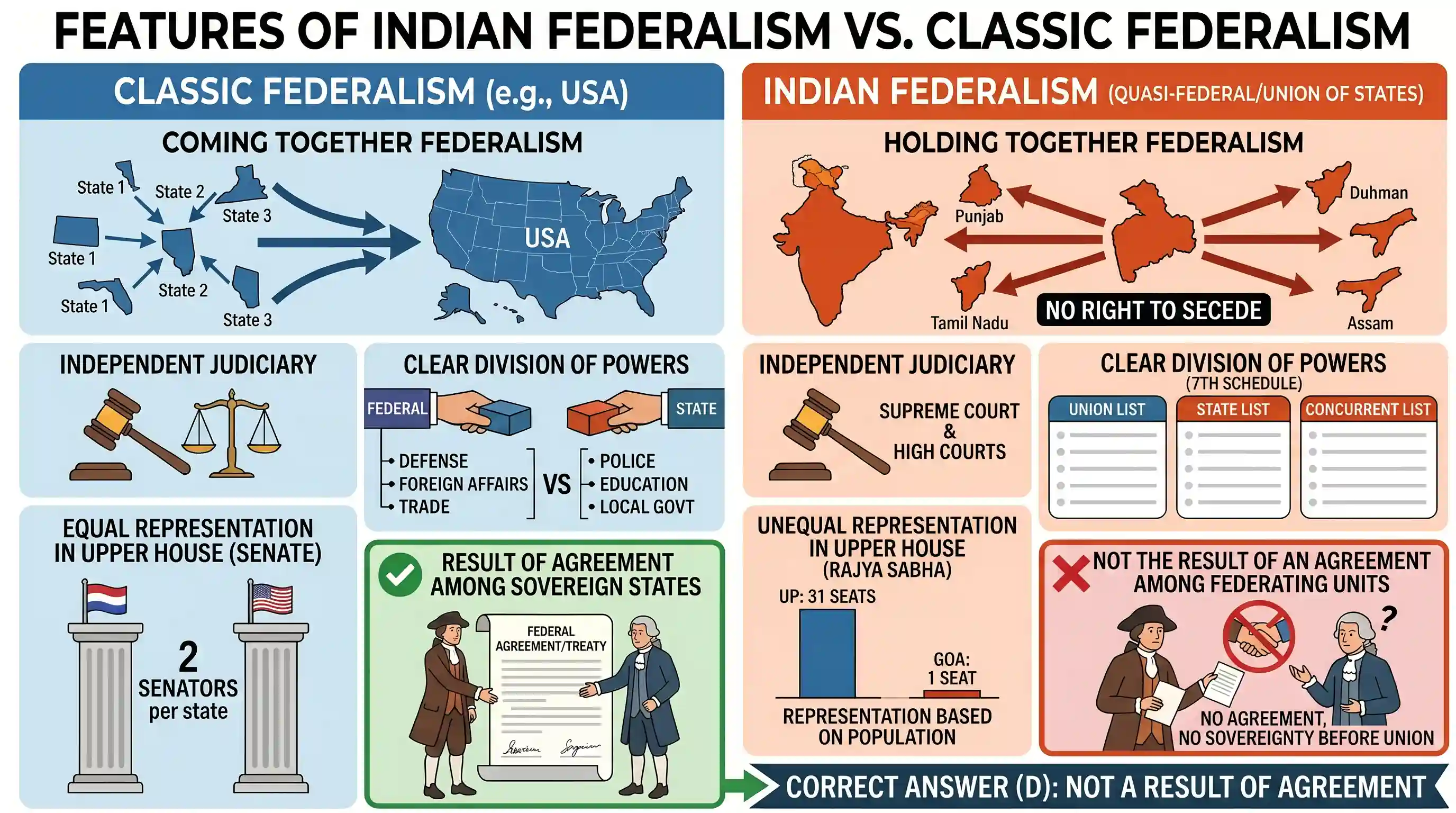
Which one of the following is not a feature of Indian federalism?

- AThere is an independent judiciary in India.
- BPowers have been clearly divided between the Centre and the States.
- CThe federating units have been given unequal representation in the Rajya Sabha.
- DIt is the result of an agreement among the federating units.Correct
Explanation
Indian federalism is often described as 'quasi-federal' or a 'Union of States' because it exhibits characteristics of both a federal and a unitary system. Let's analyze the given options in this context:
A) There is an independent judiciary in India. This is a feature of Indian federalism. An independent judiciary (Supreme Court and High Courts) is essential to interpret the Constitution, settle disputes between the Centre and States, and uphold the division of powers, which is a hallmark of a federal system.
B) Powers have been clearly divided between the Centre and the States. This is a feature of Indian federalism. The Seventh Schedule of the Constitution explicitly divides legislative powers between the Union (Central), State, and Concurrent Lists, indicating a clear demarcation of responsibilities, typical of a federal structure.
C) The federating units have been given unequal representation in the Rajya Sabha. This is a feature of Indian federalism, though it's a departure from 'classic' federalism (like the USA where all states have equal representation in the Senate). In India, representation in the Rajya Sabha is based on the population of the states, leading to unequal representation among states. This asymmetrical federalism is a characteristic of the Indian system.
D) It is the result of an an agreement among the federating units. This is NOT a feature of Indian federalism. Unlike federal systems such as that of the USA, where independent states came together and signed an agreement to form a federation, the Indian Union was not formed by an agreement among sovereign states. India is described as a 'Union of States' and states have no right to secede from the Union. This indicates a strong unitary bias and distinguishes Indian federalism from true 'coming together' federations.
Therefore, the statement that is not a feature of Indian federalism is that it is the result of an agreement among the federating units.
Related questions
More UPSC Prelims practice from the same subject and topic.
- Prelims 2017GS1polity-and-governance
With reference to the Parliament of India, consider the following statements: 1. A private member's bill is a bill presented by a Member of Parliament who is not elected but only nominated by the Pres…
- Prelims 2017GS1polity-and-governance
One of the implications of equality in society is the absence of
- Prelims 2017GS1polity-and-governance
Which principle among the following was added to the Directive Principles of State Policy by the 42nd Amendment to the Constitution?
- Prelims 2017GS1polity-and-governance
Which one of the following statements is/are correct? A) Rights are claims of the State against the citizens. B) Rights are privileges which are incorporated in the Constitution of a State. C) Rights …
- Prelims 2017GS1polity-and-governance
Which of the following gives 'Global Gender Gap Index' ranking to the countries of the world?
- Prelims 2017GS1polity-and-governance
Local self-government can be best explained as an exercise in