With reference to India's decision to levy an equalization tax of 6% on online advertisement services offered by non-resident entities, which of the following statements is/are correct? 1. It is introduced as a part of the Income Tax Act. 2. Non-resident entities that offer advertisement services in India can claim a tax credit in their home country under the "Double Taxation Avoidance Agreements". Select the correct answer using the code given below:

- A1 only
- B2 only
- CBoth 1 and 2
- DNeither 1 nor 2Correct
Explanation
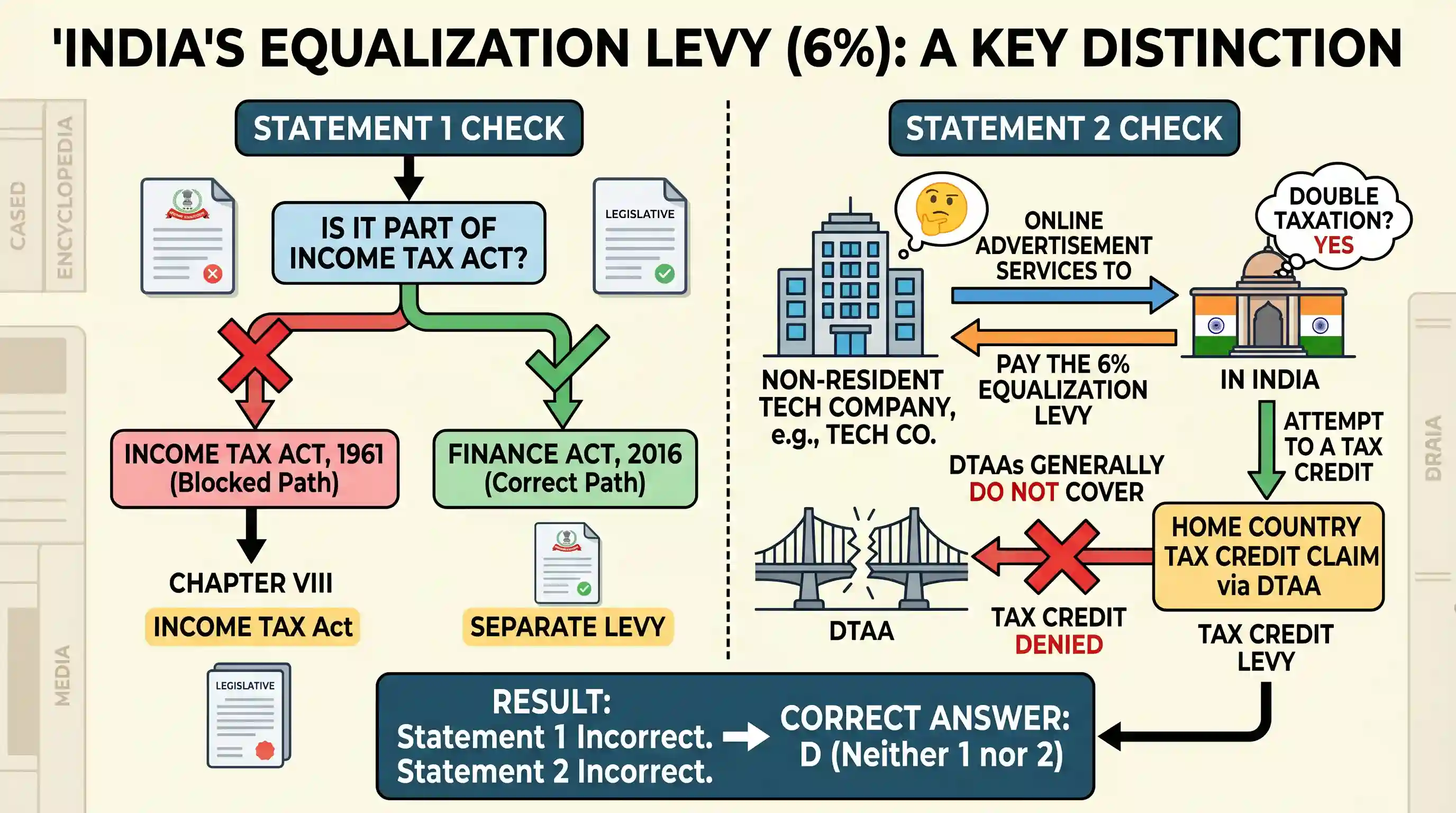
Statement 1 is incorrect: India's equalization levy (often referred to as 'Google Tax') of 6% on online advertisement services offered by non-resident entities was introduced as a new Chapter VIII in the Finance Act, 2016, specifically dealing with the equalization levy. It was not introduced as a part of the Income Tax Act, 1961. This distinction was crucial as it allowed the levy to operate outside the purview of traditional income tax treaties.
Statement 2 is incorrect: The equalization levy is generally not covered under Double Taxation Avoidance Agreements (DTAAs). DTAAs are typically designed to avoid double taxation on income as defined under income tax laws. Since the equalization levy was designed as a separate levy outside the scope of income tax, it does not usually fall under the ambit of existing DTAAs. Therefore, non-resident entities typically cannot claim a tax credit in their home country under DTAAs for this levy.
Related questions
More UPSC Prelims practice from the same subject and topic.
- Prelims 2018GS1economy
As per the NSSO 70th Round "Situation Assessment Survey of Agricultural Households", consider the following statements: 1. Rajasthan has the highest percentage share of agricultural households among i…
- Prelims 2018GS1economy
Which one of the following best describes the term "Merchant Discount Rate" sometimes seen in news?
- Prelims 2018GS1economy
Consider the following statements: 1. The Fiscal Responsibility and Budget Management (FRBM) Review Committee Report has recommended a debt to GDP ratio of 60% for the general (combined) government by…
- Prelims 2018GS1economy
Consider the following statements: 1. The quantity of imported edible oils is more than the domestic production of edible oils in the last five years. 2. The Government does not impose any customs dut…
- Prelims 2018GS1economy
Which one of the following links all the ATMs in India?
- Prelims 2018GS1economy
Consider the following statements: 1. Capital Adequacy Ratio (CAR) is the amount that banks have to maintain in the form of their own funds to offset any loss that banks incur if the account-holders f…