Consider the following statements: 1. Capital Adequacy Ratio (CAR) is the amount that banks have to maintain in the form of their own funds to offset any loss that banks incur if the account-holders fail to repay dues. 2. CAR is decided by each individual bank. Which of the statements given above is/are correct?

- A1 onlyCorrect
- B2 only
- CBoth 1 and 2
- DNeither 1 nor 2
Explanation
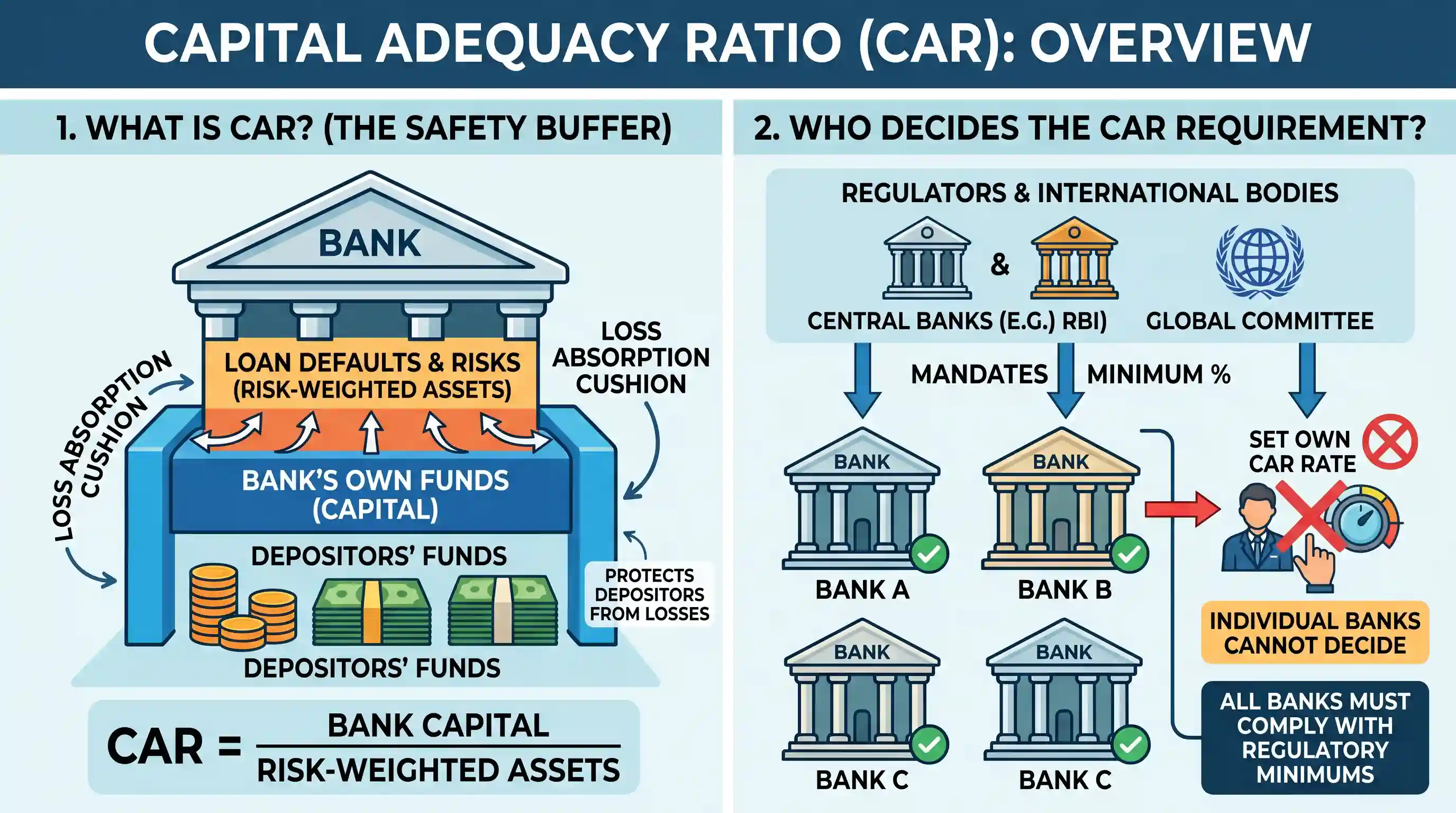
Statement 1 is correct: Capital Adequacy Ratio (CAR), also known as Capital to Risk-weighted Assets Ratio (CRAR), is a measure of a bank's financial strength, expressed as a ratio of its capital to its risk-weighted assets. It represents the amount of capital a bank must hold to absorb potential losses from its operations. This ensures that banks have sufficient cushion to protect depositors and promote stability in the financial system.
Statement 2 is incorrect: CAR is not decided by each individual bank. It is mandated by banking regulators, such as the Reserve Bank of India (RBI) in India, and international standards-setting bodies like the Basel Committee on Banking Supervision (BCBS). These regulatory bodies set minimum CAR requirements that all banks under their jurisdiction must adhere to, to ensure systemic financial stability.
Related questions
More UPSC Prelims practice from the same subject and topic.
- Prelims 2018GS1economy
Which one of the following best describes the term "Merchant Discount Rate" sometimes seen in news?
- Prelims 2018GS1economy
Which one of the following links all the ATMs in India?
- Prelims 2018GS1economy
With reference to digital payments, consider the following statements: 1. BHIM app allows the user to transfer money to anyone with a UPI-enabled bank account. 2. While a chip-pin debit card has four …
- Prelims 2018GS1economy
Which one of the following statements correctly describes the meaning of legal tender money?
- Prelims 2018GS1economy
Consider the following statements: 1. The Reserve Bank of India manages and services Government of India Securities but not any State Government Securities. 2. Treasury bills are issued by the Governm…
- Prelims 2018GS1economy
With reference to the governance of public sector banking in India, consider the following statements: 1. Capital infusion into public sector banks by the Government of India has steadily increased in…