Which one of the following statements correctly describes the meaning of legal tender money?

- AThe money which is tendered in courts of law to defray the fee of legal cases
- BThe money which a creditor is under compulsion to accept in settlement of his claimsCorrect
- CThe bank money in the form of cheques, drafts, bills of exchange, etc.
- DThe metallic money in circulation in a country
Explanation
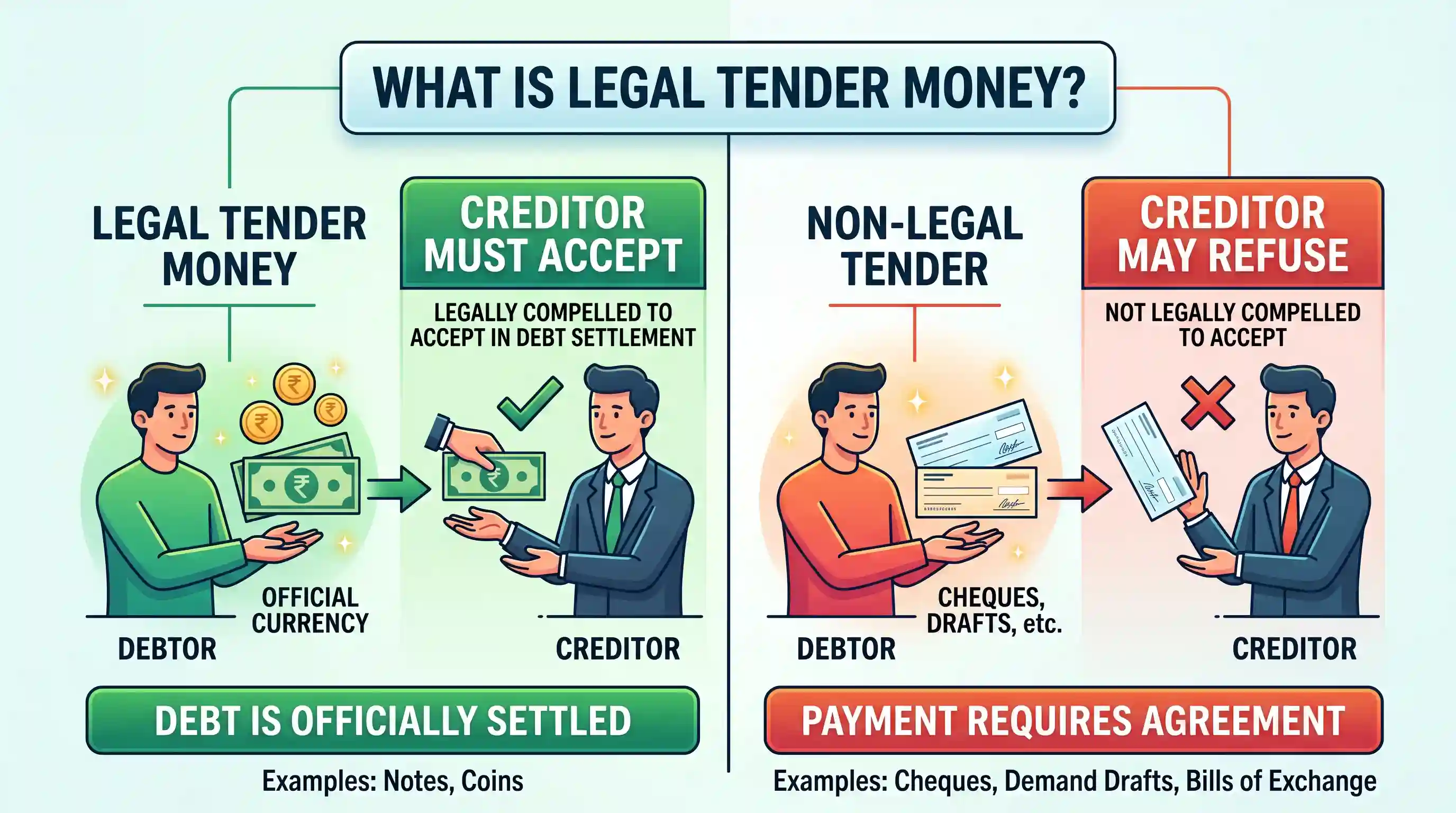
Legal tender money refers to any official medium of payment recognized by law that can be used to extinguish a public or private debt. If a creditor is offered legal tender in settlement of a debt, they are legally compelled to accept it. Refusal to accept legal tender for a debt means the debt is still considered paid in the eyes of the law, even if the creditor did not physically receive the funds.
A) This option describes money used for legal fees, which is a specific application, not the definition. B) This precisely defines legal tender: it is money that must be accepted in payment of a debt. C) Bank money in the form of cheques, drafts, etc., is not legal tender. A creditor is not obliged to accept them; they are promises to pay, not the final payment itself. D) While metallic money can be legal tender, this option describes only one form of money and not the inherent characteristic of being legally mandated for debt settlement.
Related questions
More UPSC Prelims practice from the same subject and topic.
- Prelims 2018GS1economy
Which one of the following best describes the term "Merchant Discount Rate" sometimes seen in news?
- Prelims 2018GS1economy
Which one of the following links all the ATMs in India?
- Prelims 2018GS1economy
Consider the following statements: 1. Capital Adequacy Ratio (CAR) is the amount that banks have to maintain in the form of their own funds to offset any loss that banks incur if the account-holders f…
- Prelims 2018GS1economy
With reference to digital payments, consider the following statements: 1. BHIM app allows the user to transfer money to anyone with a UPI-enabled bank account. 2. While a chip-pin debit card has four …
- Prelims 2018GS1economy
Consider the following statements: 1. The Reserve Bank of India manages and services Government of India Securities but not any State Government Securities. 2. Treasury bills are issued by the Governm…
- Prelims 2018GS1economy
With reference to the governance of public sector banking in India, consider the following statements: 1. Capital infusion into public sector banks by the Government of India has steadily increased in…