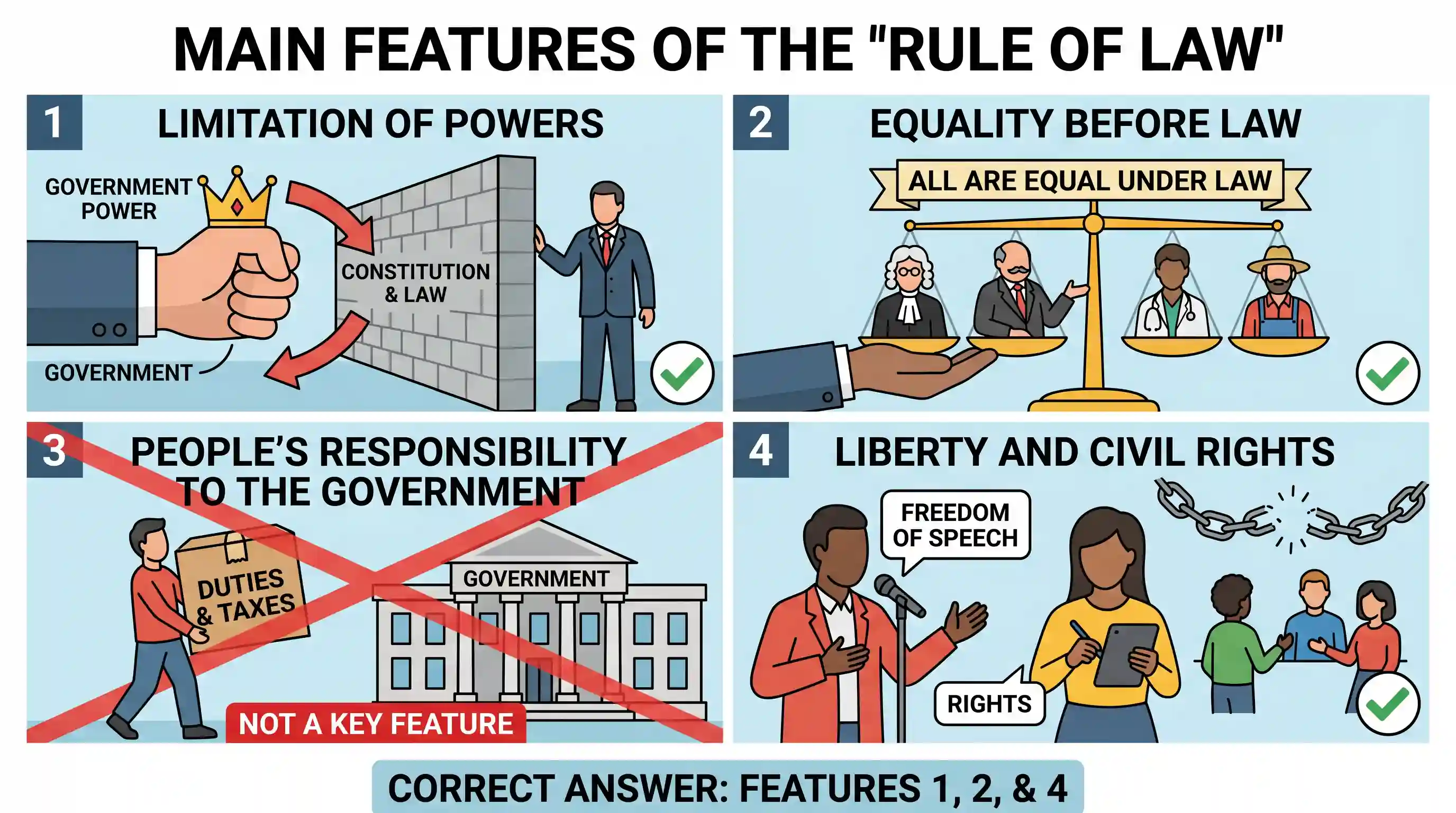
Which of the following are regarded as the main features of the "Rule of Law"? 1. Limitation of powers 2. Equality before law 3. People's responsibility to the Government 4. Liberty and civil rights Select the correct answer using the code given below:

- A1 and 3 only
- B2 and 4 only
- C1, 2 and 4 onlyCorrect
- D1, 2, 3 and 4
Explanation
The "Rule of Law" is a foundational principle of democratic governance, implying that all persons and institutions are accountable to laws that are publicly promulgated, equally enforced, and independently adjudicated. Key features defining the Rule of Law include:
-
Limitation of powers: This is a core feature. The Rule of Law ensures that governmental powers are limited and exercised according to established laws, preventing arbitrary rule and protecting against abuse of authority.
-
Equality before law: This is also a fundamental feature. It means that everyone, including those in positions of power, is subject to the same laws, and no one is above the law. Laws apply equally to all, without discrimination.
-
People's responsibility to the Government: While citizens have responsibilities within a legal framework, this is not considered a primary feature that defines the Rule of Law itself. The Rule of Law primarily focuses on how the government and its citizens are bound by law, ensuring justice and fairness, rather than enumerating citizens' duties to the government.
-
Liberty and civil rights: The Rule of Law is intrinsically linked to the protection of individual liberties and civil rights. By providing a stable, predictable, and just legal framework, it ensures that citizens can exercise their rights and freedoms without arbitrary interference from the state or other individuals.
Therefore, statements 1, 2, and 4 are regarded as the main features of the Rule of Law.
Related questions
More UPSC Prelims practice from the same subject and topic.
- Prelims 2018GS1polity-and-governance
Consider the following statements: 1. In the first Lok Sabha, the single largest party in the opposition was the Swatantra Party. 2. In the Lok Sabha, a "Leader of the Opposition" was recognised for t…
- Prelims 2018GS1polity-and-governance
How is the National Green Tribunal (NGT) different from the Central Pollution Control Board (CPCB)? 1. The NGT has been established by an Act whereas the CPCB has been created by an executive order of…
- Prelims 2018GS1polity-and-governance
Consider the following statements: 1. Aadhaar card can be used as a proof of citizenship or domicile. 2. Once issued, Aadhaar number cannot be deactivated or omitted by the Issuing Authority. Which of…
- Prelims 2018GS1polity-and-governance
The identity platform 'Aadhaar' provides open "Application Programming Interfaces (APIs)". What does it imply? 1. It can be integrated into any electronic device. 2. Online authentication using iris i…
- Prelims 2018GS1polity-and-governance
Consider the following statements: 1. As per the Right to Education (RTE) Act, to be eligible for appointment as a teacher in a State, a person would be required to possess the minimum qualification l…
- Prelims 2018GS1polity-and-governance
Consider the following statements: 1. The Food Safety and Standards Act, 2006 replaced the Prevention of Food Adulteration Act, 1954. 2. The Food Safety and Standards Authority of India (FSSAI) is und…