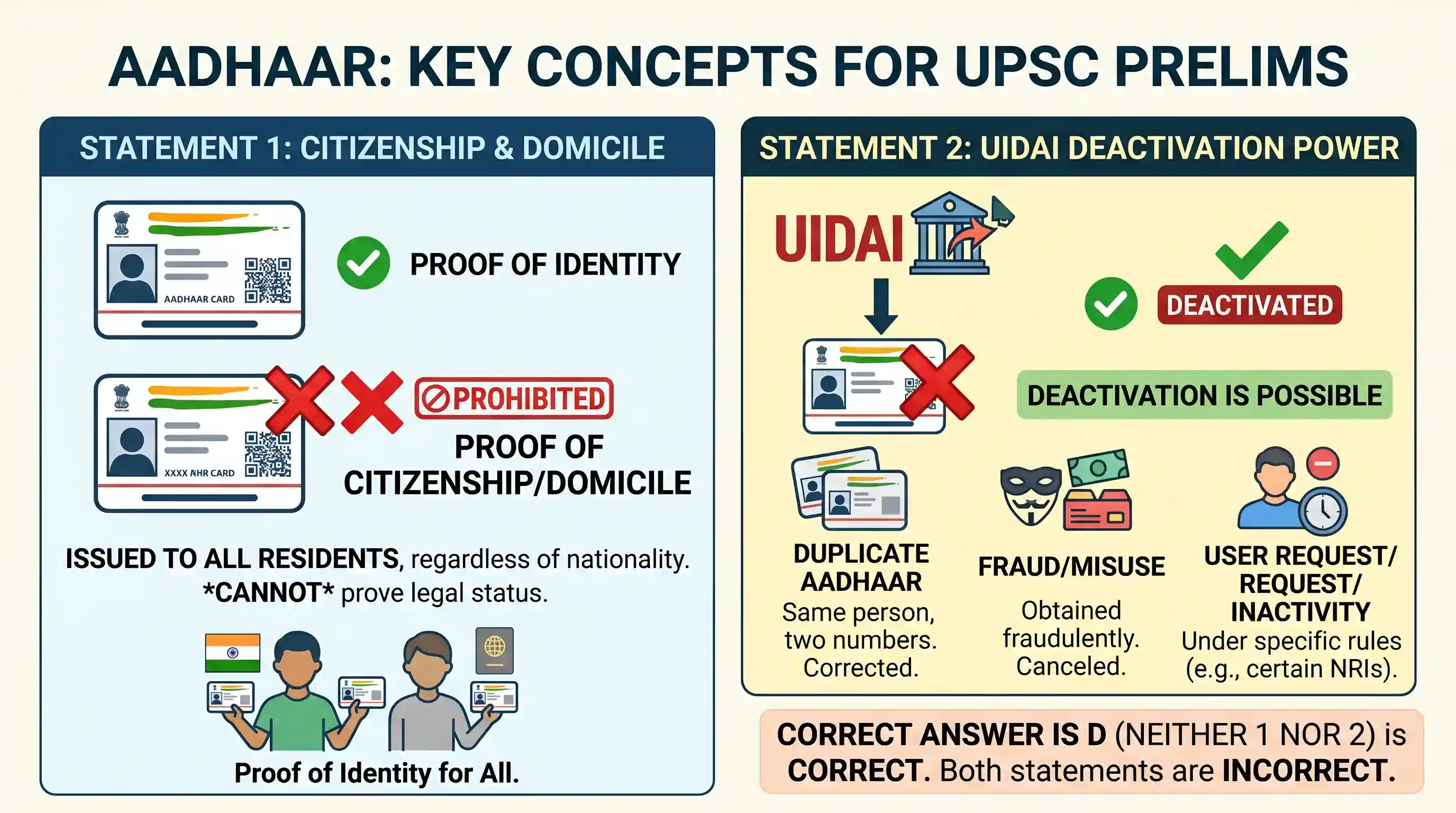
Consider the following statements: 1. Aadhaar card can be used as a proof of citizenship or domicile. 2. Once issued, Aadhaar number cannot be deactivated or omitted by the Issuing Authority. Which of the statements given above is/are correct?

- A1 only
- B2 only
- CBoth 1 and 2
- DNeither 1 nor 2Correct
Explanation
Statement 1 is incorrect: The Unique Identification Authority of India (UIDAI), the issuing body for Aadhaar, explicitly states that Aadhaar is a proof of identity, not a proof of citizenship or domicile. It is issued to residents of India, regardless of their citizenship status, and does not confer any rights of citizenship or domicile. Therefore, it cannot be used as a standalone document for these purposes.
Statement 2 is incorrect: While Aadhaar is designed to be a lifelong identity number, the Aadhaar Act and UIDAI regulations do provide mechanisms for deactivation or omission in certain circumstances. These can include cases where multiple Aadhaar numbers are issued to a single individual (one must be deactivated), or where an Aadhaar number was obtained fraudulently, or if a person explicitly requests deactivation under specific rules (e.g., if they are an NRI who has been away for long). Thus, it is not true that an Aadhaar number cannot be deactivated or omitted by the Issuing Authority.
Related questions
More UPSC Prelims practice from the same subject and topic.
- Prelims 2018GS1polity-and-governance
Consider the following statements: 1. In the first Lok Sabha, the single largest party in the opposition was the Swatantra Party. 2. In the Lok Sabha, a "Leader of the Opposition" was recognised for t…
- Prelims 2018GS1polity-and-governance
How is the National Green Tribunal (NGT) different from the Central Pollution Control Board (CPCB)? 1. The NGT has been established by an Act whereas the CPCB has been created by an executive order of…
- Prelims 2018GS1polity-and-governance
The identity platform 'Aadhaar' provides open "Application Programming Interfaces (APIs)". What does it imply? 1. It can be integrated into any electronic device. 2. Online authentication using iris i…
- Prelims 2018GS1polity-and-governance
Consider the following statements: 1. As per the Right to Education (RTE) Act, to be eligible for appointment as a teacher in a State, a person would be required to possess the minimum qualification l…
- Prelims 2018GS1polity-and-governance
Consider the following statements: 1. The Food Safety and Standards Act, 2006 replaced the Prevention of Food Adulteration Act, 1954. 2. The Food Safety and Standards Authority of India (FSSAI) is und…
- Prelims 2018GS1polity-and-governance
With reference to the provisions made under the National Food Security Act, 2013, consider the following statements : 1. The families coming under the category of 'below poverty line (BPL)' only are e…