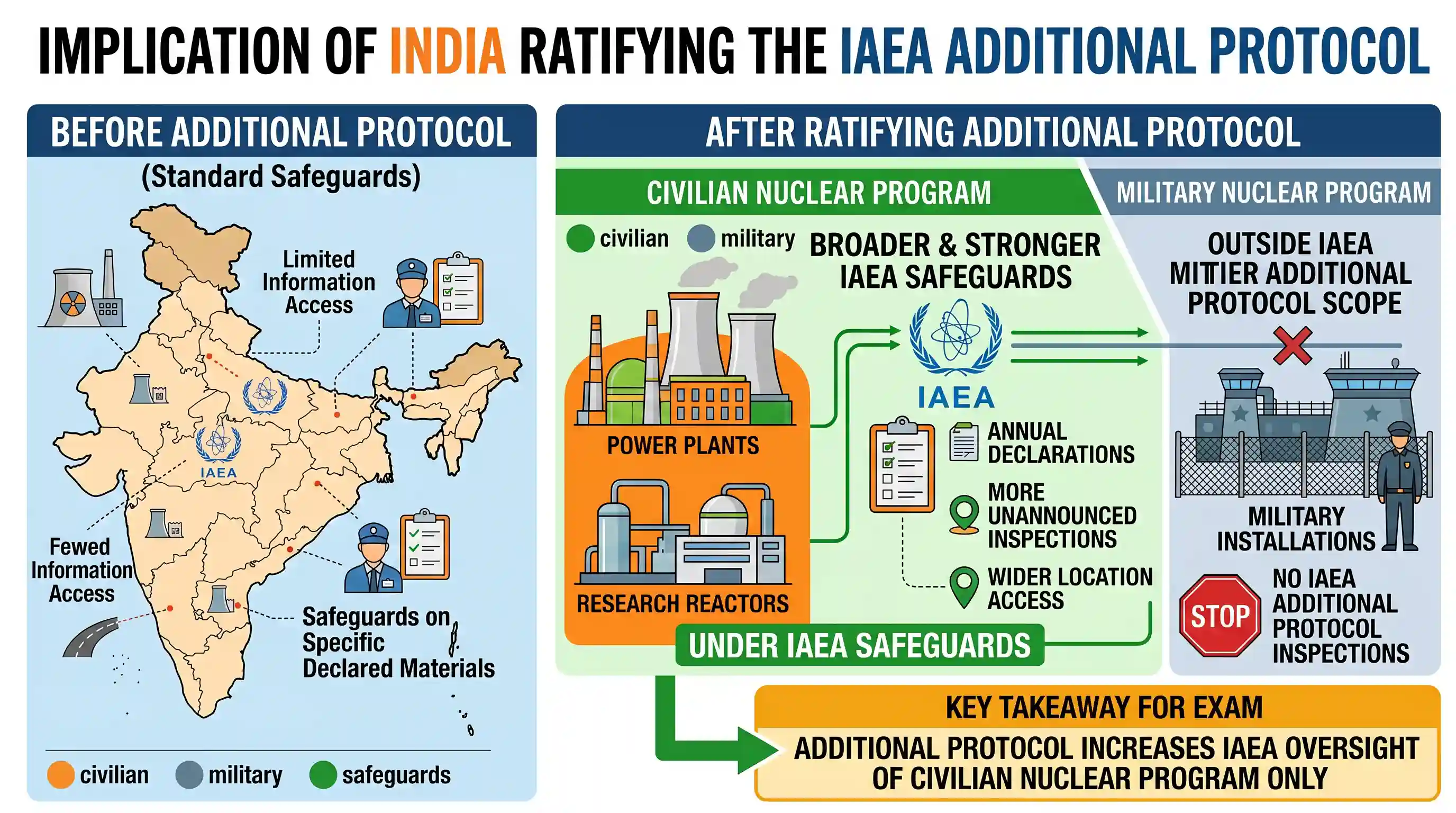
In the Indian context, what is the implication of ratifying the 'Additional Protocol' with the 'International Atomic Energy Agency (IAEA)'?

- AThe civilian nuclear reactors come under IAEA safeguards.Correct
- BThe military nuclear installations come under the inspection of IAEA.
- CThe country will have the privilege to buy uranium from the Nuclear Suppliers Group (NSG).
- DThe country automatically becomes a member of the NSG.
Explanation
The 'Additional Protocol' with the 'International Atomic Energy Agency (IAEA)' is a legal document that significantly strengthens the IAEA's safeguards system. For a country like India, ratifying the Additional Protocol primarily implies granting the IAEA broader inspection rights and increased access to information and facilities related to its civilian nuclear program. This is aimed at providing credible assurances that nuclear material and technology are not being diverted from peaceful uses to nuclear weapons programs. It enhances transparency and verification capabilities of the IAEA over a nation's declared civilian nuclear activities. It does not automatically mean military nuclear installations come under inspection, nor does it guarantee specific trade privileges or automatic membership in groups like the NSG, although increased transparency can build trust and facilitate such relationships.
Related questions
More UPSC Prelims practice from the same subject and topic.
- Prelims 2018GS1science-and-technology
What is/are the consequence/consequences of a country becoming the member of the 'Nuclear Suppliers Group'? 1. It will have access to the latest and most efficient nuclear technologies. 2. It automati…
- Prelims 2018GS1science-and-technology
What is "Terminal High Altitude Area Defense (THAAD)", sometimes seen in the news?
- Prelims 2018GS1science-and-technology
In which of the following areas can GPS technology be used? 1. Mobile phone operations 2. Banking operations 3. Controlling the power grids Select the correct answer using the code given below:
- Prelims 2018GS1science-and-technology
The terms 'WannaCry, Petya and EternalBlue' sometimes mentioned in the news recently are related to
- Prelims 2018GS1science-and-technology
With reference to the Indian Regional Navigation Satellite System (IRNSS), consider the following statements: 1. IRNSS has three satellites in geostationary and four satellites in geosynchronous orbit…
- Prelims 2018GS1science-and-technology
Consider the following phenomena : 1. Light is affected by gravity. 2. The Universe is constantly expanding. 3. Matter warps its surrounding space-time. Which of the above is/are the prediction/predic…