With reference to the Indian Regional Navigation Satellite System (IRNSS), consider the following statements: 1. IRNSS has three satellites in geostationary and four satellites in geosynchronous orbits. 2. IRNSS covers entire India and about 5500 sq. km beyond its borders. 3. India will have its own satellite navigation system with full global coverage by the middle of 2019. Which of the statements given above is/are correct?

- A1 onlyCorrect
- B1 and 2 only
- C2 and 3 only
- DNone
Explanation
-
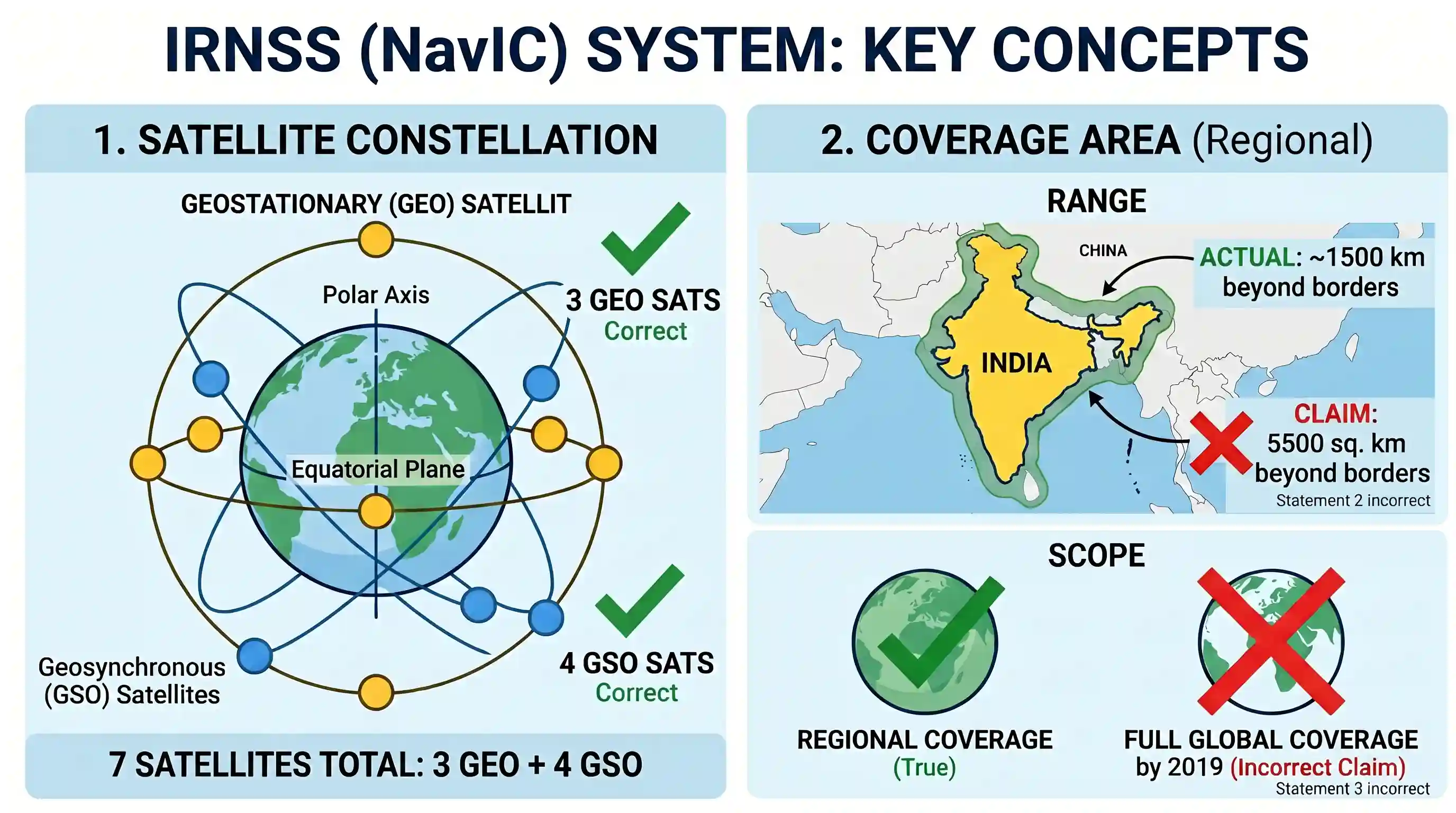
IRNSS has three satellites in geostationary and four satellites in geosynchronous orbits: Correct. NavIC consists of seven satellites — three in geostationary orbit (GEO) and four in geosynchronous orbit (GSO).
-
IRNSS covers entire India and about 5500 sq. km beyond its borders: Incorrect. IRNSS/NavIC is designed to provide coverage over India and a region extending up to 1500 km beyond its borders, not 5500 sq. km.
-
India will have its own satellite navigation system with full global coverage by the middle of 2019: Incorrect. NavIC is a regional navigation satellite system (RNSS), not a global one. It provides regional coverage only.
Therefore, only statement 1 is correct.
Related questions
More UPSC Prelims practice from the same subject and topic.
- Prelims 2018GS1science-and-technology
With reference to India's satellite launch vehicles, consider the following statements: 1. PSLVs launch the satellites useful for Earth resources monitoring whereas GSLVs are designed mainly to launch…
- Prelims 2018GS1science-and-technology
What is/are the consequence/consequences of a country becoming the member of the 'Nuclear Suppliers Group'? 1. It will have access to the latest and most efficient nuclear technologies. 2. It automati…
- Prelims 2018GS1science-and-technology
In the Indian context, what is the implication of ratifying the 'Additional Protocol' with the 'International Atomic Energy Agency (IAEA)'?
- Prelims 2018GS1science-and-technology
What is "Terminal High Altitude Area Defense (THAAD)", sometimes seen in the news?
- Prelims 2018GS1science-and-technology
In which of the following areas can GPS technology be used? 1. Mobile phone operations 2. Banking operations 3. Controlling the power grids Select the correct answer using the code given below:
- Prelims 2018GS1science-and-technology
The terms 'WannaCry, Petya and EternalBlue' sometimes mentioned in the news recently are related to