With reference to India's satellite launch vehicles, consider the following statements: 1. PSLVs launch the satellites useful for Earth resources monitoring whereas GSLVs are designed mainly to launch communication satellites. 2. Satellites launched by PSLV appear to remain permanently fixed in the same position in the sky, as viewed from a particular location on Earth. 3. GSLV Mk III is a four-staged launch vehicle with the first and third stages using solid rocket motors; and the second and fourth stages using liquid rocket engines. Which of the statements given above is/are correct?

- A1 onlyCorrect
- B2 and 3
- C1 and 2
- D3 only
Explanation
Let's analyze the statements regarding India's satellite launch vehicles (PSLV and GSLV):
-
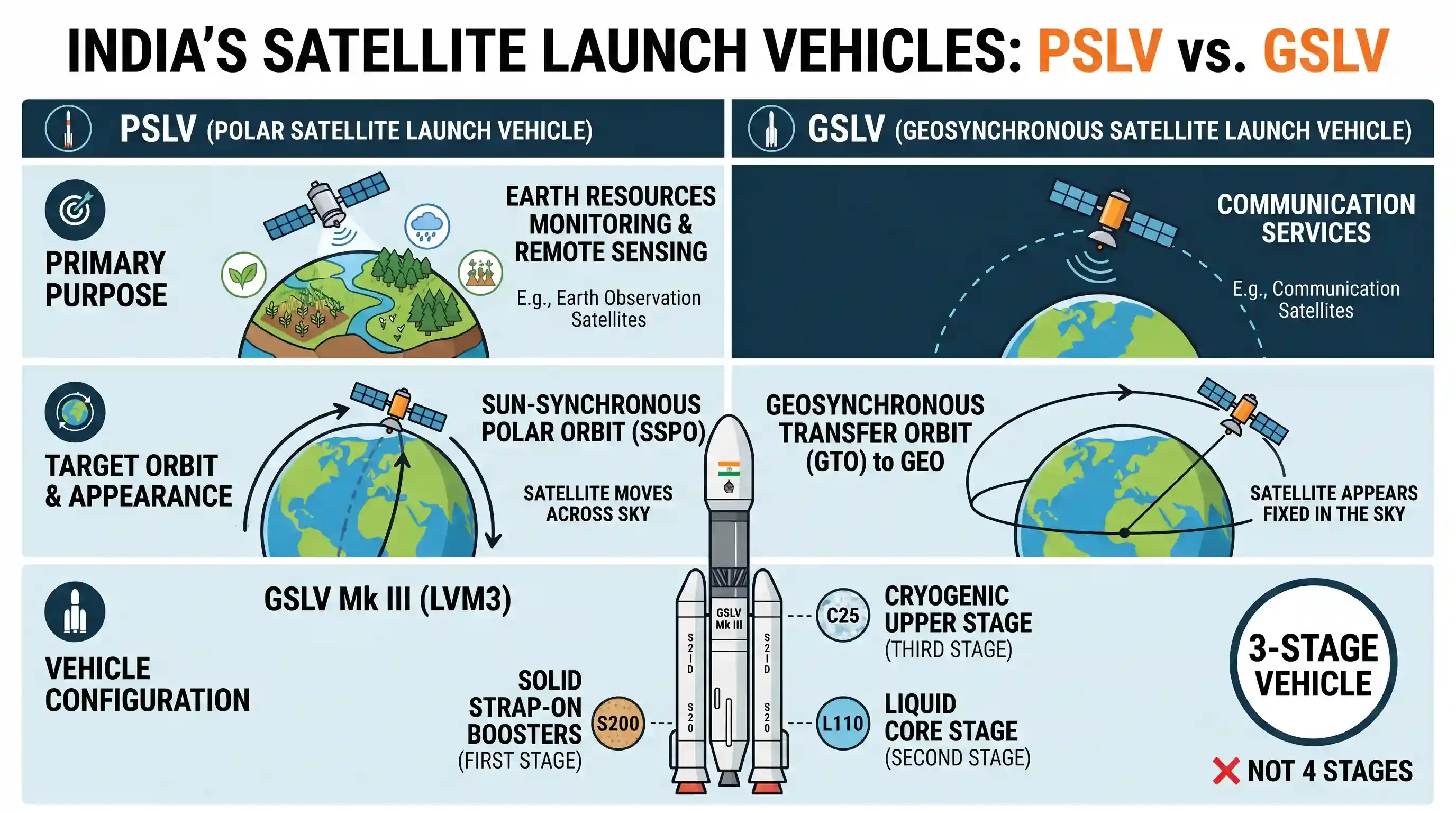
PSLVs launch the satellites useful for Earth resources monitoring whereas GSLVs are designed mainly to launch communication satellites. This statement is correct.PSLV (Polar Satellite Launch Vehicle) is India's workhorse launch vehicle primarily designed for launching Earth Observation Satellites (also known as remote sensing satellites) into sun-synchronous polar orbits (SSPO). These satellites are used for applications like Earth resource monitoring, weather forecasting, and disaster management. GSLV (Geosynchronous Satellite Launch Vehicle) is designed to launch heavier communication satellites into Geosynchronous Transfer Orbit (GTO), from where they are maneuvered into Geostationary Earth Orbit (GEO). Communication satellites require geostationary orbits to appear fixed over a particular spot on Earth.
-
Satellites launched by PSLV appear to remain permanently fixed in the same position in the sky, as viewed from a particular location on Earth. This statement is incorrect. Satellites that appear fixed in the sky are in geostationary orbit, which is achieved by GSLV. PSLV primarily launches satellites into polar or sun-synchronous orbits, where the satellites continuously move across the sky as viewed from the Earth's surface.
-
GSLV Mk III is a four-staged launch vehicle with the first and third stages using solid rocket motors; and the second and fourth stages using liquid rocket engines. This statement is incorrect. GSLV Mk III (now officially known as Launch Vehicle Mark-3 or LVM3) is a three-stage launch vehicle. Its configuration is:First stage: Two large solid strap-on boosters (S200). Second stage: A liquid core stage (L110). Third stage: A cryogenic upper stage (C25). It does not have four stages.
Based on the analysis, only statement 1 is correct.
Related questions
More UPSC Prelims practice from the same subject and topic.
- Prelims 2018GS1science-and-technology
With reference to the Indian Regional Navigation Satellite System (IRNSS), consider the following statements: 1. IRNSS has three satellites in geostationary and four satellites in geosynchronous orbit…
- Prelims 2018GS1science-and-technology
What is/are the consequence/consequences of a country becoming the member of the 'Nuclear Suppliers Group'? 1. It will have access to the latest and most efficient nuclear technologies. 2. It automati…
- Prelims 2018GS1science-and-technology
In the Indian context, what is the implication of ratifying the 'Additional Protocol' with the 'International Atomic Energy Agency (IAEA)'?
- Prelims 2018GS1science-and-technology
What is "Terminal High Altitude Area Defense (THAAD)", sometimes seen in the news?
- Prelims 2018GS1science-and-technology
In which of the following areas can GPS technology be used? 1. Mobile phone operations 2. Banking operations 3. Controlling the power grids Select the correct answer using the code given below:
- Prelims 2018GS1science-and-technology
The terms 'WannaCry, Petya and EternalBlue' sometimes mentioned in the news recently are related to