Consider the following statements: 1. Asiatic lion is naturally found in India only. 2. Double-humped camel is naturally found in India only. 3. One-horned rhinoceros is naturally found in India only. Which of the statements given above is/are correct?

- A1 onlyCorrect
- B2 only
- C1 and 3 only
- D1, 2 and 3
Explanation
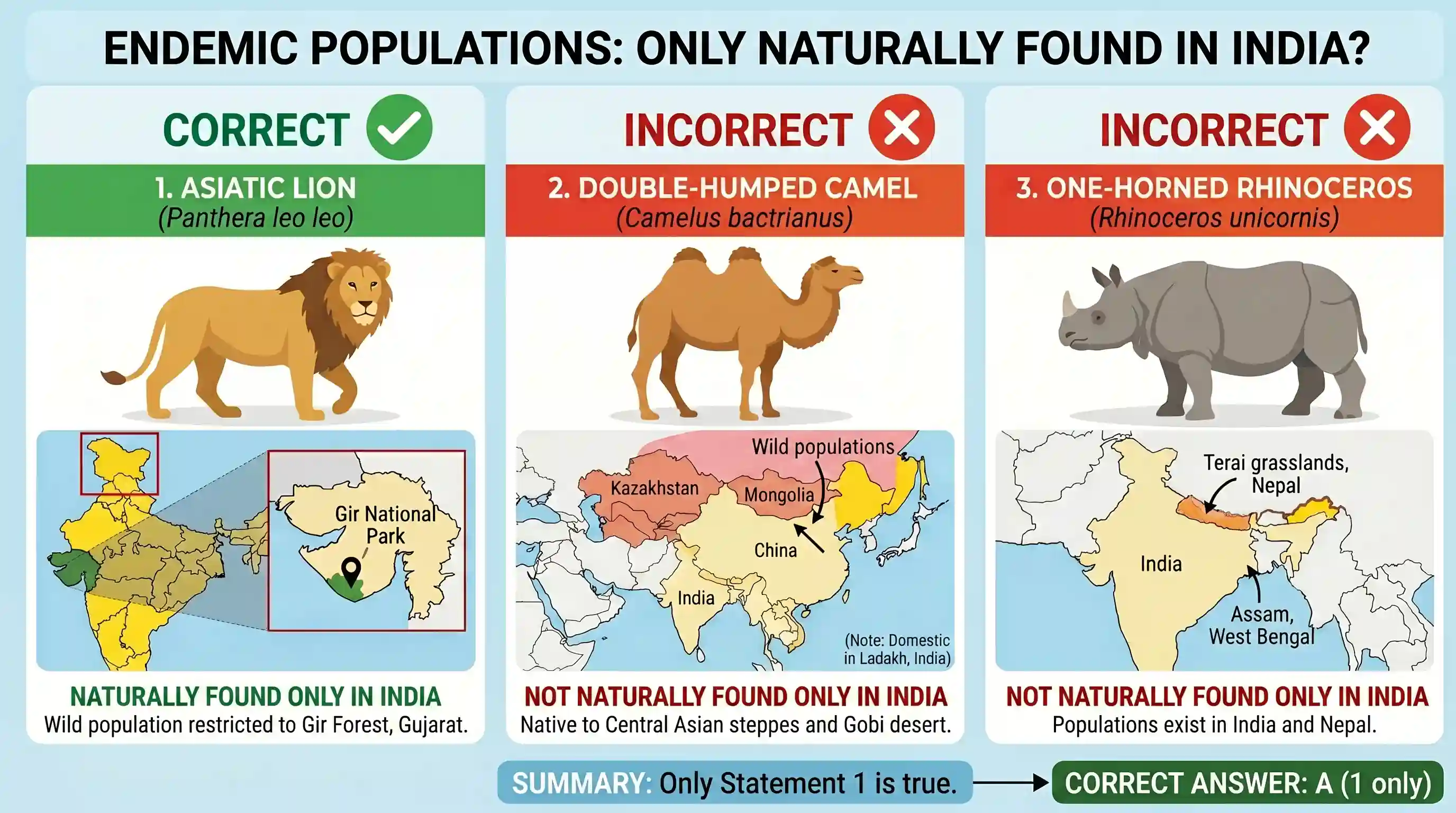
Statement 1 is correct. The Asiatic lion (Panthera leo leo) is naturally found only in India. The last remaining wild population of Asiatic lions exists exclusively in the Gir Forest National Park and Wildlife Sanctuary in Gujarat, India.
Statement 2 is incorrect. The Double-humped camel (Bactrian camel, Camelus bactrianus) is naturally found in Central Asia, including parts of Mongolia, China, and Kazakhstan, with a small wild population in the Gobi Desert. While there are domestic populations in India (e.g., Ladakh), it is not naturally found only in India.
Statement 3 is incorrect. The One-horned rhinoceros (Indian rhinoceros, Rhinoceros unicornis) is naturally found in the grasslands and forests of India and Nepal. Significant populations exist in Assam (India) and the Terai region of Nepal, so it is not found only in India.
Related questions
More UPSC Prelims practice from the same subject and topic.
- Prelims 2019GS1geography
Which one of the following National Parks lies completely in the temperate alpine zone?
- Prelims 2019GS1geography
Which of the following are in Agasthyamala Biosphere Reserve?
- Prelims 2019GS1geography
Consider the following statements: 1. Some species of turtles are herbivores. 2. Some species of fish are herbivores. 3. Some species of marine mammals are herbivores. 4. Some species of snakes are vi…
- Prelims 2019GS1geography
Consider the following pairs: Wildlife Naturally found in 1. Blue-finned Mahseer : Cauvery River 2. Irrawaddy Dolphin : Chambal River 3. Rusty-spotted Cat : Eastern Ghats Which of the pairs given abov…
- Prelims 2019GS1geography
Why is there a great concern about the 'microbeads' that are released into environment?
- Prelims 2019GS1geography
Recently, there was a growing awareness in our country about the importance of Himalayan nettle (Girardinia diversifolia) because it is found to be a sustainable source of