Consider the following statements : 1. According to the Indian Patents Act, a biological process to create a seed can be patented in India. 2. In India, there is no Intellectual Property Appellate Board. 3. Plant varieties are not eligible to be patented in India. Which of the statements given above is/are correct?

- A1 and 3 only
- B2 and 3 only
- C3 onlyCorrect
- D1, 2 and 3
Explanation
-
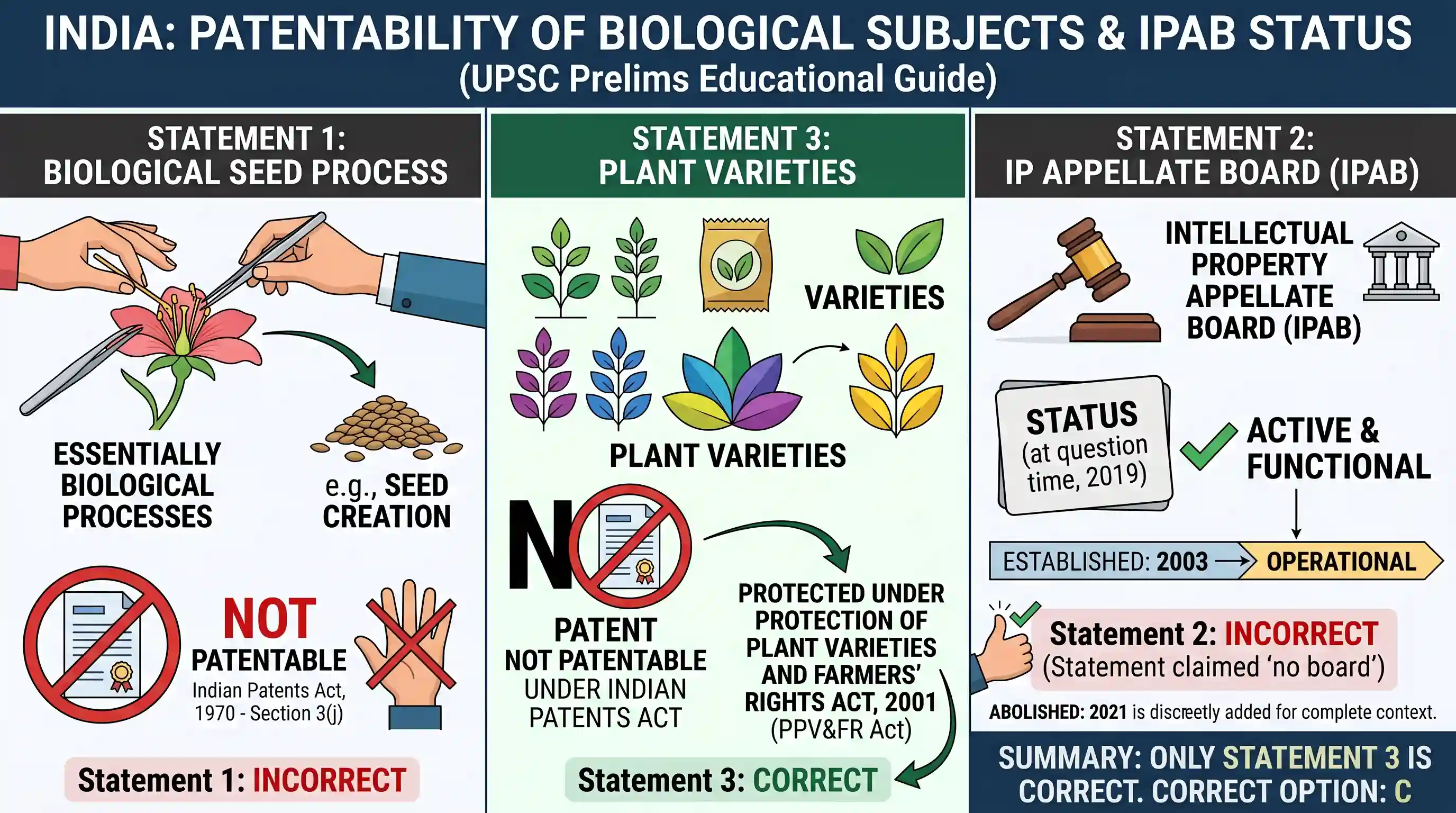
According to the Indian Patents Act, a biological process to create a seed can be patented in India: Incorrect. Section 3(j) of the Indian Patents Act, 1970 explicitly excludes plants and animals (other than micro-organisms), and essentially biological processes for the production of plants and animals, from patentability.
-
There is no Intellectual Property Appellate Board in India: Incorrect. The Intellectual Property Appellate Board (IPAB) was established in 2003 and was functional in 2019 when this question was asked. (It was later abolished in 2021.)
-
Plant varieties are not patentable in India: Correct. Plant varieties are not patentable under the Indian Patents Act. Instead, they are protected under the Protection of Plant Varieties and Farmers' Rights Act, 2001.
Therefore, only statement 3 is correct.
Related questions
More UPSC Prelims practice from the same subject and topic.
- Prelims 2019GS1science-and-technology
With reference to the recent developments in science, which one of the following statements is not correct?
- Prelims 2019GS1science-and-technology
'RNA interference (RNAi)' technology has gained popularity in the last few years. Why? 1. It is used in developing gene silencing therapies. 2. It can be used in developing therapies for the treatment…
- Prelims 2019GS1science-and-technology
What is Cas9 protein that is often mentioned in news?
- Prelims 2019GS1science-and-technology
In the context of which one of the following are the terms 'pyrolysis and plasma gasification' mentioned?
- Prelims 2019GS1science-and-technology
In India, the use of carbofuran, methyl parathion, phorate and triazophos is viewed with apprehension. These chemicals are used as
- Prelims 2019GS1science-and-technology
In the context of proposals to the use of hydrogen-enriched CNG (H-CNG) as fuel for buses in public transport, consider the following statements: 1. The main advantage of the use of H-CNG is the elimi…