In a class, there are three groups A, B and C. If one student from group A and two students from group B are shifted to group C, then what happens to the average weight of the students of the class?

- Aincreases
- Bdecreases
- CsameCorrect
- Dcbd
Explanation
The average weight of the students of the class is calculated by dividing the total weight of all students in the class by the total number of students in the class.
-
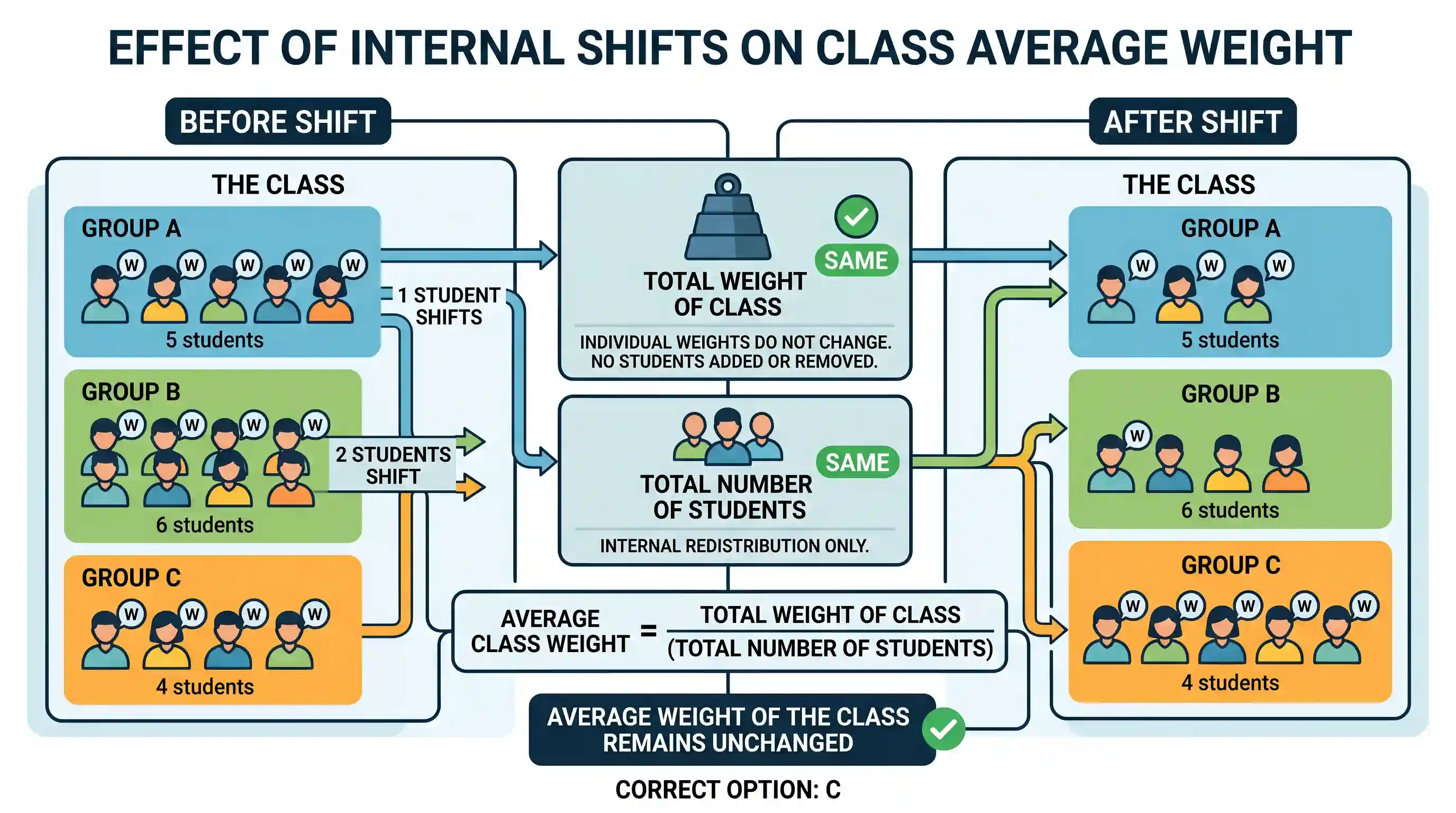
Total Weight of the Class: When students are shifted between groups (A, B, C) within the same class, no students are added to or removed from the class, and no student's weight changes. Therefore, the total weight of all students in the entire class remains constant.
-
Total Number of Students in the Class: Similarly, shifting students between groups within the class does not change the total number of students in the entire class. The total count remains the same.
Since both the total weight of the students in the class and the total number of students in the class remain unchanged, their ratio (the average weight of the class) must also remain unchanged.
Option Analysis: A) increases: Incorrect, as total weight and number are constant. B) decreases: Incorrect, as total weight and number are constant. C) same: Correct, as the total weight and total number of students in the class are unaltered. D) cbd (cannot be determined): Incorrect, because the class average is definitively constant based on the principles of averages.
Related questions
More UPSC Prelims practice from the same subject and topic.
- Prelims 2020CSATQuantitative Aptitude
If you have two straight sticks of length 7.5 feet and 3.25 feet, what is the minimum length can you measure?
- Prelims 2020CSATQuantitative Aptitude
Consider the following data: | | Average marks in English | Average marks in Hindi | | Girls | 9 | 8 | | Boys | 8 | 7 | | Overall average marks | 8.8 | X | What is the value of x in the above table?
- Prelims 2020CSATQuantitative Aptitude
The average age of a teacher and three students is 20 years. If all the three students are of same age and the difference between the age of the teacher and each student is 20 years, then what is the …
- Prelims 2020CSATQuantitative Aptitude
A person bought a car and sold it for Rs. 3, 00,000. If he incurred a loss of 20%, then how much did he spend to buy the car?
- Prelims 2020CSATQuantitative Aptitude
A shop owner offers the following discount options on an article to a customer: Successive discounts or 10% and 20% , and then pay a service tax of 10% Successive discounts of 20% and 10% , and then p…
- Prelims 2020CSATQuantitative Aptitude
What is the largest number among the following?