If you have two straight sticks of length 7.5 feet and 3.25 feet, what is the minimum length can you measure?

- A0.05 foot
- B0.25 footCorrect
- C1 foot
- D3.25 feet
Explanation
The problem asks for the minimum length that can be measured using two sticks of given lengths. This is a classic application of finding the Greatest Common Divisor (GCD) of the two lengths. The GCD represents the smallest positive length that can be formed by repeatedly adding or subtracting the given lengths.
Given lengths: Stick 1 = 7.5 feet Stick 2 = 3.25 feet
To find the GCD of these decimal numbers, we can convert them to integers by multiplying by a factor (in this case, 100 to remove two decimal places), find the GCD of the integers, and then divide the result back by the same factor.
-
Convert to integers: 7.5 feet * 100 = 750 3.25 feet * 100 = 325
-
Find the GCD of 750 and 325 using the Euclidean algorithm:
- 750 = 2 * 325 + 100
- 325 = 3 * 100 + 25
- 100 = 4 * 25 + 0 The last non-zero remainder is 25. So, GCD(750, 325) = 25.
-
Divide the GCD by the factor (100) to get the GCD of the original lengths: GCD(7.5, 3.25) = 25 / 100 = 0.25 feet.
This means the minimum length that can be measured is 0.25 feet.
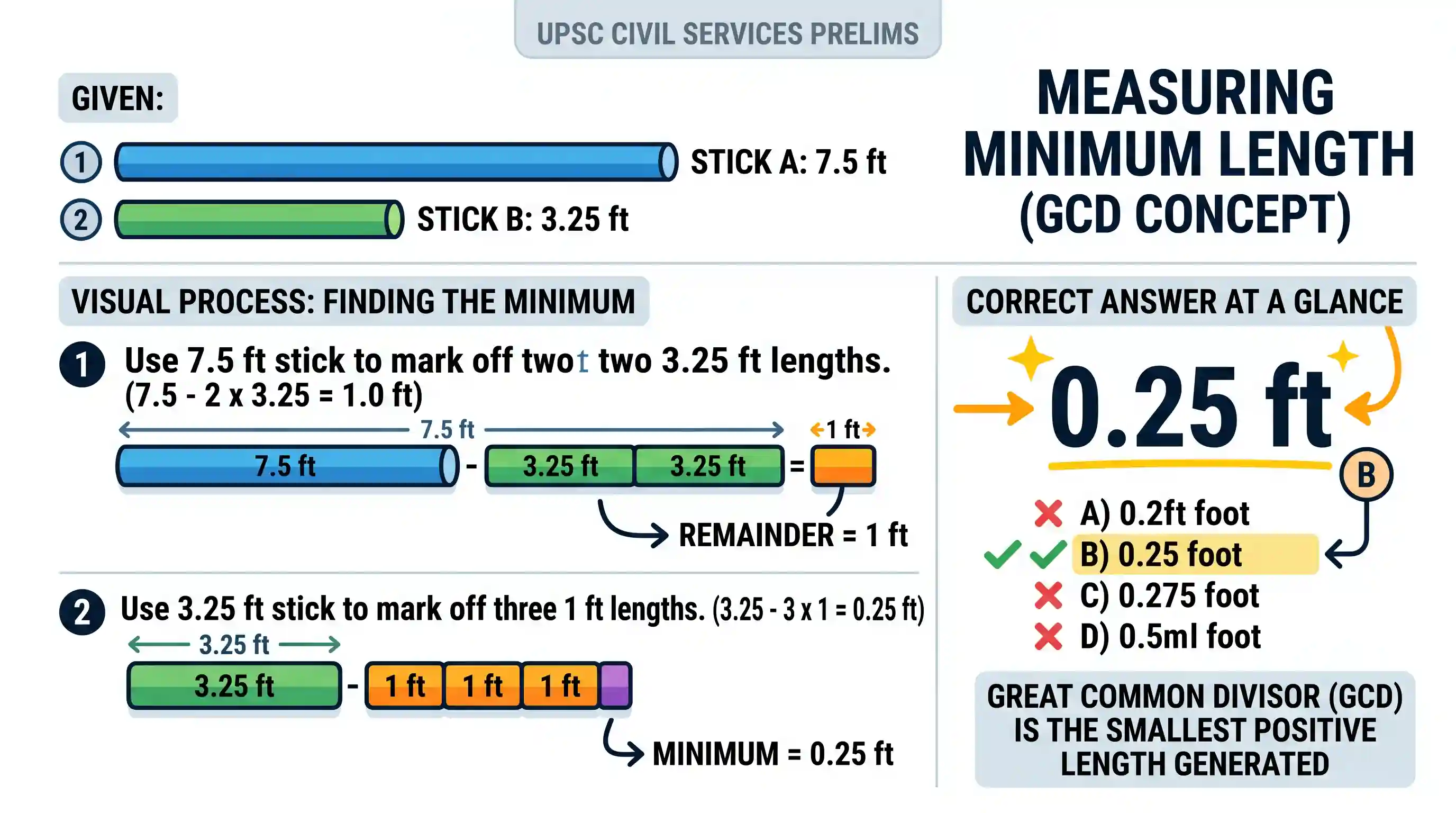
Analysis of options: A) 0.05 foot: While 0.05 is a common divisor of 7.5 and 3.25 (7.5 = 150 * 0.05, 3.25 = 65 * 0.05), it is not the greatest common divisor, and therefore not the minimum length that can be generated by using the sticks. The GCD method finds the smallest unit that can be formed. B) 0.25 foot: This matches our calculated GCD. We can demonstrate how to measure it: * Use the 7.5 ft stick to mark off two 3.25 ft lengths: 7.5 - (2 * 3.25) = 7.5 - 6.5 = 1 foot. Now we have a 1-foot measurable length. * Use the 3.25 ft stick to mark off three 1 ft lengths: 3.25 - (3 * 1) = 3.25 - 3 = 0.25 foot. Thus, 0.25 foot can be measured. C) 1 foot: As shown above, 1 foot can be measured, but it is not the minimum possible length, as 0.25 foot is smaller and also measurable. D) 3.25 feet: This is one of the given stick lengths, so it can be measured, but it is not the minimum.
The final answer is B
Related questions
More UPSC Prelims practice from the same subject and topic.
- Prelims 2020CSATQuantitative Aptitude
Consider the following data: | | Average marks in English | Average marks in Hindi | | Girls | 9 | 8 | | Boys | 8 | 7 | | Overall average marks | 8.8 | X | What is the value of x in the above table?
- Prelims 2020CSATQuantitative Aptitude
The average age of a teacher and three students is 20 years. If all the three students are of same age and the difference between the age of the teacher and each student is 20 years, then what is the …
- Prelims 2020CSATQuantitative Aptitude
A person bought a car and sold it for Rs. 3, 00,000. If he incurred a loss of 20%, then how much did he spend to buy the car?
- Prelims 2020CSATQuantitative Aptitude
A shop owner offers the following discount options on an article to a customer: Successive discounts or 10% and 20% , and then pay a service tax of 10% Successive discounts of 20% and 10% , and then p…
- Prelims 2020CSATQuantitative Aptitude
What is the largest number among the following?
- Prelims 2020CSATQuantitative Aptitude
| Year | Birth rate | Death rate | |---|---|---| | 1911 - 1921 | 48.1 | 35.5 | | 1921 - 1931 | 46.4 | 36.3 | | 1931 - 1941 | 45.2 | 31.2 | | 1941 - 1951 | 39.9 | 27.4 | | 1951 - 1961 | 41.7 | 22.8 | |…