A simple mathematical operation in each number of the sequence 14, 18, 20, 24, 30, 32, .... results in a sequence with respect to prime numbers. Which one of the following is the next number in the sequence?

- A34
- B36
- C38Correct
- D40
Explanation
The given sequence is 14, 18, 20, 24, 30, 32.
The problem states that a simple mathematical operation on each number results in a sequence with respect to prime numbers.
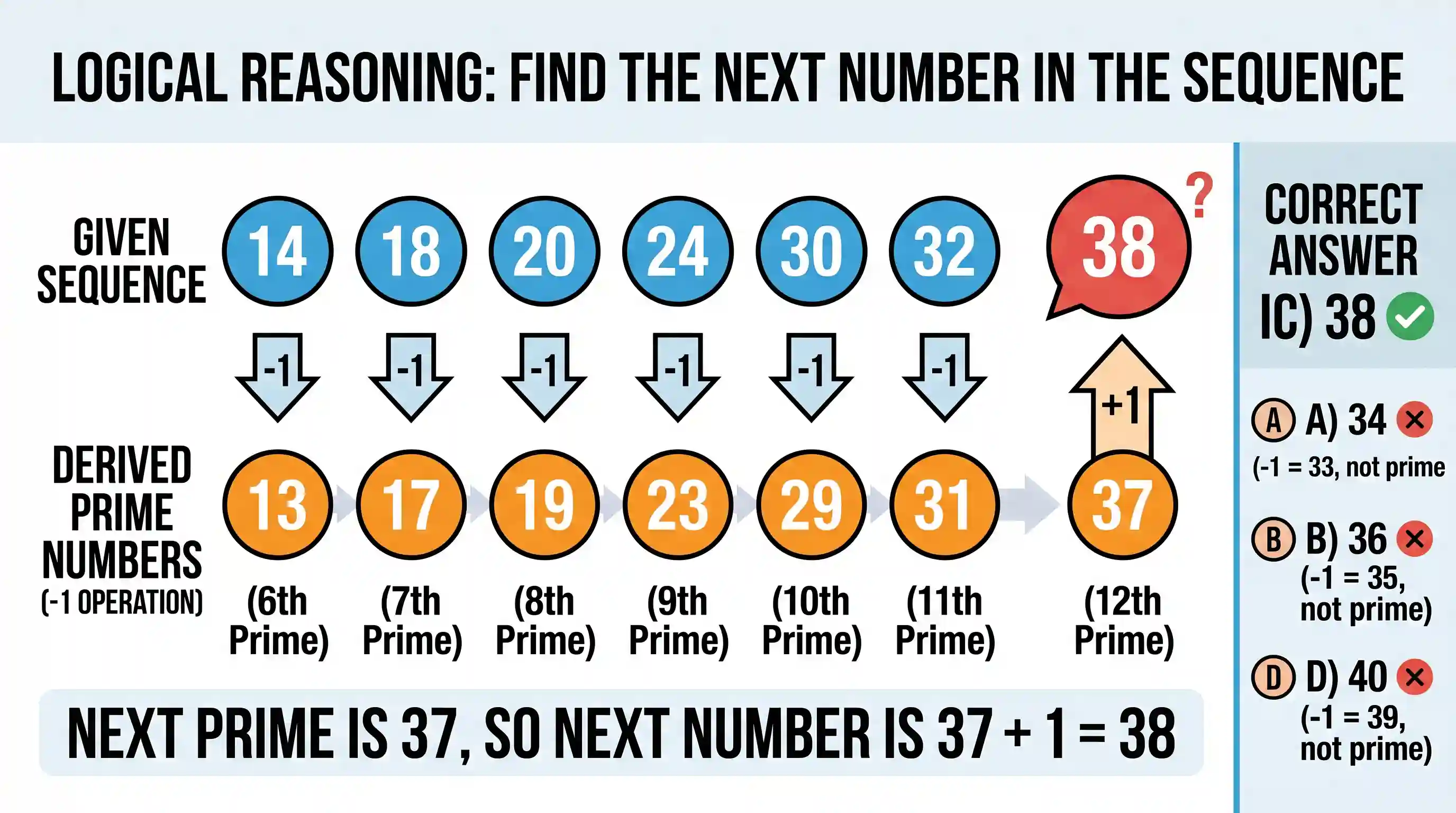
Let's try subtracting 1 from each number in the given sequence: 14 - 1 = 13 18 - 1 = 17 20 - 1 = 19 24 - 1 = 23 30 - 1 = 29 32 - 1 = 31
The resulting sequence is 13, 17, 19, 23, 29, 31. These are consecutive prime numbers. 13 is the 6th prime number. 17 is the 7th prime number. 19 is the 8th prime number. 23 is the 9th prime number. 29 is the 10th prime number. 31 is the 11th prime number.
Following this pattern, the next prime number in this sequence would be the 12th prime number. The prime numbers are 2, 3, 5, 7, 11, 13, 17, 19, 23, 29, 31, 37, ... The 12th prime number is 37.
Since the operation was to subtract 1 from the original sequence number to get the prime, to find the next number in the original sequence, we add 1 to the next prime number (37). Next number = 37 + 1 = 38.
Therefore, the next number in the sequence is 38.
Analyzing the options: A) 34: If 34 were the next number, 34-1 = 33, which is not prime. B) 36: If 36 were the next number, 36-1 = 35, which is not prime. C) 38: If 38 were the next number, 38-1 = 37, which is the next prime number in the series. This fits the pattern. D) 40: If 40 were the next number, 40-1 = 39, which is not prime.
The final answer is C) 38.
Related questions
More UPSC Prelims practice from the same subject and topic.
- Prelims 2020CSATLogical Reasoning
Consider the following arrangement that has some missing letters: abab_b_bcb_dcdcded_d The missing letters which complete the arrangement are
- Prelims 2020CSATLogical Reasoning
Consider the following sequence of numbers: 5 1 4 7 3 9 8 5 7 2 6 3 1 5 8 63852243496 How many odd numbers are followed by the odd number in the above sequence?
- Prelims 2020CSATLogical Reasoning
Two statements S1 and S2 are given below followed by a Question: S1: There are not more than two figures on any page of a 51-page book. S2: There is at least one figure on every page. Question: Are th…
- Prelims 2020CSATLogical Reasoning
A family of two generations consisting of six members P, Q, R, S, T and U has three males and three females. There are two married couples and two unmarried siblings. U is P's daughter and Q is R's mo…
- Prelims 2020CSATLogical Reasoning
If in a particular year 12th January is a Sunday, then which one of the following is correct?
- Prelims 2020CSATLogical Reasoning
Two Statements S1 and S2 are given below with regard to four numbers P, Q, R and S followed by a Question: S1: R is greater-than P as well as Q. S2: S is not the largest one. Among four numbers P, Q, …