A family of two generations consisting of six members P, Q, R, S, T and U has three males and three females. There are two married couples and two unmarried siblings. U is P's daughter and Q is R's mother-in-law. T is an unmarried male and S is a male. Which one of the following is correct?

- AR is U's husband
- BR is S's wifeCorrect
- CS is unmarried
- DNone of the above
Explanation
Let's break down the information to construct the family tree:
- Members: P, Q, R, S, T, U (6 members)
- Generations: Two generations
- Gender distribution: 3 males, 3 females
- Marital status: Two married couples, two unmarried siblings
Now, let's use the specific clues:
-
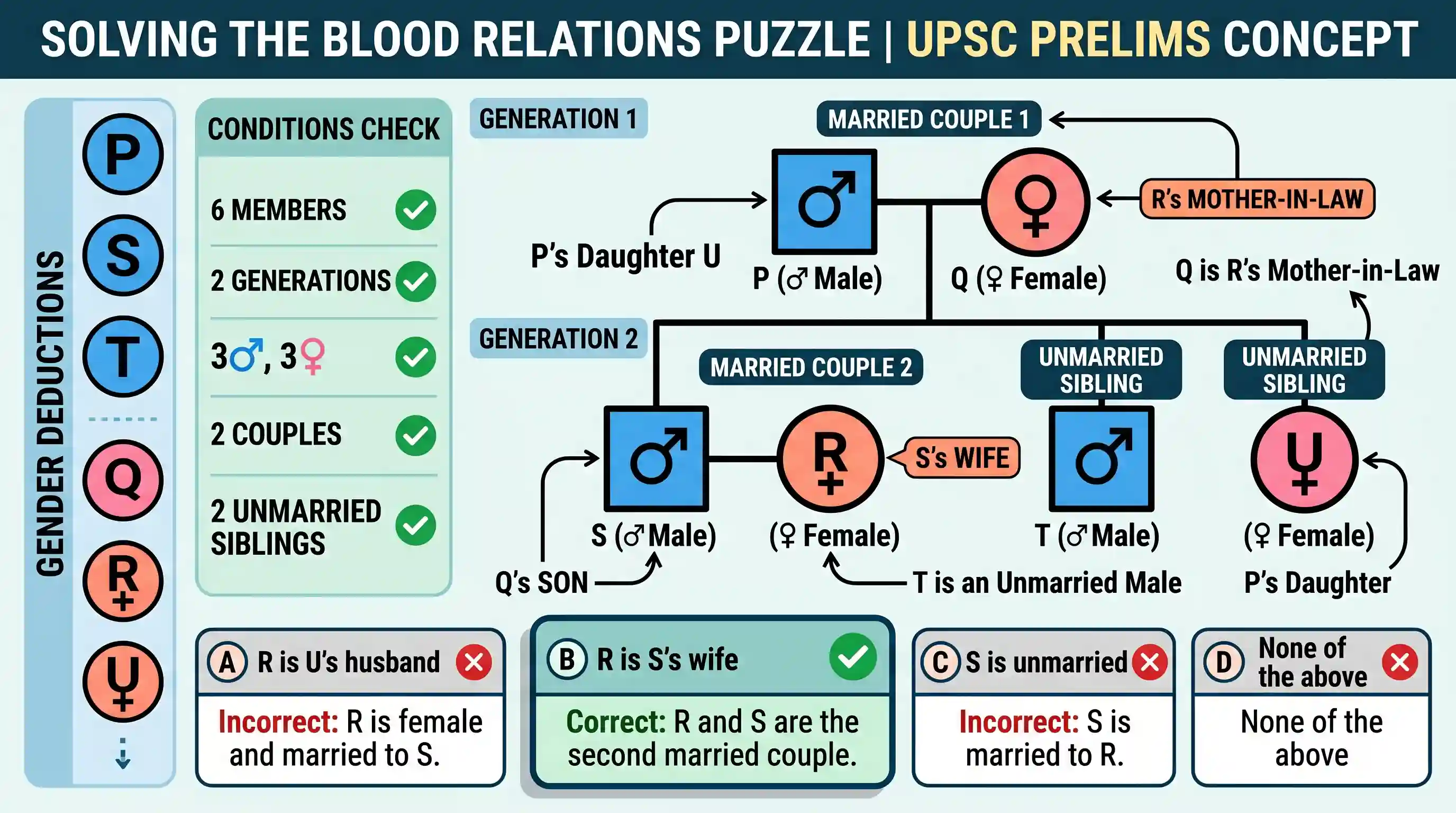
U is P's daughter: This means U is female. P is in the first generation, U in the second. P (Gen 1) | U (Female, Gen 2)
-
Q is R's mother-in-law: This means Q is female. Q has a child who is married to R. So, Q is in the first generation, and her child and R are in the second. Q (Female, Gen 1) | Child (Gen 2) -- R (Gen 2)
-
T is an unmarried male: T is male and unmarried. He must be in the second generation as an unmarried sibling.
-
S is a male: S is male.
Let's consolidate the known genders: U = Female Q = Female T = Male S = Male
We need one more female and one more male to reach 3 males and 3 females. The remaining members are P and R.
Let's assume P and Q are the married couple in the first generation. P -- Q (Female)
Since Q is R's mother-in-law, Q's child is married to R. P and Q have children in the second generation. U is P's daughter.
Consider the gender of P: If P is female, then P(-) -- Q(-), which is not possible for a married couple. Therefore, P must be male. So, P (Male) -- Q (Female) is the first married couple.
Now we have P (Male), Q (Female), U (Female), T (Male), S (Male). The remaining member is R. To balance the genders (3 males, 3 females), R must be female. So, R = Female.
The family structure is taking shape: Generation 1: P (Male) -- Q (Female) (Couple 1) Generation 2: Their children U, T, S (and R, who is married into the family)
From "Q is R's mother-in-law," Q's child is married to R (Female). The children of P and Q are U (Female), T (Male), and S (Male).
- U (Female) cannot be married to R (Female).
- T is an unmarried male. So T cannot be married to R.
- Therefore, S (Male) must be the child of P and Q who is married to R (Female). So, S (Male) -- R (Female) is the second married couple.
Now, let's verify all conditions with the derived family tree: Generation 1: P (Male) -- Q (Female) Generation 2: S (Male) -- R (Female) U (Female, unmarried sibling) T (Male, unmarried sibling)
- Members: P, Q, R, S, T, U - All accounted for.
- Genders: P(M), Q(F), S(M), R(F), U(F), T(M). (3 Males, 3 Females) - Correct.
- Generations: P,Q in Gen 1; S,R,U,T in Gen 2 - Correct.
- Married couples: (P, Q) and (S, R) - Two couples. Correct.
- Unmarried siblings: U and T - Two unmarried siblings. Correct.
- U is P's daughter: U is the daughter of P and Q. Correct.
- Q is R's mother-in-law: Q is S's mother, and S is married to R. So Q is R's mother-in-law. Correct.
- T is an unmarried male: Correct.
- S is a male: Correct.
The family tree is consistent with all given information.
Now, let's evaluate the options:
A) R is U's husband R is female, U is female. R is S's wife. This is incorrect.
B) R is S's wife R is female, S is male, and they are married in our derived tree. This is correct.
C) S is unmarried S is married to R. This is incorrect.
D) None of the above Since option B is correct, this is incorrect.
The final answer is B.
The final answer is B
Related questions
More UPSC Prelims practice from the same subject and topic.
- Prelims 2020CSATLogical Reasoning
A simple mathematical operation in each number of the sequence 14, 18, 20, 24, 30, 32, .... results in a sequence with respect to prime numbers. Which one of the following is the next number in the se…
- Prelims 2020CSATLogical Reasoning
Consider the following arrangement that has some missing letters: abab_b_bcb_dcdcded_d The missing letters which complete the arrangement are
- Prelims 2020CSATLogical Reasoning
Two statements S1 and S2 are given below followed by a Question: S1: There are not more than two figures on any page of a 51-page book. S2: There is at least one figure on every page. Question: Are th…
- Prelims 2020CSATLogical Reasoning
If in a particular year 12th January is a Sunday, then which one of the following is correct?
- Prelims 2020CSATLogical Reasoning
Two Statements S1 and S2 are given below with regard to four numbers P, Q, R and S followed by a Question: S1: R is greater-than P as well as Q. S2: S is not the largest one. Among four numbers P, Q, …
- Prelims 2020CSATLogical Reasoning
A man walks down the backside of his house straight 25 meters, then turns to the right and walks 50 meters again; then he turns towards left and again walks 25 meters. If his house faces to the East, …