A frog tries to come out of a dried well 4.5 m deep with slippery walls. Every time the frog jumps 30 cm, slides down 15 cm. what is the number of jumps required for the frog to come out of the well?

- A28
- B29Correct
- C30
- D31
Explanation
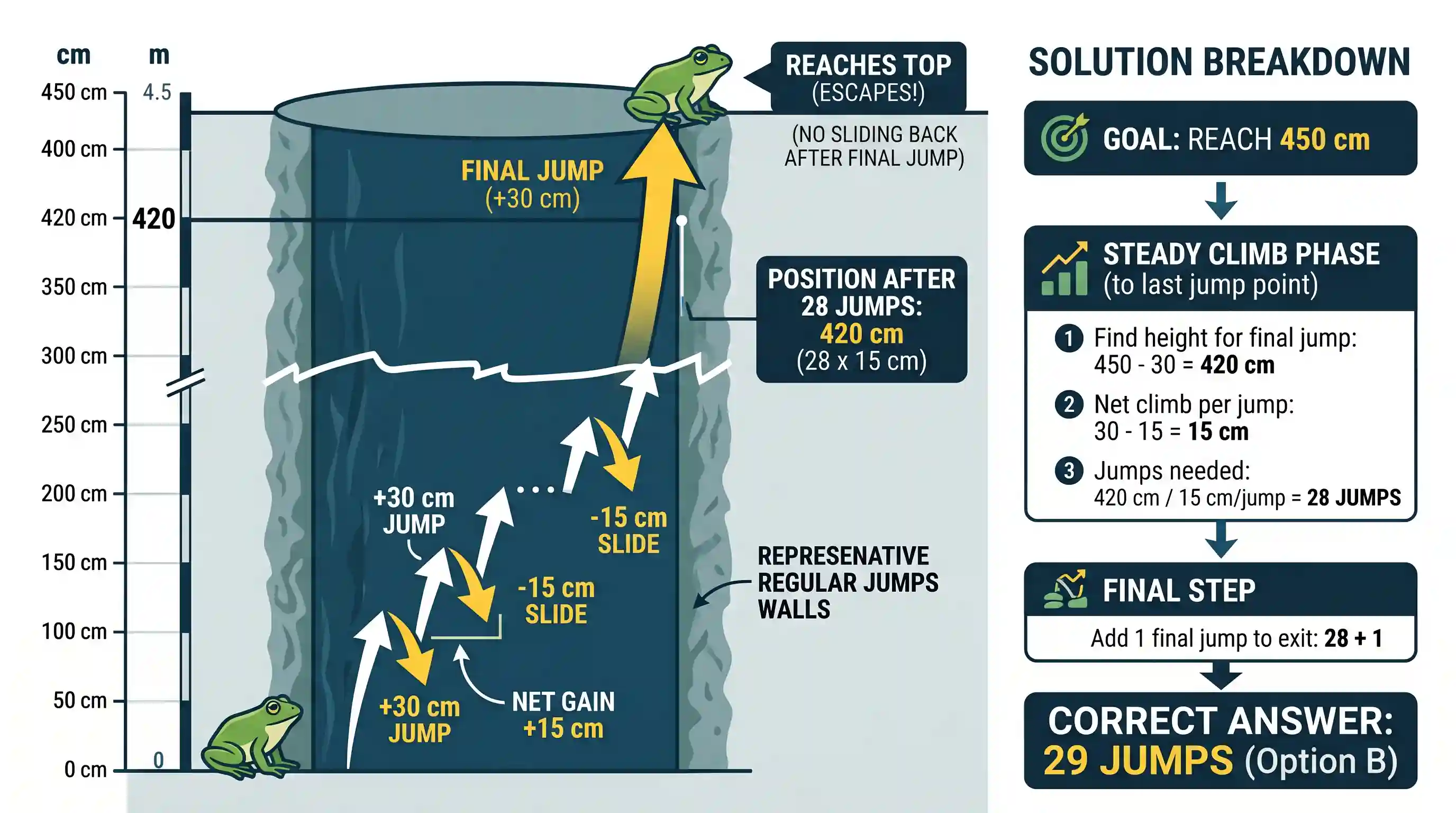
The well is 4.5 m = 450 cm deep. Each time the frog jumps 30 cm and slides down 15 cm, resulting in a net upward movement of 30 - 15 = 15 cm per jump.
The crucial point is that the frog escapes once it reaches the top of the well. It does not slide back down after the final jump that takes it out.
So, we need to find out how many jumps it takes for the frog to reach a height from which its next jump will take it out of the well. If the frog is at a height of (450 - 30) cm = 420 cm, the next jump of 30 cm will take it to 420 + 30 = 450 cm, which is out of the well.
Number of jumps required to cover 420 cm with a net gain of 15 cm per jump: 420 cm / 15 cm/jump = 28 jumps.
After 28 jumps, the frog will have reached a height of 28 * 15 cm = 420 cm. From this position, the 29th jump will take the frog up by 30 cm: 420 cm + 30 cm = 450 cm. At 450 cm, the frog is out of the well. It does not slide back down.
Therefore, the total number of jumps required is 28 + 1 = 29.
Analyzing the options: A) 28: This is the number of jumps to reach 420 cm, not out of the well. B) 29: This is the correct number of jumps, as explained above. C) 30: Incorrect. D) 31: Incorrect.
The final answer is B.
Related questions
More UPSC Prelims practice from the same subject and topic.
- Prelims 2020CSATQuantitative Aptitude
If you have two straight sticks of length 7.5 feet and 3.25 feet, what is the minimum length can you measure?
- Prelims 2020CSATQuantitative Aptitude
Consider the following data: | | Average marks in English | Average marks in Hindi | | Girls | 9 | 8 | | Boys | 8 | 7 | | Overall average marks | 8.8 | X | What is the value of x in the above table?
- Prelims 2020CSATQuantitative Aptitude
The average age of a teacher and three students is 20 years. If all the three students are of same age and the difference between the age of the teacher and each student is 20 years, then what is the …
- Prelims 2020CSATQuantitative Aptitude
A person bought a car and sold it for Rs. 3, 00,000. If he incurred a loss of 20%, then how much did he spend to buy the car?
- Prelims 2020CSATQuantitative Aptitude
A shop owner offers the following discount options on an article to a customer: Successive discounts or 10% and 20% , and then pay a service tax of 10% Successive discounts of 20% and 10% , and then p…
- Prelims 2020CSATQuantitative Aptitude
What is the largest number among the following?