With the present state of development, Artificial Intelligence can effectively do which of the following? 1. Bring down electricity consumption in industrial units 2. Create meaningful short stories and songs 3. Disease diagnosis 4. Text-to-Speech Conversion 5. Wireless transmission of electrical energy Select the correct answer using the code given below:

- A1, 2, 3 and 5 only
- B1, 3 and 4 onlyCorrect
- C2, 4 and 5 only
- D1, 2, 3, 4 and 5
Explanation
Let's evaluate the capabilities of Artificial Intelligence (AI) at its current state of development:
-
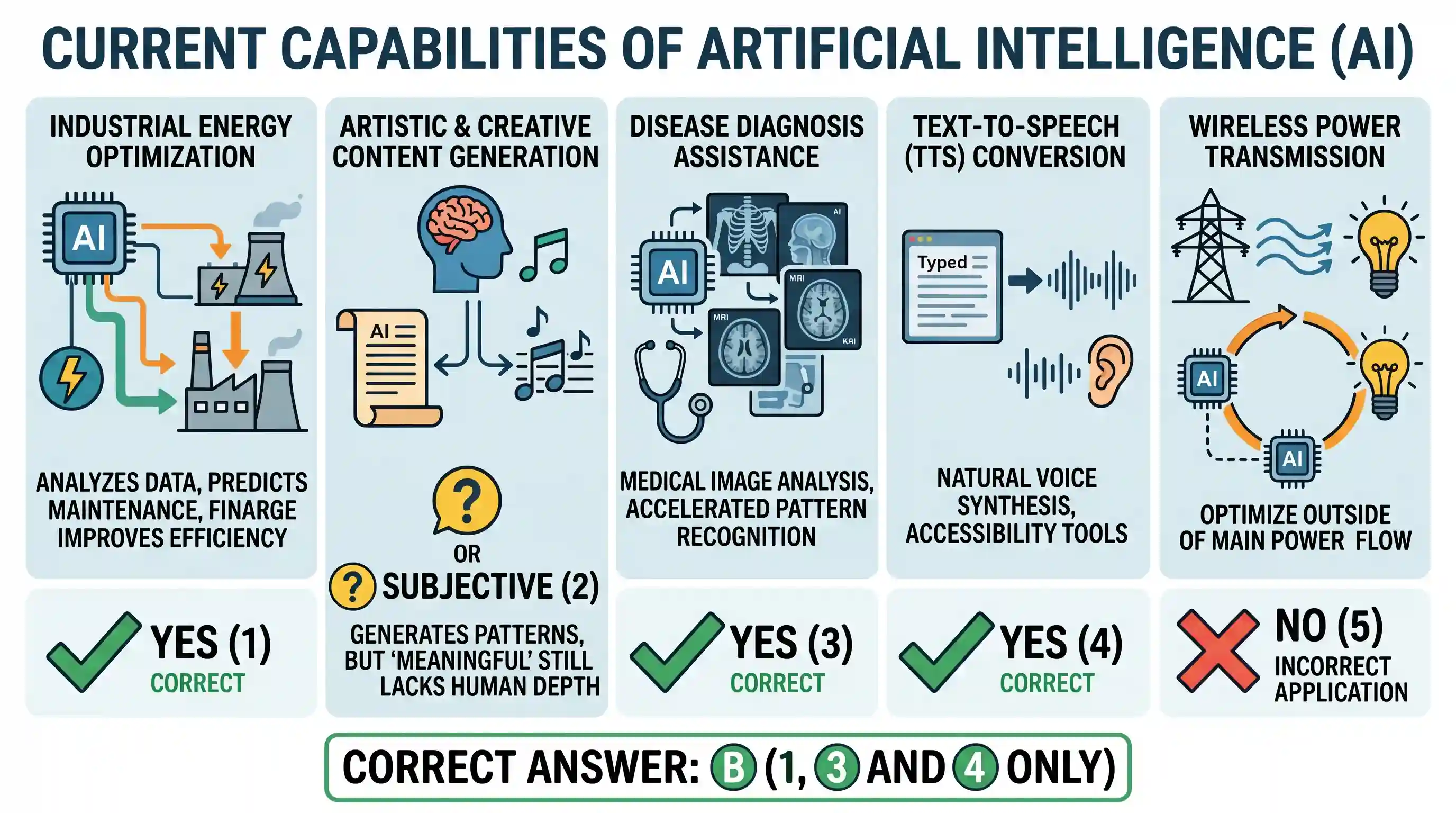
Bring down electricity consumption in industrial units: Correct. AI-powered systems can analyze vast amounts of data from industrial processes, optimize machine operations, predict maintenance needs, and manage energy flow, leading to significant reductions in electricity consumption through efficiency gains and predictive controls.
-
Create meaningful short stories and songs: While AI can generate text and music, the term "meaningful" is highly subjective and implies a level of human-like understanding, emotion, and creativity that current AI, despite its impressive generative capabilities, does not possess in a truly human sense. AI can produce grammatically correct and musically coherent pieces, but their 'meaning' and 'artistic depth' are still largely interpreted by human audiences or based on patterns learned from human-created works. This capability is still an area of active research and debate regarding its 'effectiveness' in a human context.
-
Disease diagnosis: Correct. AI, particularly machine learning algorithms, excels at analyzing medical images (X-rays, MRIs), patient data, and genomic information to assist doctors in diagnosing diseases more quickly and accurately, often identifying patterns that human eyes might miss.
-
Text-to-Speech Conversion: Correct. This is a very mature and effective application of AI. AI algorithms are used to convert written text into natural-sounding speech, widely used in virtual assistants, navigation systems, audiobooks, and accessibility tools.
-
Wireless transmission of electrical energy: Incorrect. Wireless transmission of electrical energy (e.g., resonant inductive coupling, microwave power transfer) is a field of physics and electrical engineering. While AI might be used to optimize the efficiency or control of such systems, AI itself does not perform the wireless transmission of energy. It is not an inherent capability of AI but rather a domain where AI could be an enabling tool.
Therefore, statements 1, 3, and 4 represent effective and established applications of AI.
Related questions
More UPSC Prelims practice from the same subject and topic.
- Prelims 2020GS1science-and-technology
With reference to Visible Light Communication (VLC) technology, which of the following statements are correct? 1. VLC uses electromagnetic spectrum wavelengths 375 to 780 nm. 2. VLC is known as long-r…
- Prelims 2020GS1science-and-technology
With reference to "Blockchain Technology", consider the following statements: 1. It is a public ledger that everyone can inspect, but which no single user controls. 2. The structure and design of bloc…
- Prelims 2020GS1science-and-technology
In India, the term "Public Key Infrastructure" is used in the context of
- Prelims 2020GS1science-and-technology
In the context of recent advances in human reproductive technology, "Pronuclear Transfer" is used for
- Prelims 2020GS1science-and-technology
With reference to carbon nanotubes, consider the following statements: 1. They can be used as carriers of drugs and antigens in the human body. 2. They can be made into artificial blood capillaries fo…
- Prelims 2020GS1science-and-technology
Consider the following activities : 1. Spraying pesticides on a crop field 2. Inspecting the craters of active volcanoes 3. Collecting breath samples from spouting whales for DNA analysis At the prese…