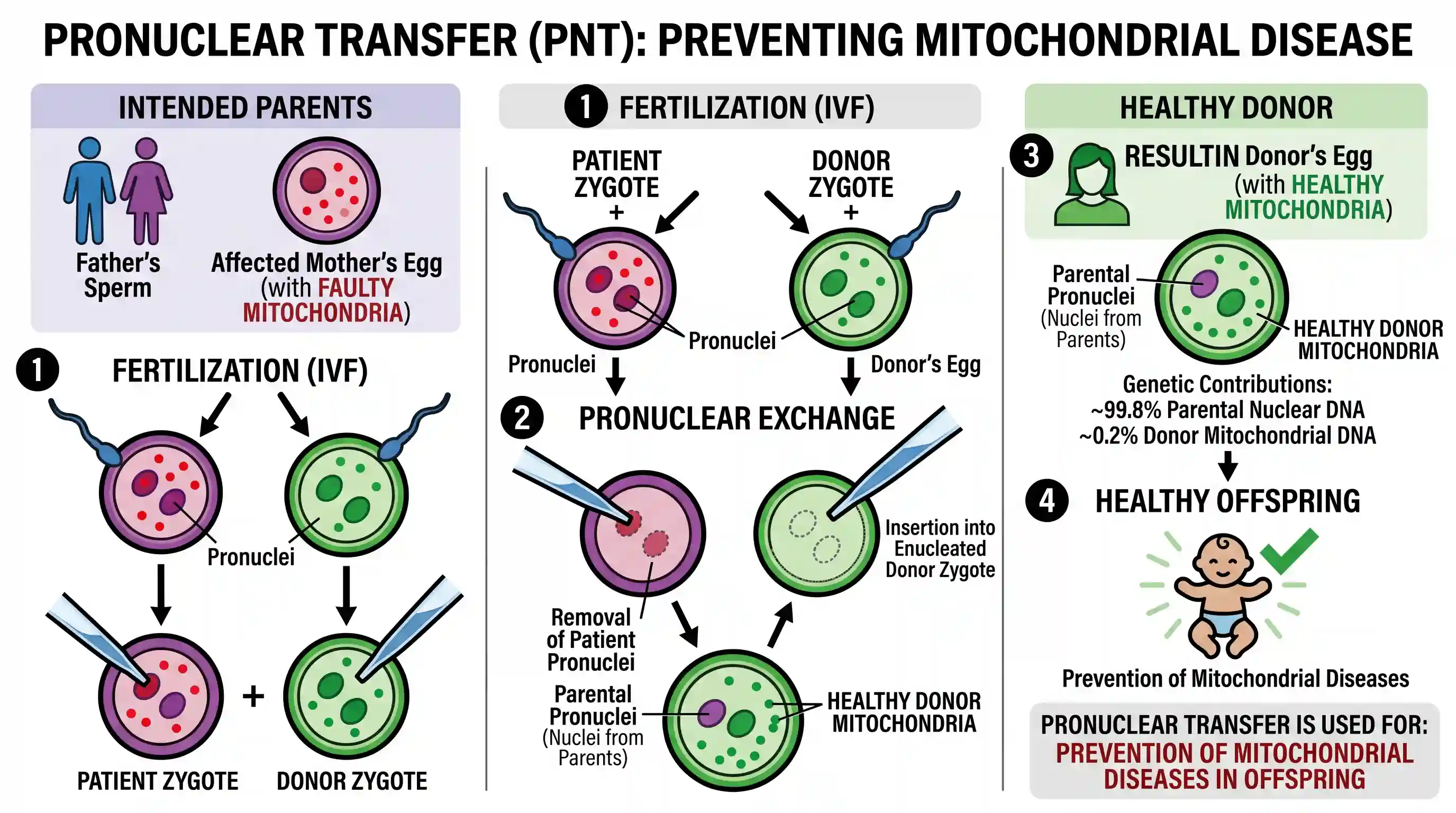
In the context of recent advances in human reproductive technology, "Pronuclear Transfer" is used for

- Afertilization of egg in vitro by the donor sperm
- Bgenetic modification of sperm producing cells
- Cdevelopment of stem cells into functional embryos
- Dprevention of mitochondrial diseases in offspringCorrect
Explanation
Pronuclear Transfer is an advanced assisted reproductive technology primarily developed and researched for the prevention of mitochondrial diseases. Mitochondrial diseases are genetic disorders caused by mutations in the mitochondrial DNA (mtDNA), which is inherited exclusively from the mother. In pronuclear transfer, the nuclear DNA (containing the vast majority of the genetic information) from a fertilized egg of a mother affected by or at risk of transmitting a mitochondrial disease is transferred into a donated egg that has had its own nuclear DNA removed but retains healthy mitochondria. This new egg is then fertilized, resulting in an embryo with the intended parents' nuclear DNA but healthy donor mitochondria, thereby preventing the transmission of the mitochondrial disease to the offspring. This technique is often referred to as 'three-parent baby' technology in common parlance due to the genetic contribution from three individuals (mother's nuclear DNA, father's nuclear DNA, and donor's mitochondrial DNA).
Related questions
More UPSC Prelims practice from the same subject and topic.
- Prelims 2020GS1science-and-technology
Consider the following statements: 1. Genetic changes can be introduced in the cells that produce eggs or sperms of a prospective parent. 2. A person's genome can be edited before birth at the early e…
- Prelims 2020GS1science-and-technology
With the present state of development, Artificial Intelligence can effectively do which of the following? 1. Bring down electricity consumption in industrial units 2. Create meaningful short stories a…
- Prelims 2020GS1science-and-technology
With reference to Visible Light Communication (VLC) technology, which of the following statements are correct? 1. VLC uses electromagnetic spectrum wavelengths 375 to 780 nm. 2. VLC is known as long-r…
- Prelims 2020GS1science-and-technology
With reference to "Blockchain Technology", consider the following statements: 1. It is a public ledger that everyone can inspect, but which no single user controls. 2. The structure and design of bloc…
- Prelims 2020GS1science-and-technology
With reference to carbon nanotubes, consider the following statements: 1. They can be used as carriers of drugs and antigens in the human body. 2. They can be made into artificial blood capillaries fo…
- Prelims 2020GS1science-and-technology
Consider the following activities : 1. Spraying pesticides on a crop field 2. Inspecting the craters of active volcanoes 3. Collecting breath samples from spouting whales for DNA analysis At the prese…