Consider the following statements: 1. Genetic changes can be introduced in the cells that produce eggs or sperms of a prospective parent. 2. A person's genome can be edited before birth at the early embryonic stage. 3. Human induced pluripotent stem cells can be injected into the embryo of a pig. Which of the statements given above is/are correct?

- A1 only
- B2 and 3 only
- C2 only
- D1, 2 and 3Correct
Explanation
Let's examine each statement in the context of recent advances in human reproductive technology and genetic modification:
-
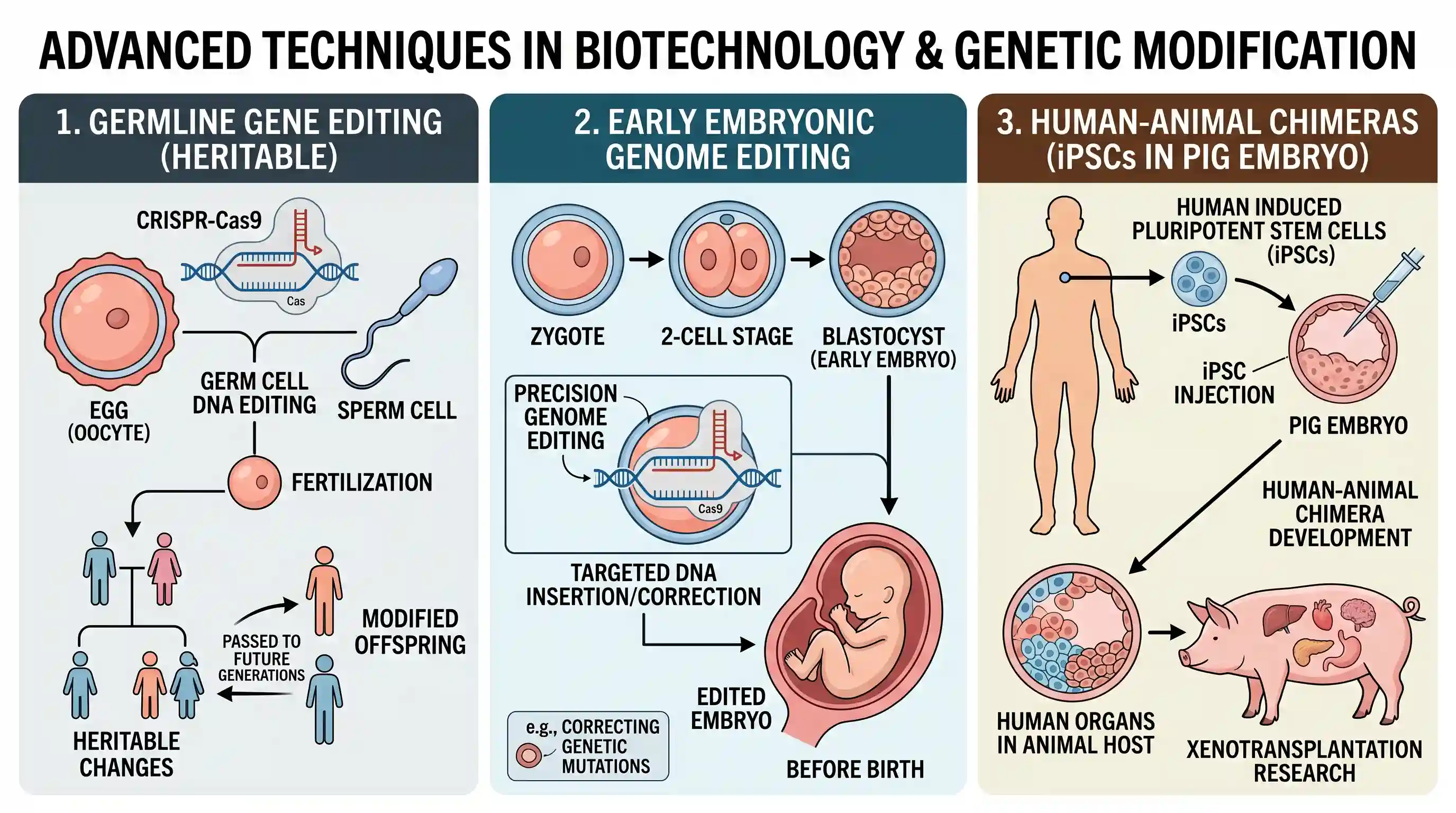
Genetic changes can be introduced in the cells that produce eggs or sperms of a prospective parent. Correct. This refers to germline gene editing, where genetic modifications are made in germ cells (sperm or egg cells) or early embryos. These changes would then be heritable, meaning they would be passed on to future generations. While highly ethically controversial and largely prohibited for clinical application in many countries, the technology to achieve this (e.g., CRISPR) exists and is a major area of research.
-
A person's genome can be edited before birth at the early embryonic stage. Correct. Technologies like CRISPR-Cas9 allow for precise editing of DNA. This can be applied to human embryos at a very early stage (e.g., zygote or blastocyst) to correct genetic mutations or introduce specific changes. This is also a subject of intense ethical and regulatory debate, but it is technologically feasible and has been demonstrated in research settings.
-
Human induced pluripotent stem cells can be injected into the embryo of a pig. Correct. This describes the creation of human-animal chimeras. Human induced pluripotent stem cells (iPSCs) have the ability to differentiate into various cell types. They can be injected into animal embryos (like pig or sheep embryos) to study human development, disease progression, or with the ultimate goal of growing human organs in animals for transplantation. This is an active area of research, albeit with significant ethical considerations.
Given the rapid advancements in genetic engineering and biotechnology, all three statements reflect capabilities that are either currently technologically feasible or are subjects of active and advanced research, even if ethical and regulatory hurdles remain for their widespread application.
Related questions
More UPSC Prelims practice from the same subject and topic.
- Prelims 2020GS1science-and-technology
In the context of recent advances in human reproductive technology, "Pronuclear Transfer" is used for
- Prelims 2020GS1science-and-technology
With the present state of development, Artificial Intelligence can effectively do which of the following? 1. Bring down electricity consumption in industrial units 2. Create meaningful short stories a…
- Prelims 2020GS1science-and-technology
With reference to Visible Light Communication (VLC) technology, which of the following statements are correct? 1. VLC uses electromagnetic spectrum wavelengths 375 to 780 nm. 2. VLC is known as long-r…
- Prelims 2020GS1science-and-technology
With reference to "Blockchain Technology", consider the following statements: 1. It is a public ledger that everyone can inspect, but which no single user controls. 2. The structure and design of bloc…
- Prelims 2020GS1science-and-technology
With reference to carbon nanotubes, consider the following statements: 1. They can be used as carriers of drugs and antigens in the human body. 2. They can be made into artificial blood capillaries fo…
- Prelims 2020GS1science-and-technology
Consider the following activities : 1. Spraying pesticides on a crop field 2. Inspecting the craters of active volcanoes 3. Collecting breath samples from spouting whales for DNA analysis At the prese…