Consider all 3-digit numbers (without repetition of digits) obtained using three non-zero digits which are multiples of 3. Let S be their sum. Which of the following is/are correct? 1. S is always divisible by 74. 2. S is always divisible by 9. select the correct answer using the code given below:

- A1 only
- B2 only
- CBoth 1 and 2Correct
- DNeither 1 nor 2
Explanation
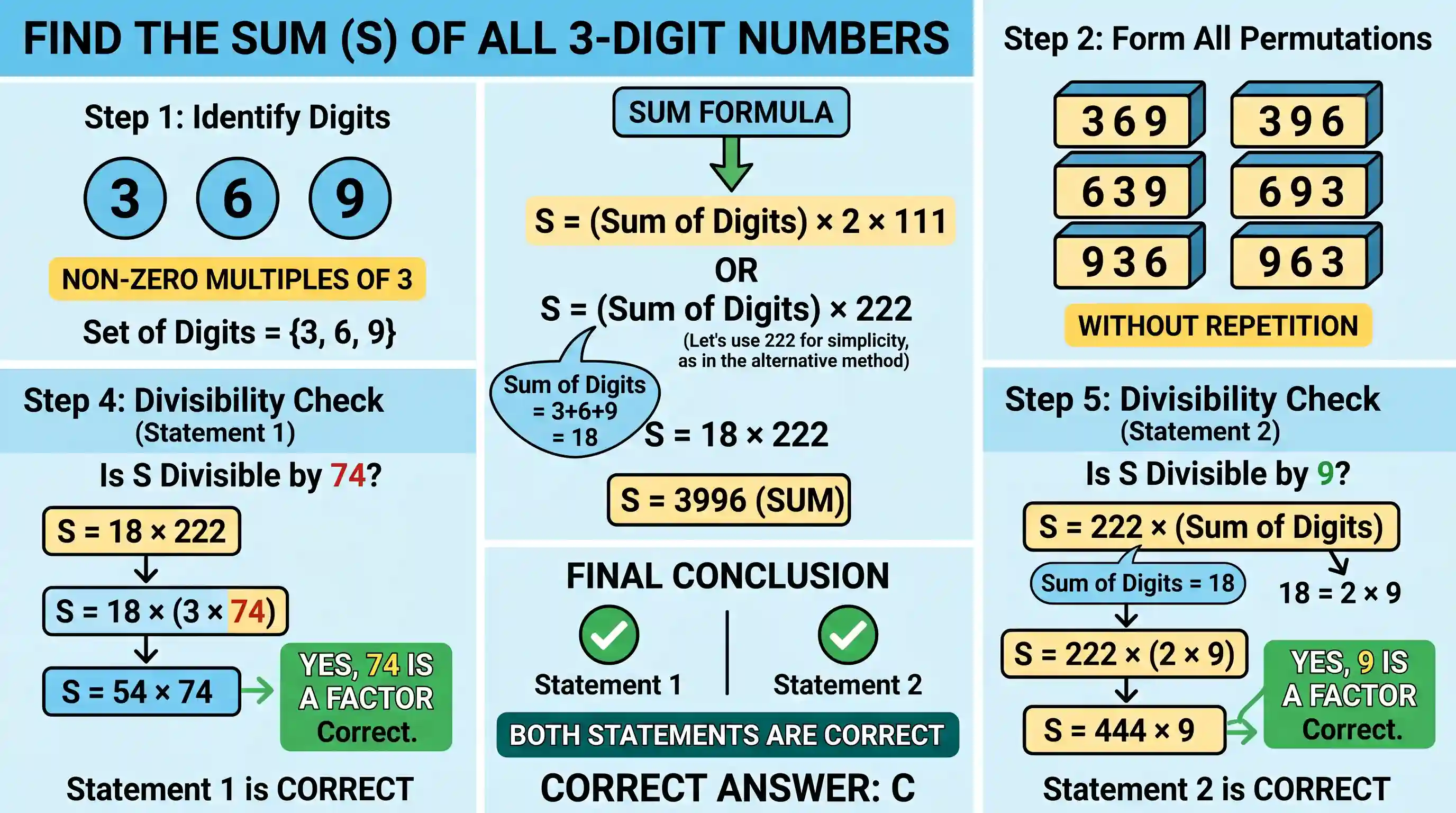
The three non-zero digits that are multiples of 3 are 3, 6, and 9. Let these digits be d1, d2, d3. The sum of these digits is d1 + d2 + d3 = 3 + 6 + 9 = 18.
When three distinct digits are used to form all possible 3-digit numbers without repetition, the sum (S) of these numbers can be calculated as: S = 2 * (d1 + d2 + d3) * (100 + 10 + 1) S = 2 * (sum of digits) * 111
Substitute the sum of digits: S = 2 * 18 * 111 S = 36 * 111 S = 3996
Now, let's analyze each statement:
Statement 1: S is always divisible by 74. We have S = 3996. Divide S by 74: 3996 / 74 = 54. Since 3996 is perfectly divisible by 74, statement 1 is correct for this specific set of digits. Generalization: S = 2 * (sum of digits) * 111 = 2 * (sum of digits) * 3 * 37 = 6 * (sum of digits) * 37. We can write 37 as 74/2. So, S = 6 * (sum of digits) * (74/2) = 3 * (sum of digits) * 74. This shows that S is always divisible by 74, regardless of the specific non-zero digits, as long as they are distinct.
Statement 2: S is always divisible by 9. We have S = 3996. To check divisibility by 9, sum the digits of S: 3 + 9 + 9 + 6 = 27. Since 27 is divisible by 9, S (3996) is divisible by 9. So, statement 2 is correct for this specific set of digits. Generalization: The problem states that the three digits are non-zero multiples of 3. Let these digits be 3k1, 3k2, 3k3 (where k1, k2, k3 are distinct integers from {1, 2, 3}). The sum of these digits (d1 + d2 + d3) will always be a multiple of 3. For example, 3+6+9 = 18 (a multiple of 3). S = 6 * (sum of digits) * 37. Since (sum of digits) is a multiple of 3, let (sum of digits) = 3M for some integer M. Then S = 6 * (3M) * 37 = 18M * 37. Since S has a factor of 18, S is always divisible by 9 (as 18 is divisible by 9).
Both statements 1 and 2 are correct.
The final answer is C
Related questions
More UPSC Prelims practice from the same subject and topic.
- Prelims 2021CSATQuantitative Aptitude
If 3²⁰¹⁹ is divided by 10, then what is the remainder?
- Prelims 2021CSATQuantitative Aptitude
The number 3798125P369 is divisible by 7. What is the value of the digit P?
- Prelims 2021CSATQuantitative Aptitude
Integers are listed from 700 to 1000. In how many integers is the sum of the digits 10 ?
- Prelims 2021CSATQuantitative Aptitude
Consider the following statements: 1 The sum of 5 consecutive integers can be 100. 2 The product of three consecutive natural numbers can be equal to their sum. Which of the above statements is/are co…
- Prelims 2021CSATQuantitative Aptitude
The difference between a 2-digit number and the number obtained by interchanging the positions of the digits is 54. Consider the following statements: 1. The sum of the two digits of the number can be…
- Prelims 2021CSATQuantitative Aptitude
When a certain number is multiplied by 7, the product entirely comprises ones only (1111...). What is the smallest such number?