Consider the following statements: 1 The sum of 5 consecutive integers can be 100. 2 The product of three consecutive natural numbers can be equal to their sum. Which of the above statements is/are correct?

- A1 only
- B2 only
- CBoth 1 and 2Correct
- DNeither 1 nor 2
Explanation
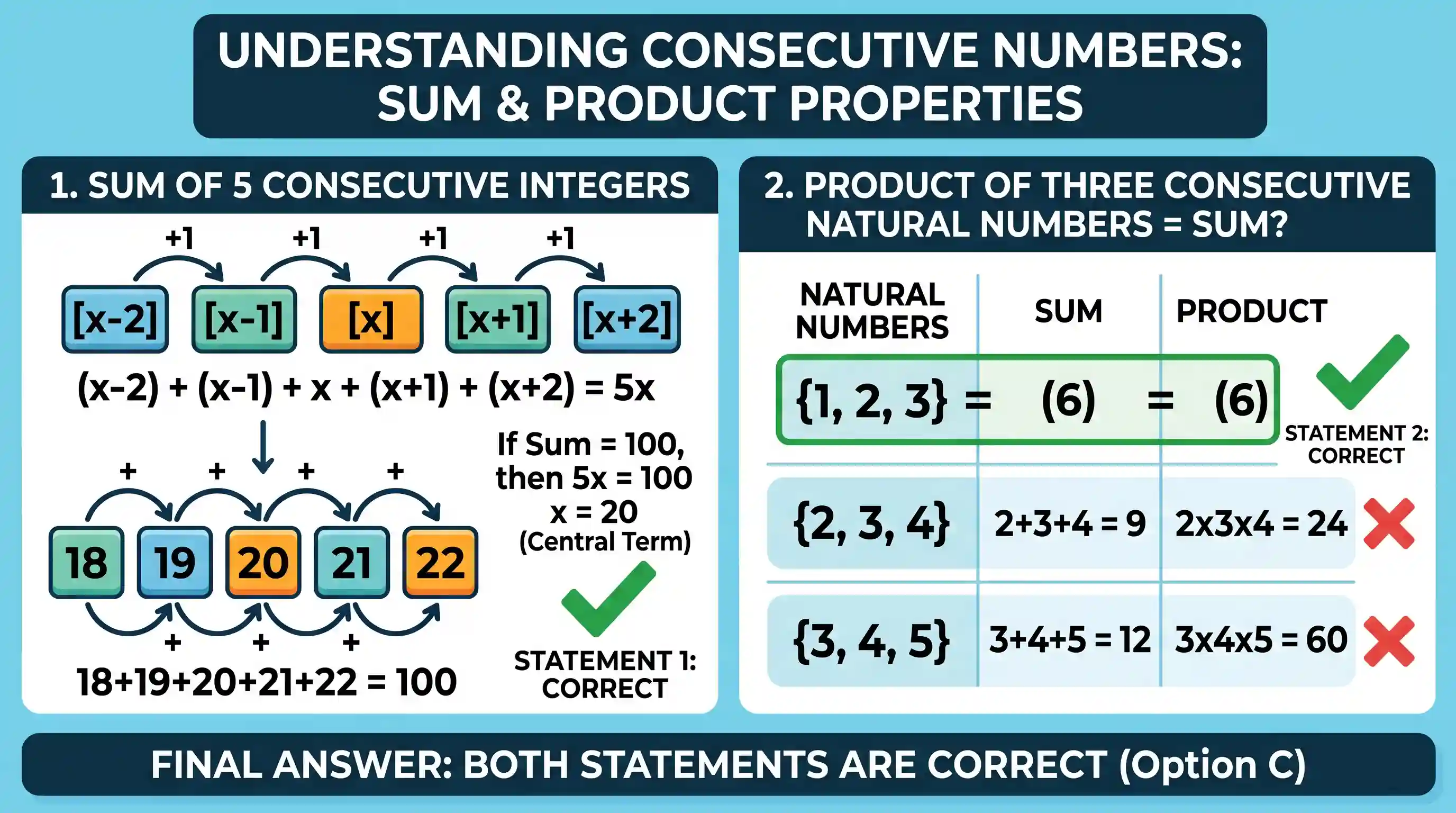
Statement 1: The sum of 5 consecutive integers can be 100. Let the 5 consecutive integers be x-2, x-1, x, x+1, x+2. Their sum is (x-2) + (x-1) + x + (x+1) + (x+2) = 5x. If 5x = 100, then x = 20. Since 20 is an integer, this is possible. The integers would be 18, 19, 20, 21, 22, and their sum is indeed 100. So, statement 1 is correct.
Statement 2: The product of three consecutive natural numbers can be equal to their sum. Let the three consecutive natural numbers be n-1, n, n+1 (where n is a natural number and n >= 2 for n-1 to be a natural number). Their product is (n-1) * n * (n+1) = n(n^2 - 1) = n^3 - n. Their sum is (n-1) + n + (n+1) = 3n. We need to check if n^3 - n = 3n. n^3 - 4n = 0 n(n^2 - 4) = 0 n(n-2)(n+2) = 0 The possible values for n are 0, 2, -2. Since n must be a natural number (n >= 2), n=2 is a valid solution. If n=2, the three consecutive natural numbers are 1, 2, 3. Their product is 1 * 2 * 3 = 6. Their sum is 1 + 2 + 3 = 6. Since the product (6) equals the sum (6), this is possible. So, statement 2 is correct.
Both statements are correct.
The final answer is C
Related questions
More UPSC Prelims practice from the same subject and topic.
- Prelims 2021CSATQuantitative Aptitude
If 3²⁰¹⁹ is divided by 10, then what is the remainder?
- Prelims 2021CSATQuantitative Aptitude
The number 3798125P369 is divisible by 7. What is the value of the digit P?
- Prelims 2021CSATQuantitative Aptitude
Consider all 3-digit numbers (without repetition of digits) obtained using three non-zero digits which are multiples of 3. Let S be their sum. Which of the following is/are correct? 1. S is always div…
- Prelims 2021CSATQuantitative Aptitude
Integers are listed from 700 to 1000. In how many integers is the sum of the digits 10 ?
- Prelims 2021CSATQuantitative Aptitude
The difference between a 2-digit number and the number obtained by interchanging the positions of the digits is 54. Consider the following statements: 1. The sum of the two digits of the number can be…
- Prelims 2021CSATQuantitative Aptitude
When a certain number is multiplied by 7, the product entirely comprises ones only (1111...). What is the smallest such number?