There are 6 persons arranged in a row. Another person has to shake hands with 3 of them so that he should not shake hands with two consecutive persons. In how many distinct possible combinations can the handshakes take place?

- A3
- B4Correct
- C5
- D6
Explanation
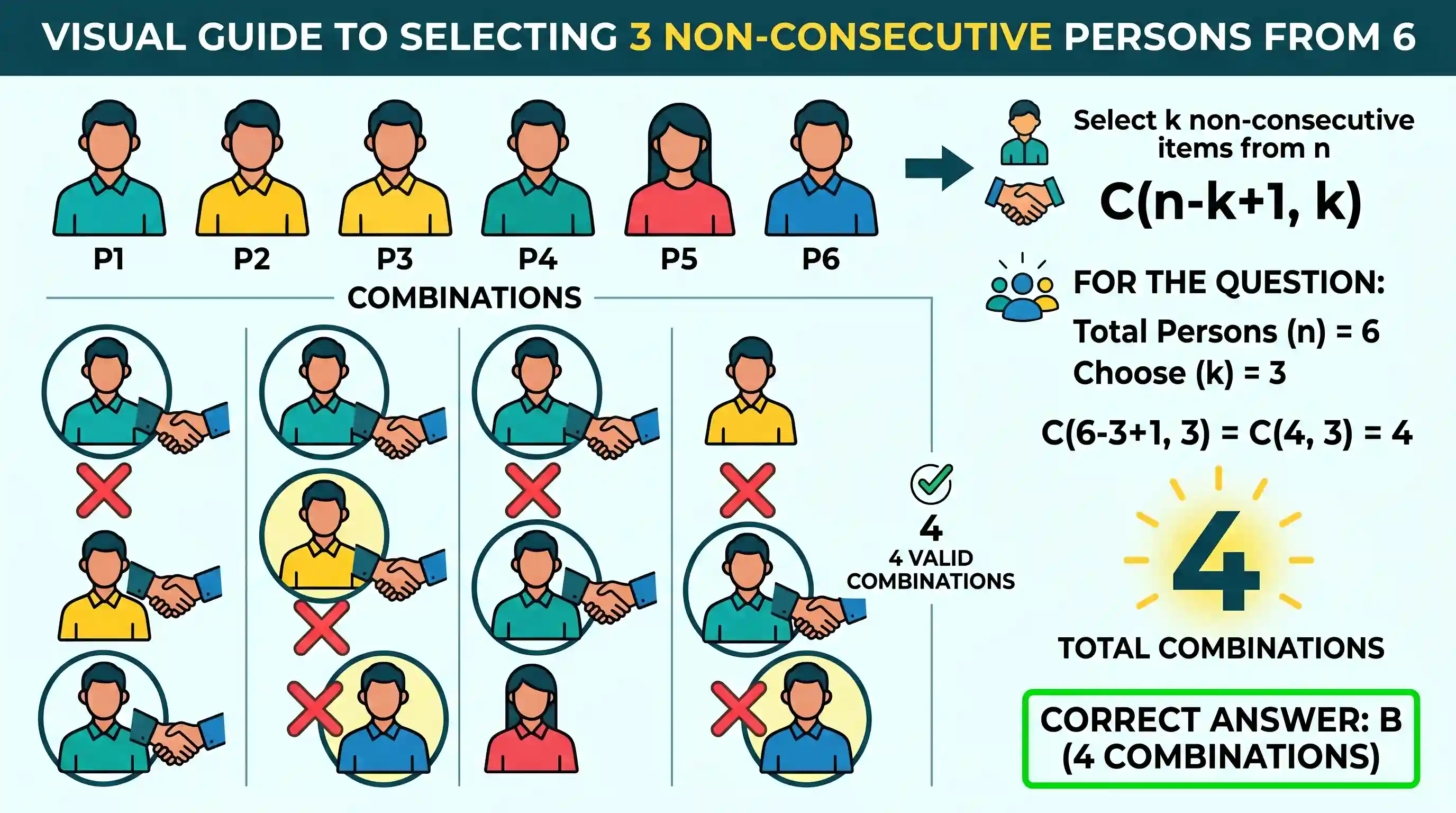
Let the 6 persons be P1, P2, P3, P4, P5, P6. We need to choose 3 persons such that no two chosen persons are consecutive.
This is a classic combinatorial problem of selecting 'k' non-consecutive items from 'n' items arranged in a row. The formula for this is C(n - k + 1, k), where C denotes combinations.
In this problem: n = 6 (total number of persons) k = 3 (number of persons to be chosen)
Applying the formula: Number of combinations = C(6 - 3 + 1, 3) = C(4, 3)
Calculating C(4, 3): C(4, 3) = 4! / (3! * (4-3)!) = 4! / (3! * 1!) = (4 * 3 * 2 * 1) / ((3 * 2 * 1) * 1) = 4
The 4 distinct possible combinations are:
- (P1, P3, P5)
- (P1, P3, P6)
- (P1, P4, P6)
- (P2, P4, P6)
Thus, there are 4 distinct possible combinations.
The final answer is B
Related questions
More UPSC Prelims practice from the same subject and topic.
- Prelims 2021CSATQuantitative Aptitude
In a group of 120 persons, 80 are Indians and rest are foreigners. Further, 70 persons in the group can speak English, The number of Indians who can speak English is
- Prelims 2021CSATQuantitative Aptitude
On a chess board, in how many different ways can 6 consecutive squares be chosen on the diagonals along a straight path?
- Prelims 2021CSATQuantitative Aptitude
Using 2, 2, 3, 3, 3 as digits, how many distinct numbers greater than 30000 can be formed?
- Prelims 2021CSATQuantitative Aptitude
A person X from a place A and another person Y from a place B set out at the same time to walk towards each other. The places are separated by a distance of 15 km. X walks with a uniform speed of 1.5 …
- Prelims 2021CSATQuantitative Aptitude
A student appeared in 6 papers. The maximum marks are the same for each paper. His marks in these papers are in the proportion of 5 : 6 : 7 : 8 : 9 : 10. Overall he scored 60%. In how many number of p…
- Prelims 2021CSATQuantitative Aptitude
If 3²⁰¹⁹ is divided by 10, then what is the remainder?