An amount of money was distributed among A, B and C in the ratio p : q : r. Consider the following statements : 1. A gets the maximum share if p is greater than (q + r) . 2. C gets the minimum share if r is less than (p + q) . Which of the above statements is/are correct ?

- A1 onlyCorrect
- B2 only
- CBoth 1 and 2
- DNeither 1 nor 2
Explanation
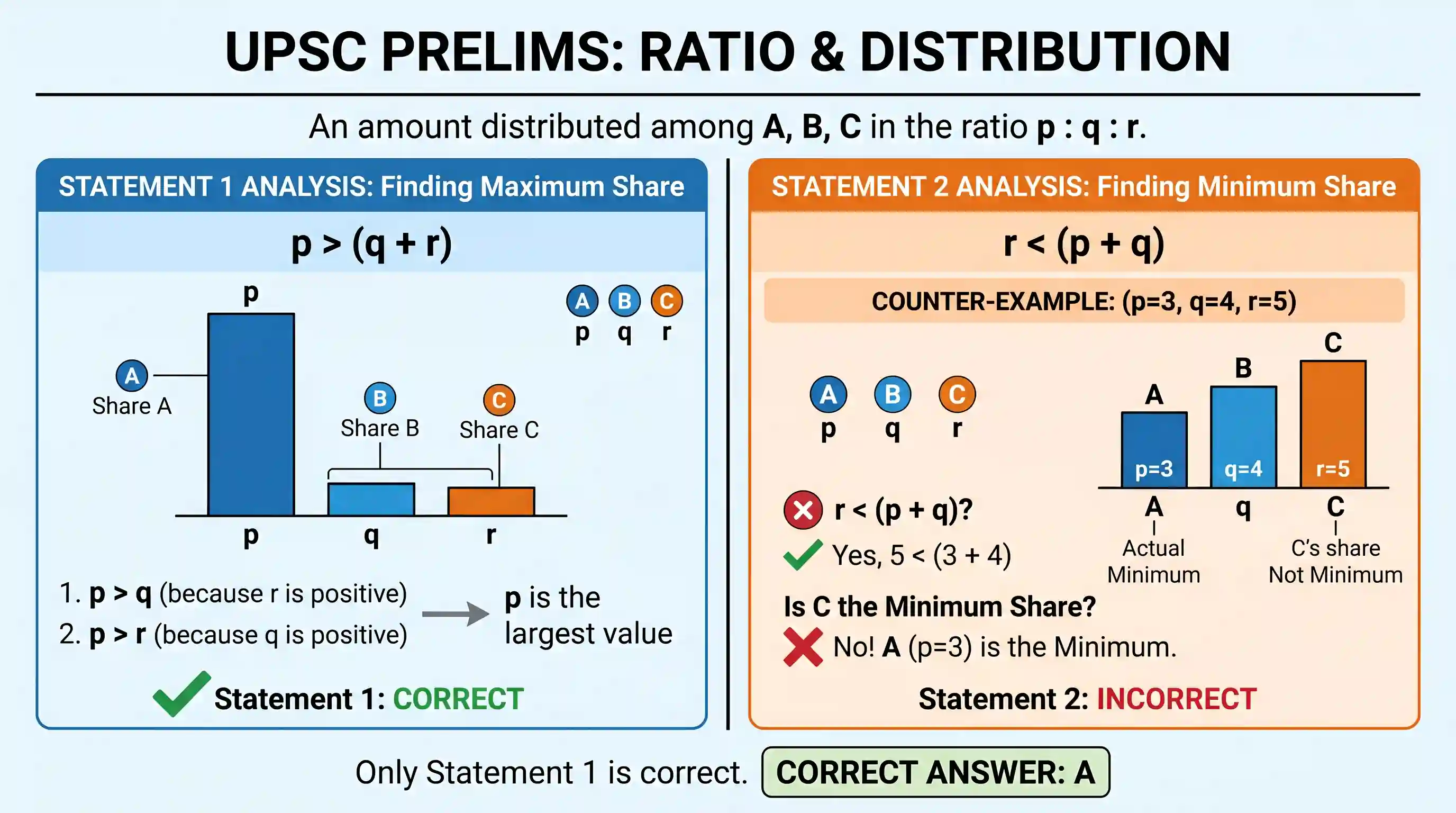
Statement 1: A gets the maximum share if p is greater than (q + r). To get the maximum share, 'p' must be greater than both 'q' and 'r' individually. If p > (q + r), then since q and r are positive values (shares in a ratio), it automatically implies:
- p > q (because p is greater than q plus another positive number r)
- p > r (because p is greater than r plus another positive number q) Since p is greater than both q and r, A indeed gets the maximum share. Thus, Statement 1 is correct.
Statement 2: C gets the minimum share if r is less than (p + q). To get the minimum share, 'r' must be less than both 'p' and 'q' individually. If r < (p + q), this does not guarantee that r is less than both p and q. Consider a counter-example: Let p = 3, q = 4, r = 5. Here, r = 5. p + q = 3 + 4 = 7. Is r < (p + q)? Yes, 5 < 7. However, in this example, C's share (r=5) is not the minimum. A's share (p=3) is the minimum. The condition r < (p + q) only means r is smaller than the sum of the other two, which is almost always true unless r is extremely large. It does not ensure r is the smallest among the three. Thus, Statement 2 is incorrect.
Therefore, only Statement 1 is correct.
The final answer is A
Related questions
More UPSC Prelims practice from the same subject and topic.
- Prelims 2021CSATQuantitative Aptitude
A student appeared in 6 papers. The maximum marks are the same for each paper. His marks in these papers are in the proportion of 5 : 6 : 7 : 8 : 9 : 10. Overall he scored 60%. In how many number of p…
- Prelims 2021CSATQuantitative Aptitude
From January 1, 2021, the price of petrol (in Rupees per litre) on m ^ {th} day of the year is 80 + 0.1 m, where m = 1, 2, 3, … , 100 and thereafter remains constant. On the other hand, the price of d…
- Prelims 2021CSATQuantitative Aptitude
In a class, 60% of students are from India and 50% of the students are girls. If 30% of the Indian students are girls, then what percentage of foreign students are boys?
- Prelims 2021CSATQuantitative Aptitude
There are two Classes A and B having 25 and 30 students respectively. In Class-A the highest score is 21 and lowest score is 17. In Class-B the highest score is 30 and lowest score is 22. Four student…
- Prelims 2021CSATQuantitative Aptitude
A boy plays with a ball and he drops it from a height of 1.5 m. Every time the ball hits the ground, it bounces back to attain a height 4 / 5th of the previous height. The ball does not bounce further…
- Prelims 2021CSATQuantitative Aptitude
Consider the following Table: +--------+-------------------------------+-------------------------------+--------------------------------+--------------------------------+ | Player | Runs scored in the…