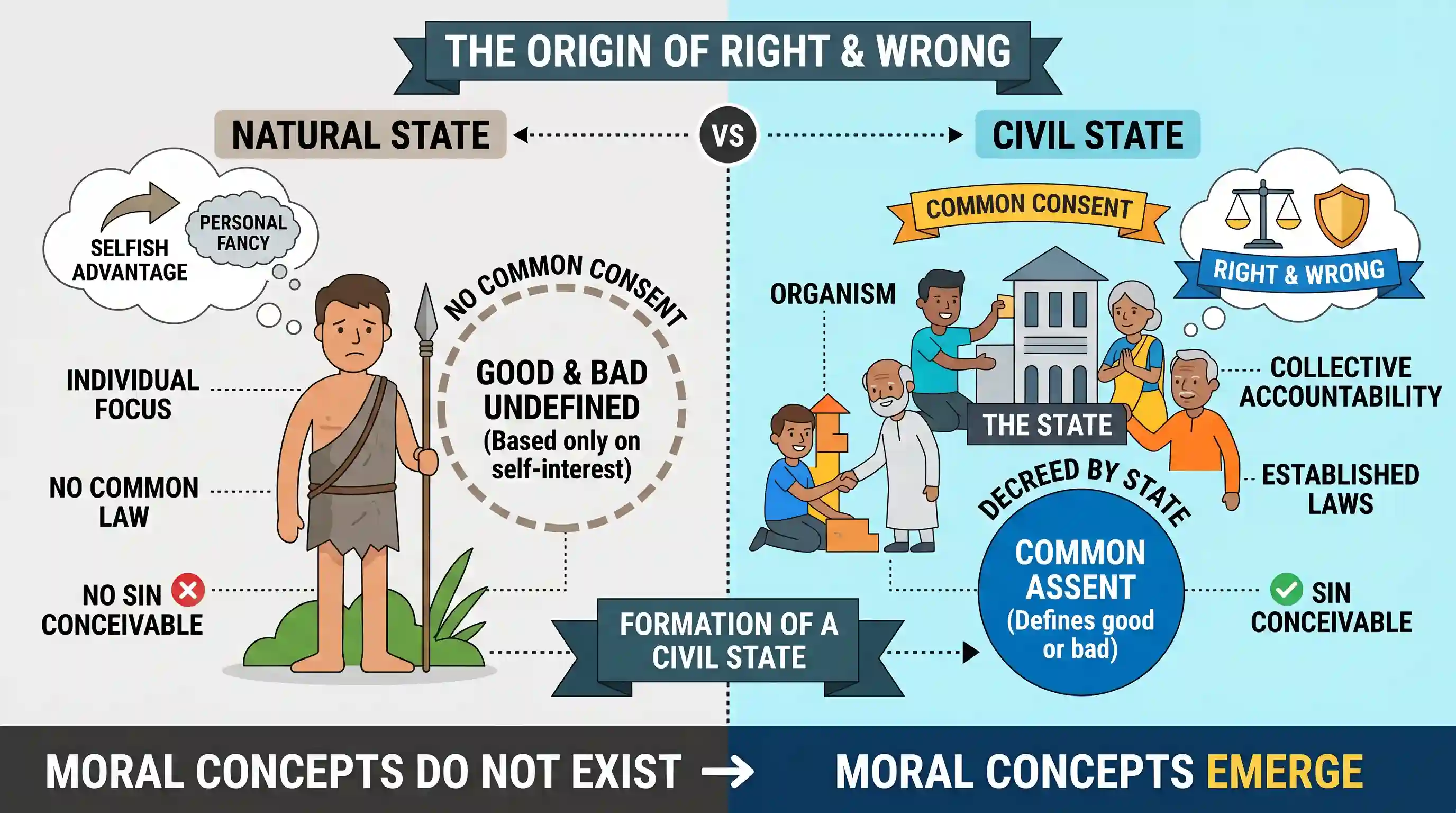
Read the following passage and answer the items that follow. Your answers to these items should be based on the passages only Nothing can exist in a natural state which can be called good or bad by common assent, since every man who is in a natural state consults only his own advantage, and determines what is good or bad according to his own fancy and insofar as he has regard for his own advantage alone, and holds himself responsible to no one save himself by any law; and therefore sin cannot be conceived in a natural state, but only in a civil state, which is decreed by common consent what is good or bad, and each one holds himself responsible to the state. Which one of the following statements best reflects the central idea of the passage given above?

- AThe conceptions of what is right or wrong exist due to the formation of a stateCorrect
- BUnless a ruling authority decides as to what is right or wrong, no man would be morally right
- CMan is inherently immoral and selfish in a natural state
- DThe idea of what is right or wrong is necessary for the survival of human species
Explanation
The central idea of the passage is that the concepts of good, bad, right, or wrong (and sin) do not exist in a natural state but only arise within a civil state. In a natural state, individuals act solely for their own advantage without external laws or accountability. It is the civil state, formed by common consent, that defines these concepts and establishes responsibility.
Let's analyze the options:
A) The conceptions of what is right or wrong exist due to the formation of a state. This statement perfectly reflects the passage. The passage explicitly states, "sin cannot be conceived in a natural state, but only in a civil state, which is decreed by common consent what is good or bad." This directly links the existence of these moral concepts to the formation of a state.
B) Unless a ruling authority decides as to what is right or wrong, no man would be morally right. This option is too strong and slightly misinterprets the passage. The passage focuses on the conception and definition of good/bad by common assent within a state, not on whether an individual man can be "morally right" in an absolute sense without such an authority. It's about the framework, not individual moral status.
C) Man is inherently immoral and selfish in a natural state. While the passage states that man in a natural state "consults only his own advantage" and acts "according to his own fancy," it also explicitly says that "sin cannot be conceived in a natural state." This implies that the very concept of "immoral" does not apply in the natural state, as there is no moral framework. Therefore, man cannot be "inherently immoral" if immorality itself doesn't exist. Selfishness is described, but not immorality.
D) The idea of what is right or wrong is necessary for the survival of human species. The passage does not discuss the necessity of these ideas for the survival of the human species. It focuses solely on the origin and existence of these concepts in relation to the state versus the natural state. This is an external idea not supported by the text.
Therefore, option A best reflects the central idea by accurately capturing the passage's argument that the framework for right and wrong is a product of the civil state.
Related questions
More UPSC Prelims practice from the same subject and topic.
- Prelims 2021CSATReading Comprehension
India faces a challenging immediate future in energy and climate policy- making. The problems are multiple: sputtering fossil fuel production capabilities; limited access to electricity and modern coo…
- Prelims 2021CSATReading Comprehension
There are reports that some of the antibiotics sold in the market are fed to poultry and other livestock as growth promoters. Overusing these substances can create superbugs, pathogens that are resist…
- Prelims 2021CSATReading Comprehension
Policymakers and media have placed the blame for skyrocketing food prices on a variety of factors, including high fuel prices, bad weather in key food producing countries, and the diversion of land to…
- Prelims 2021CSATReading Comprehension
A central message of modern development economics is the importance of income growth, by which is meant growth in Gross Domestic Product (GDP). In theory, rising GDP creates employment and investment …
- Prelims 2021CSATReading Comprehension
Researchers simulated street lighting on artificial grassland plots containing pea- aphids, sap- sucking insects, at night. These were exposed to two different types of light - a white light similar t…
- Prelims 2021CSATReading Comprehension
Approximately 80 percent of all flowering plant species are pollinated by animals, including birds and mammals, but the main pollinators are insects. Pollination is responsible for providing us with a…