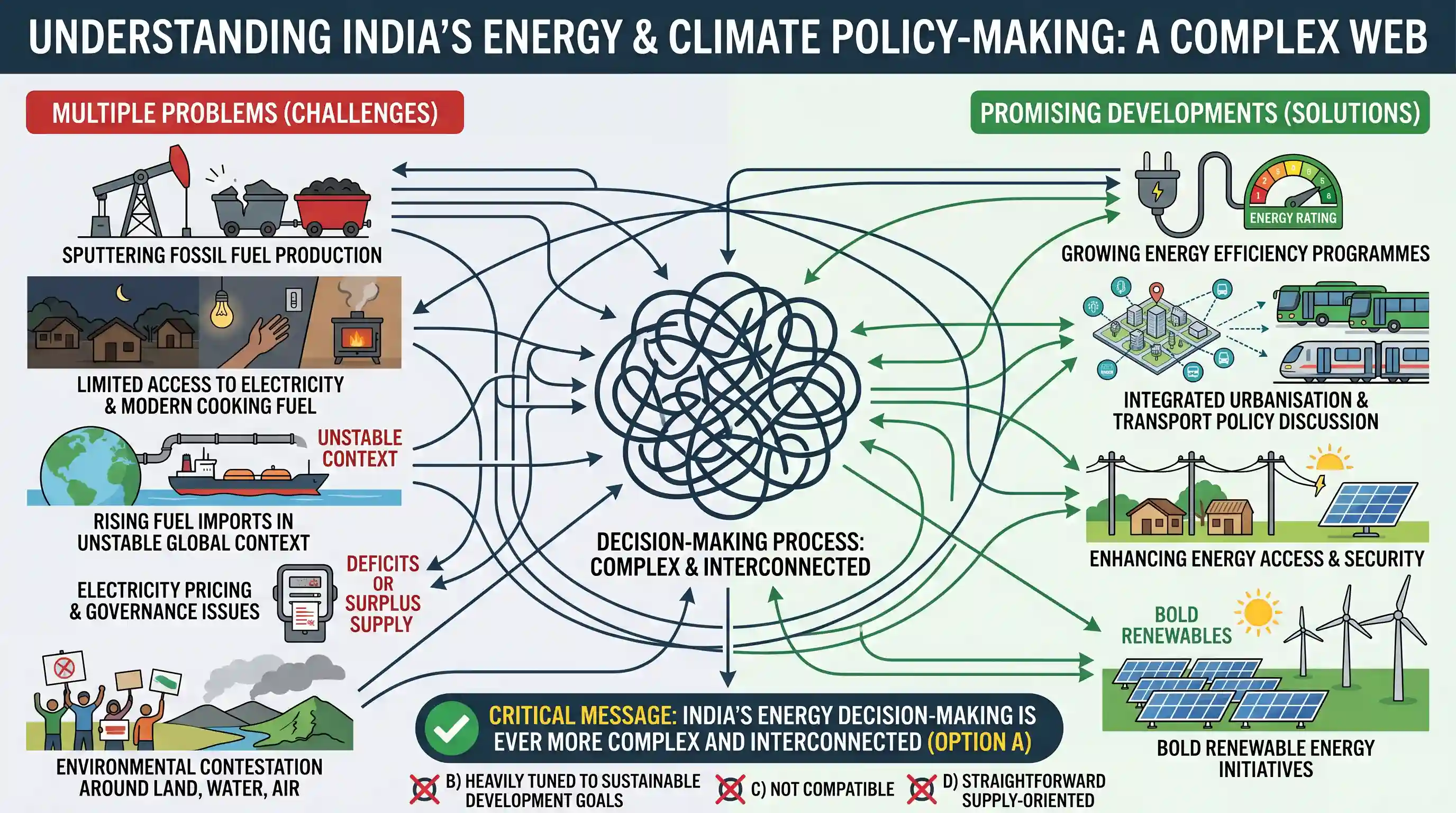
India faces a challenging immediate future in energy and climate policy- making. The problems are multiple: sputtering fossil fuel production capabilities; limited access to electricity and modern cooking fuel for the poorest; rising fuel imports in an unstable global energy context; continued electricity pricing and governance challenges leading to its costly deficits or surplus supply; and not least, growing environmental contestation around land, water and air. But all is not bleak: growing energy efficiency programmes; integrated urbanisation and transport policy discussion; inroads to enhancing energy access and security; and bold renewable energy initiatives, even if not fully conceptualised, suggest the promise of transformation. Which one of the following statements best reflects the critical message conveyed by the passage given above?

- AIndia's energy decision-making process is ever more complex and interconnectedCorrect
- BIndia's energy and climate policy is heavily tuned to sustainable development goals
- CIndia's energy and climate actions are not compatible with its broader social, economic and environmental goals
- DIndia's energy decision-making process is straightforward supply- oriented and ignores the demand side.
Explanation
The passage details a multitude of interconnected problems (sputtering fossil fuels, limited access for the poor, rising imports, electricity pricing issues, environmental contestation) and a variety of promising solutions (energy efficiency, integrated urbanisation, enhanced access, renewable energy). This extensive list of diverse factors clearly indicates a highly complex and interconnected scenario for energy and climate policy-making in India.
Let's analyze each option:
A) India's energy decision-making process is ever more complex and interconnected. This statement perfectly reflects the passage. The passage highlights the "multiple" problems and the various, often interlinked, aspects of both challenges and potential solutions (economic, social, environmental, technological, governance). This points to an increasingly intricate and interwoven decision-making environment.
B) India's energy and climate policy is heavily tuned to sustainable development goals. While the passage mentions some efforts aligned with sustainable development (renewable energy, energy access), it also highlights significant challenges and problems (sputtering fossil fuels, rising imports, environmental contestation) that suggest the policy is not yet "heavily tuned" or fully successful in achieving these goals. It describes a struggle and a promise, not a fully aligned policy.
C) India's energy and climate actions are not compatible with its broader social, economic and environmental goals. This statement is too extreme. While the passage lists incompatibilities (e.g., limited access for the poor, environmental contestation), it also points to actions that are compatible with these goals (e.g., enhancing energy access, bold renewable energy initiatives). The passage presents a mixed picture, not a complete lack of compatibility.
D) India's energy decision-making process is straightforward supply- oriented and ignores the demand side. This statement is incorrect. The passage explicitly mentions "limited access to electricity and modern cooking fuel for the poorest" (a demand-side issue) and "growing energy efficiency programmes" and "integrated urbanisation and transport policy discussion" (both of which involve managing demand). This contradicts the idea that the process ignores the demand side or is straightforward.
Therefore, option A best captures the critical message of the passage, which describes a multifaceted and intricate landscape of challenges and opportunities in India's energy and climate policy.
Related questions
More UPSC Prelims practice from the same subject and topic.
- Prelims 2021CSATReading Comprehension
There are reports that some of the antibiotics sold in the market are fed to poultry and other livestock as growth promoters. Overusing these substances can create superbugs, pathogens that are resist…
- Prelims 2021CSATReading Comprehension
Policymakers and media have placed the blame for skyrocketing food prices on a variety of factors, including high fuel prices, bad weather in key food producing countries, and the diversion of land to…
- Prelims 2021CSATReading Comprehension
A central message of modern development economics is the importance of income growth, by which is meant growth in Gross Domestic Product (GDP). In theory, rising GDP creates employment and investment …
- Prelims 2021CSATReading Comprehension
Researchers simulated street lighting on artificial grassland plots containing pea- aphids, sap- sucking insects, at night. These were exposed to two different types of light - a white light similar t…
- Prelims 2021CSATReading Comprehension
Approximately 80 percent of all flowering plant species are pollinated by animals, including birds and mammals, but the main pollinators are insects. Pollination is responsible for providing us with a…
- Prelims 2021CSATReading Comprehension
A study conducted on the impacts of climate change over the Cauvery basin of Tamil Nadu using regional climate models showed an increasing trend for maximum and minimum temperatures, and a decrease in…