Approximately 80 percent of all flowering plant species are pollinated by animals, including birds and mammals, but the main pollinators are insects. Pollination is responsible for providing us with a wide variety of food, as well as many plant- derived medicines. At least one- third of the world's agricultural crops depend upon pollination. Bees are the most dominant taxa when it comes to pollination and they are crucial to more than four hundred crops. Pollination is an essential service that is the result of intricate relationships between plants and animals, and the reduction or loss of either affects the survival of both. Effective pollination requires resources, such as refuges of pristine natural vegetation. On the basis of the passage given above, the following assumptions have been made: 1. Sustainable production of India's cereal food grains is impossible without the diversity of pollinating animals. 2. Monoculture of horticultural crops hampers the survival of insects. 3. Pollinators become scarce in cultivated areas devoid of natural vegetation. 4. Diversity in insects induces diversity of plants. Which of the above assumptions is/are valid?

- A1 only
- B2, 3 and 4 only
- C1 and 2 only
- D3 and 4 onlyCorrect
Explanation
The correct answer is D because assumptions 3 and 4 are valid based on the passage.
Let's analyze each assumption:
-
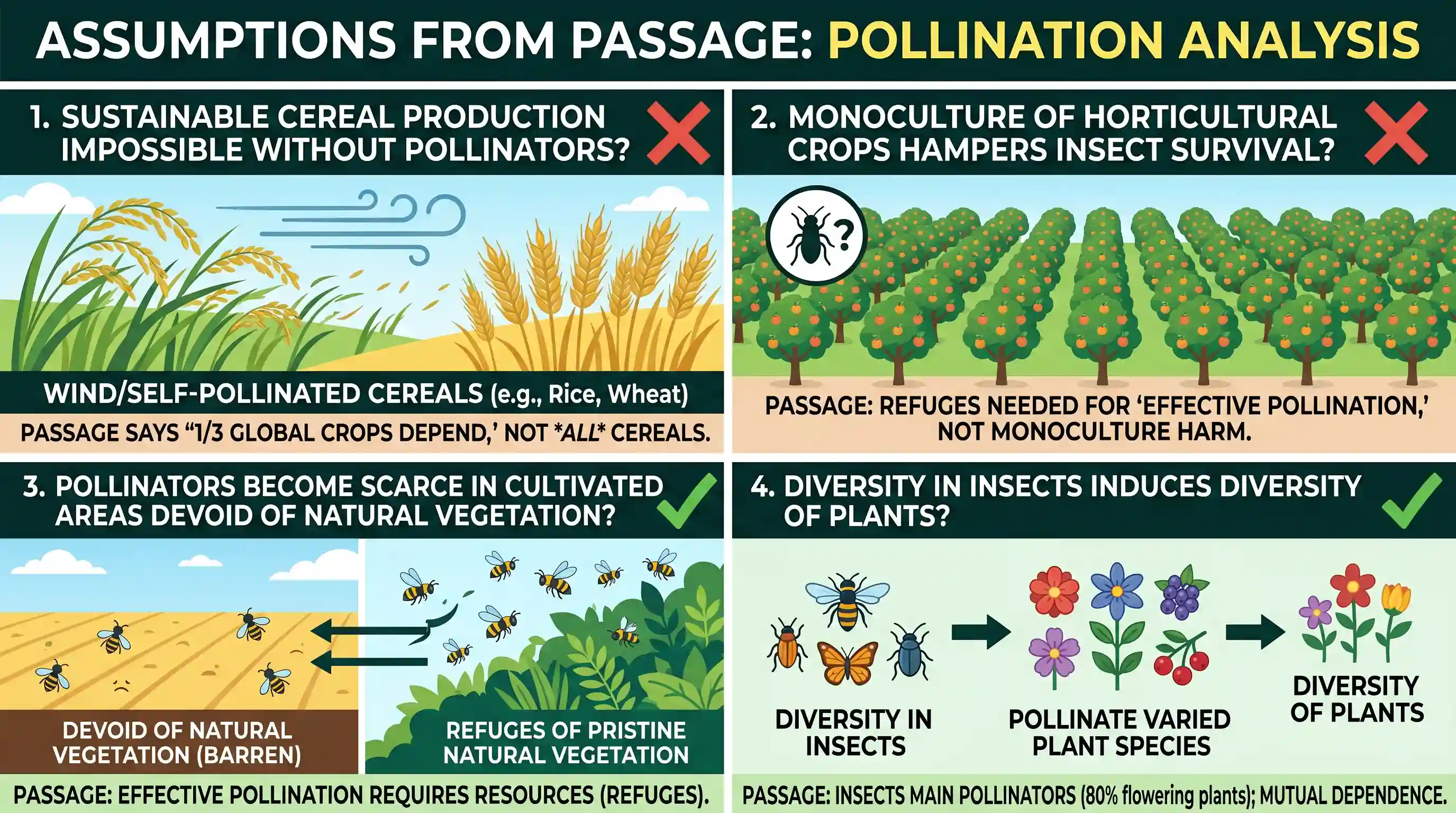
Sustainable production of India's cereal food grains is impossible without the diversity of pollinating animals.
- The passage states that "At least one-third of the world's agricultural crops depend upon pollination." It does not specify which crops (e.g., cereals vs. fruits/vegetables) nor does it claim that all cereal food grains depend on animal pollination. Many major cereal crops (like rice, wheat, corn) are wind-pollinated or self-pollinated. Therefore, claiming "impossible" for "India's cereal food grains" is too strong and not supported by the passage. This assumption is invalid.
-
Monoculture of horticultural crops hampers the survival of insects.
- The passage mentions that "Effective pollination requires resources, such as refuges of pristine natural vegetation." While monoculture (growing a single crop) often implies a lack of diverse natural vegetation, the passage does not explicitly state that monoculture of horticultural crops directly "hampers the survival of insects." It's an inference that goes beyond the direct statements in the text. This assumption is invalid.
-
Pollinators become scarce in cultivated areas devoid of natural vegetation.
- The passage states, "Effective pollination requires resources, such as refuges of pristine natural vegetation." If an area is "devoid of natural vegetation," it lacks these essential resources. It logically follows that the pollinators, which depend on these resources for effective pollination, would become scarce in such areas. This assumption is directly supported by the passage.
-
Diversity in insects induces diversity of plants.
- The passage highlights that "Approximately 80 percent of all flowering plant species are pollinated by animals... but the main pollinators are insects." It also states, "Pollination is an essential service that is the result of intricate relationships between plants and animals, and the reduction or loss of either affects the survival of both." If insects are crucial for the survival and diversity of plants, and different insects pollinate different plant species, then a diversity of insects would naturally support and induce a diversity of plants. This assumption is a logical extension of the intricate relationship and mutual dependence described.
Therefore, only assumptions 3 and 4 are valid.
Related questions
More UPSC Prelims practice from the same subject and topic.
- Prelims 2021CSATReading Comprehension
India faces a challenging immediate future in energy and climate policy- making. The problems are multiple: sputtering fossil fuel production capabilities; limited access to electricity and modern coo…
- Prelims 2021CSATReading Comprehension
There are reports that some of the antibiotics sold in the market are fed to poultry and other livestock as growth promoters. Overusing these substances can create superbugs, pathogens that are resist…
- Prelims 2021CSATReading Comprehension
Policymakers and media have placed the blame for skyrocketing food prices on a variety of factors, including high fuel prices, bad weather in key food producing countries, and the diversion of land to…
- Prelims 2021CSATReading Comprehension
A central message of modern development economics is the importance of income growth, by which is meant growth in Gross Domestic Product (GDP). In theory, rising GDP creates employment and investment …
- Prelims 2021CSATReading Comprehension
Researchers simulated street lighting on artificial grassland plots containing pea- aphids, sap- sucking insects, at night. These were exposed to two different types of light - a white light similar t…
- Prelims 2021CSATReading Comprehension
A study conducted on the impacts of climate change over the Cauvery basin of Tamil Nadu using regional climate models showed an increasing trend for maximum and minimum temperatures, and a decrease in…