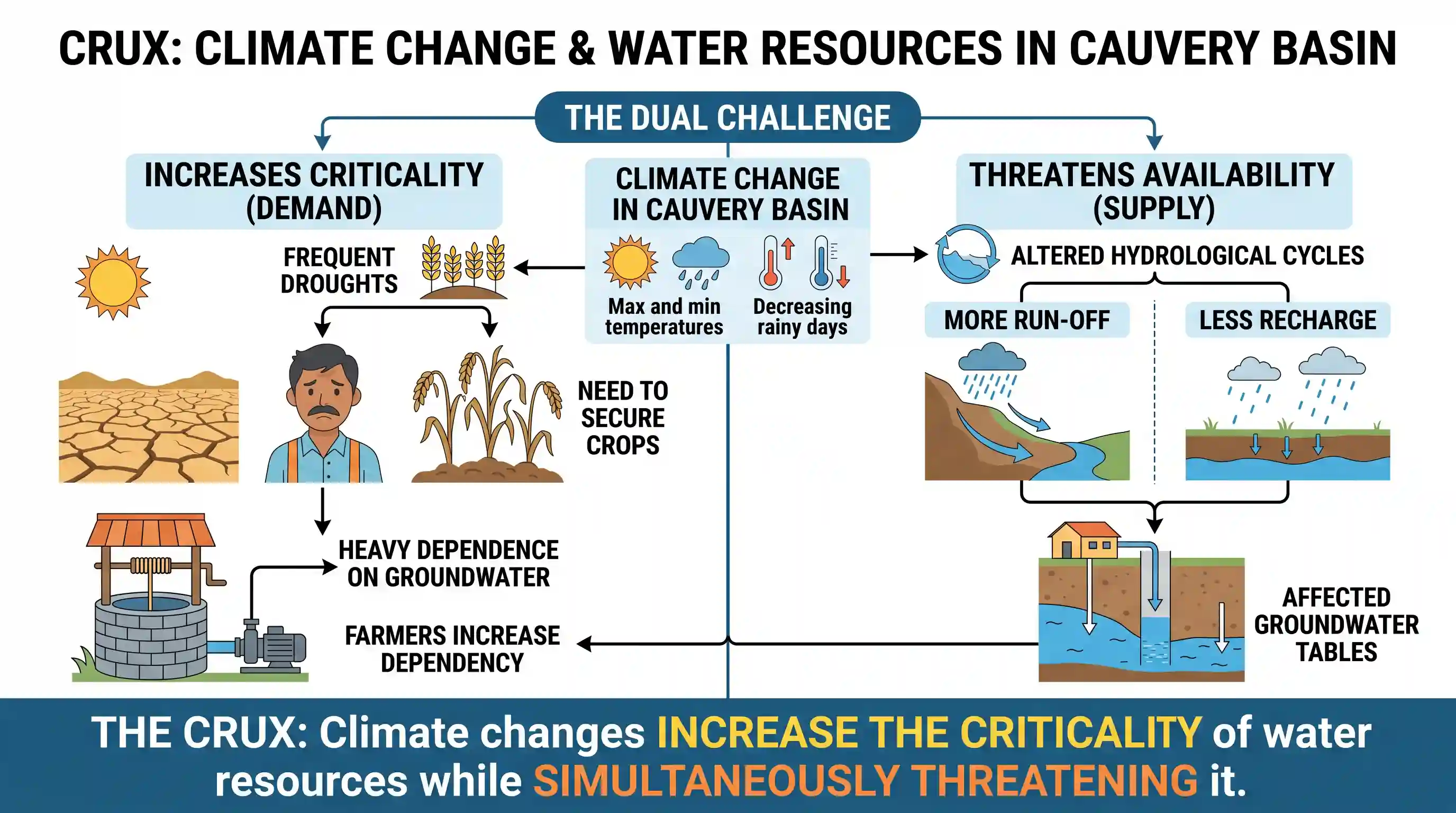
A study conducted on the impacts of climate change over the Cauvery basin of Tamil Nadu using regional climate models showed an increasing trend for maximum and minimum temperatures, and a decrease in the number of rainy days. These climatic shifts will have an impact on the hydrological cycles in the region, lead to more run- off and less recharge, and affect the groundwater tables. Further, there has been an increase in the frequency of droughts in the State. This has driven farmers to increase dependency on groundwater resources to secure their crops. Which one of the following statements best reflects the crux of the passage given above?

- ADevelopment of regional climate models helps in choosing climate-smart agricultural practices
- BHeavy dependence on groundwater resources can be reduced by adopting dry-land cropping systems
- CClimate changes increase the criticality of water resources while simultaneously threatening itCorrect
- DClimate changes cause the farmers to adopt unsustainable livelihoods and risky coping strategies.
Explanation
The passage describes how climate change (increasing temperatures, fewer rainy days) in the Cauvery basin leads to hydrological shifts (more run-off, less recharge, affected groundwater). This causes increased frequency of droughts, making water resources more critical for farmers, who then increase their dependency on groundwater. This increased dependency further threatens the already stressed groundwater tables.
Analyzing the options:
A) Development of regional climate models helps in choosing climate-smart agricultural practices: The passage mentions the use of regional climate models but does not discuss their utility in choosing agricultural practices. This is not the main point.
B) Heavy dependence on groundwater resources can be reduced by adopting dry-land cropping systems: The passage identifies heavy dependence on groundwater as a problem but does not offer solutions or discuss alternative cropping systems. This goes beyond the scope of the passage.
C) Climate changes increase the criticality of water resources while simultaneously threatening it: This statement perfectly captures the essence. Climate change leads to droughts and less recharge, making water resources more vital and critical (increased criticality). At the same time, it causes more run-off, less recharge, affects groundwater tables, and forces farmers to over-extract groundwater, thereby threatening the availability and sustainability of these very resources.
D) Climate changes cause the farmers to adopt unsustainable livelihoods and risky coping strategies: While farmers' increased dependency on groundwater is an unsustainable coping strategy, this option focuses only on the farmers' response. The passage's crux is broader, encompassing the direct impact of climate change on hydrological cycles and the overall water resource situation, not just the farmers' actions. Option C provides a more comprehensive summary of the entire situation described.
Therefore, C best reflects the crux of the passage.
Related questions
More UPSC Prelims practice from the same subject and topic.
- Prelims 2021CSATReading Comprehension
India faces a challenging immediate future in energy and climate policy- making. The problems are multiple: sputtering fossil fuel production capabilities; limited access to electricity and modern coo…
- Prelims 2021CSATReading Comprehension
There are reports that some of the antibiotics sold in the market are fed to poultry and other livestock as growth promoters. Overusing these substances can create superbugs, pathogens that are resist…
- Prelims 2021CSATReading Comprehension
Policymakers and media have placed the blame for skyrocketing food prices on a variety of factors, including high fuel prices, bad weather in key food producing countries, and the diversion of land to…
- Prelims 2021CSATReading Comprehension
A central message of modern development economics is the importance of income growth, by which is meant growth in Gross Domestic Product (GDP). In theory, rising GDP creates employment and investment …
- Prelims 2021CSATReading Comprehension
Researchers simulated street lighting on artificial grassland plots containing pea- aphids, sap- sucking insects, at night. These were exposed to two different types of light - a white light similar t…
- Prelims 2021CSATReading Comprehension
Approximately 80 percent of all flowering plant species are pollinated by animals, including birds and mammals, but the main pollinators are insects. Pollination is responsible for providing us with a…