A central message of modern development economics is the importance of income growth, by which is meant growth in Gross Domestic Product (GDP). In theory, rising GDP creates employment and investment opportunities. As incomes grow in a country where the level of GDP was once low, households, communities, and governments are increasingly able to set aside some funds for the production of things that make for a good life. Today GDP has assumed such a significant place in the development lexicon, that if someone mentions "economic growth", we know they mean growth in GDP. With reference to the above passage, the following assumptions have been made: 1. Rising GDP is essential for a country to be a developed country. 2. Rising GDP guarantees a reasonable distribution of income to all households. Which of the above assumptions is/are valid?

- A1 only
- B2 only
- CBoth 1 and 2
- DNeither 1 nor 2Correct
Explanation
The passage discusses the importance of GDP growth in modern development economics, highlighting its role in creating opportunities and enabling funds for a "good life."
Let's analyze each assumption:
-
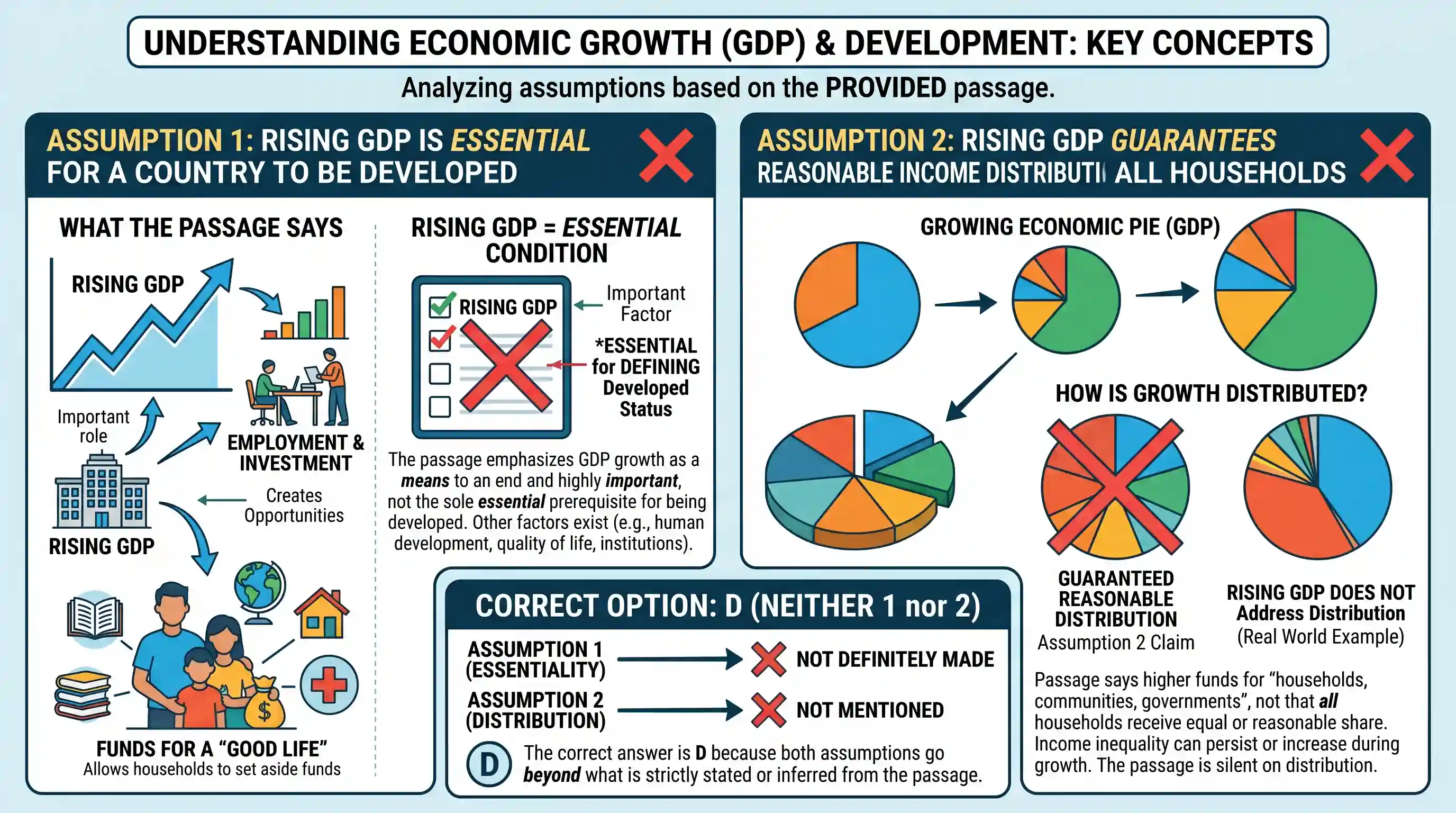
Rising GDP is essential for a country to be a developed country. The passage states that GDP growth is a "central message" and "important" for development, allowing funds to be set aside for a "good life." While GDP growth is generally considered a crucial factor in a country's development trajectory and for achieving characteristics of a developed country, the passage does not explicitly state or assume that it is the sole essential prerequisite for a country to be developed. It emphasizes its importance and enabling power, but "essential" is a very strong claim that the passage does not make. A country's developed status can also depend on other factors like human development, institutional strength, and quality of life, even if its GDP growth is not always high. Therefore, this assumption is not definitively made by the passage.
-
Rising GDP guarantees a reasonable distribution of income to all households. The passage mentions that rising GDP creates employment and investment opportunities, and allows "households, communities, and governments" to set aside funds. However, it makes no mention whatsoever of income distribution or whether the benefits of rising GDP are shared reasonably among all households. In fact, economic growth can sometimes be accompanied by increasing income inequality. The passage is silent on this aspect. Therefore, this assumption is not made by the passage.
Since neither assumption is valid based on the provided passage, the correct answer is D.
Related questions
More UPSC Prelims practice from the same subject and topic.
- Prelims 2021CSATReading Comprehension
India faces a challenging immediate future in energy and climate policy- making. The problems are multiple: sputtering fossil fuel production capabilities; limited access to electricity and modern coo…
- Prelims 2021CSATReading Comprehension
There are reports that some of the antibiotics sold in the market are fed to poultry and other livestock as growth promoters. Overusing these substances can create superbugs, pathogens that are resist…
- Prelims 2021CSATReading Comprehension
Policymakers and media have placed the blame for skyrocketing food prices on a variety of factors, including high fuel prices, bad weather in key food producing countries, and the diversion of land to…
- Prelims 2021CSATReading Comprehension
Researchers simulated street lighting on artificial grassland plots containing pea- aphids, sap- sucking insects, at night. These were exposed to two different types of light - a white light similar t…
- Prelims 2021CSATReading Comprehension
Approximately 80 percent of all flowering plant species are pollinated by animals, including birds and mammals, but the main pollinators are insects. Pollination is responsible for providing us with a…
- Prelims 2021CSATReading Comprehension
A study conducted on the impacts of climate change over the Cauvery basin of Tamil Nadu using regional climate models showed an increasing trend for maximum and minimum temperatures, and a decrease in…