Read the following passage and answer the items that follow. Your answers to these items should be based on the passages only In the immediate future, we will see the increasing commodification of many new technologies - artificial intelligence and robotics, 3D manufacturing, custom made biological and pharmaceutical products, lethal autonomous weapons and driverless cars. This will pose conundrums. The moral question of how a driverless car will decide between hitting a jaywalker and swerving and damaging the car has often been debated. The answer is both simple - save the human life - and complex. At which angle should the car swerve - just enough to save. the jaywalker or more than enough? If the driverless car is in Dublin, who would take the decision? The Irish Government, or the car's original code writer in California, or a software programmer in Hyderabad to whom maintenance is outsourced? If different national jurisdictions have different fine print on prioritising a human life, how will it affect insurance and investment decisions, including transnational ones? Which of the following statements best reflect the rational, plausible and practical implications that can be derived from the passage given above? 1. Too much globalization is not in the best interests of any country. 2. Modern technologies are increasingly blurring the economic borders. 3. Innovation and capital have impinged on the domain of the State. 4. Public policy of every country should focus on developing its own supply chains. 5. Geopolitics will have to reconcile to many ambiguities and uncertainties. Select the correct answer using the code given below:

- A1, 4 and 6 only
- B1, 2, 3 and 4 only
- C2, 3 and 5 onlyCorrect
- D1, 2, 3, 4 and 5
Explanation
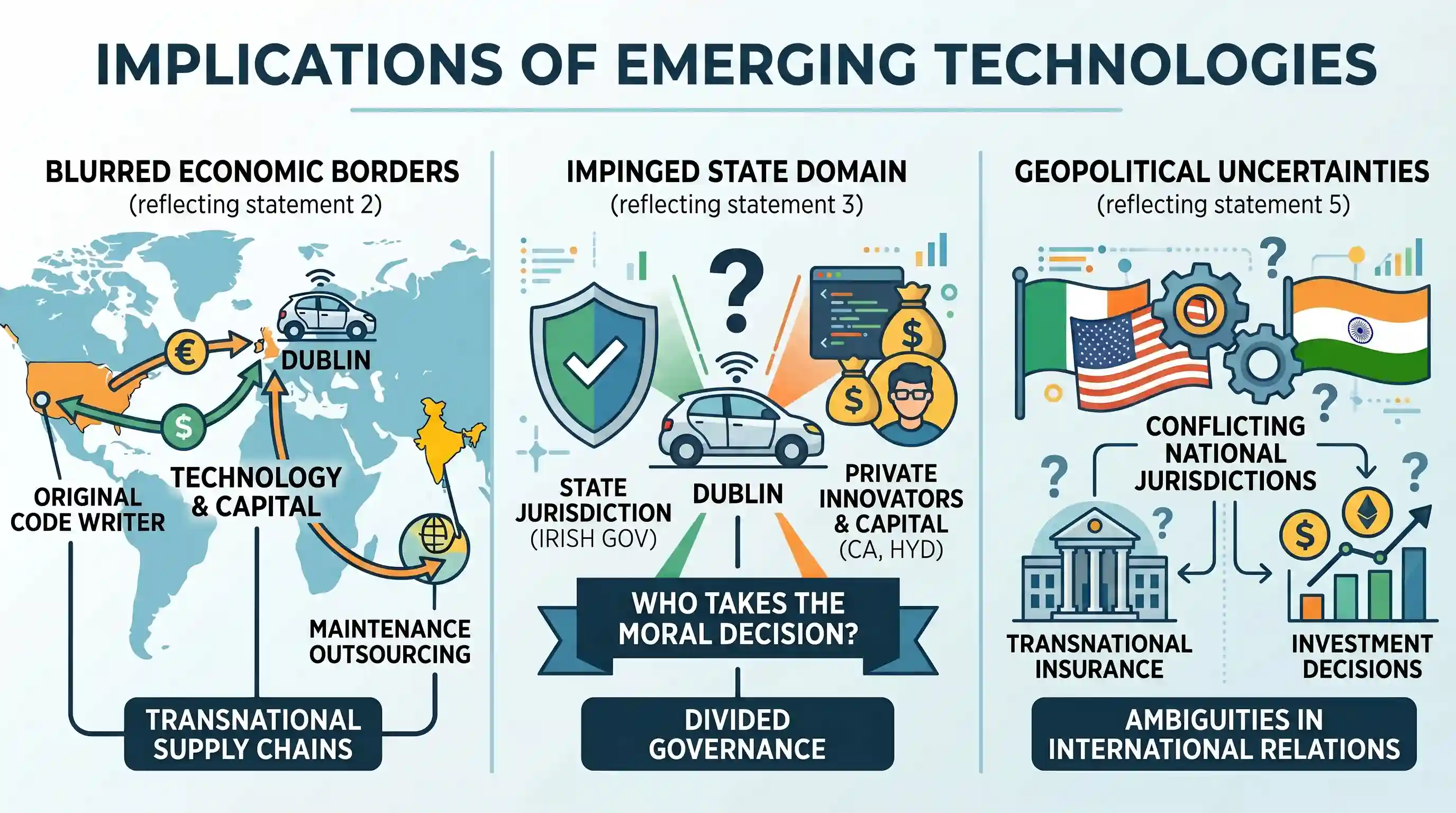
The passage discusses the increasing commodification of new technologies and the complex "conundrums" they pose, using the example of a driverless car. It highlights issues like moral decision-making, conflicting national jurisdictions (Dublin, California, Hyderabad), and their impact on insurance and investment across borders.
Let's analyze each statement:
-
Too much globalization is not in the best interests of any country. The passage describes challenges arising from cross-border technology and decision-making, but it does not make a normative judgment that globalization itself is inherently bad or "too much." It points out the problems created by technology operating globally, not a general condemnation of globalization. Thus, this statement is too strong and not directly derivable as a primary implication.
-
Modern technologies are increasingly blurring the economic borders. The example of a driverless car involving decision-makers and jurisdictions in Dublin, California, and Hyderabad, and the mention of "transnational" insurance and investment decisions, clearly illustrates how technology transcends national boundaries and creates economic interdependencies and complexities across borders. This directly implies the blurring of economic borders.
-
Innovation and capital have impinged on the domain of the State. The passage explicitly asks, "If the driverless car is in Dublin, who would take the decision? The Irish Government, or the car's original code writer in California, or a software programmer in Hyderabad...?" This directly questions the traditional authority and decision-making power of the State in regulating and controlling such matters, showing how technological innovation and the associated capital (investment, insurance) challenge the State's domain.
-
Public policy of every country should focus on developing its own supply chains. The passage identifies problems and complexities arising from globalized technology. It does not offer specific policy prescriptions or solutions like focusing on developing domestic supply chains. This is an external recommendation not directly derived from the passage's focus on identifying the "conundrums."
-
Geopolitics will have to reconcile to many ambiguities and uncertainties. The passage details "conundrums," "moral questions," conflicts in "national jurisdictions," and their impact on "transnational" decisions. These are all issues that directly affect international relations and the interactions between states (geopolitics). The lack of clear answers and the complex, cross-border nature of these problems inherently create "ambiguities and uncertainties" that geopolitics will need to address.
Based on this analysis, statements 2, 3, and 5 are rational, plausible, and practical implications directly derivable from the passage.
The final answer is C
Related questions
More UPSC Prelims practice from the same subject and topic.
- Prelims 2021CSATReading Comprehension
India faces a challenging immediate future in energy and climate policy- making. The problems are multiple: sputtering fossil fuel production capabilities; limited access to electricity and modern coo…
- Prelims 2021CSATReading Comprehension
There are reports that some of the antibiotics sold in the market are fed to poultry and other livestock as growth promoters. Overusing these substances can create superbugs, pathogens that are resist…
- Prelims 2021CSATReading Comprehension
Policymakers and media have placed the blame for skyrocketing food prices on a variety of factors, including high fuel prices, bad weather in key food producing countries, and the diversion of land to…
- Prelims 2021CSATReading Comprehension
A central message of modern development economics is the importance of income growth, by which is meant growth in Gross Domestic Product (GDP). In theory, rising GDP creates employment and investment …
- Prelims 2021CSATReading Comprehension
Researchers simulated street lighting on artificial grassland plots containing pea- aphids, sap- sucking insects, at night. These were exposed to two different types of light - a white light similar t…
- Prelims 2021CSATReading Comprehension
Approximately 80 percent of all flowering plant species are pollinated by animals, including birds and mammals, but the main pollinators are insects. Pollination is responsible for providing us with a…