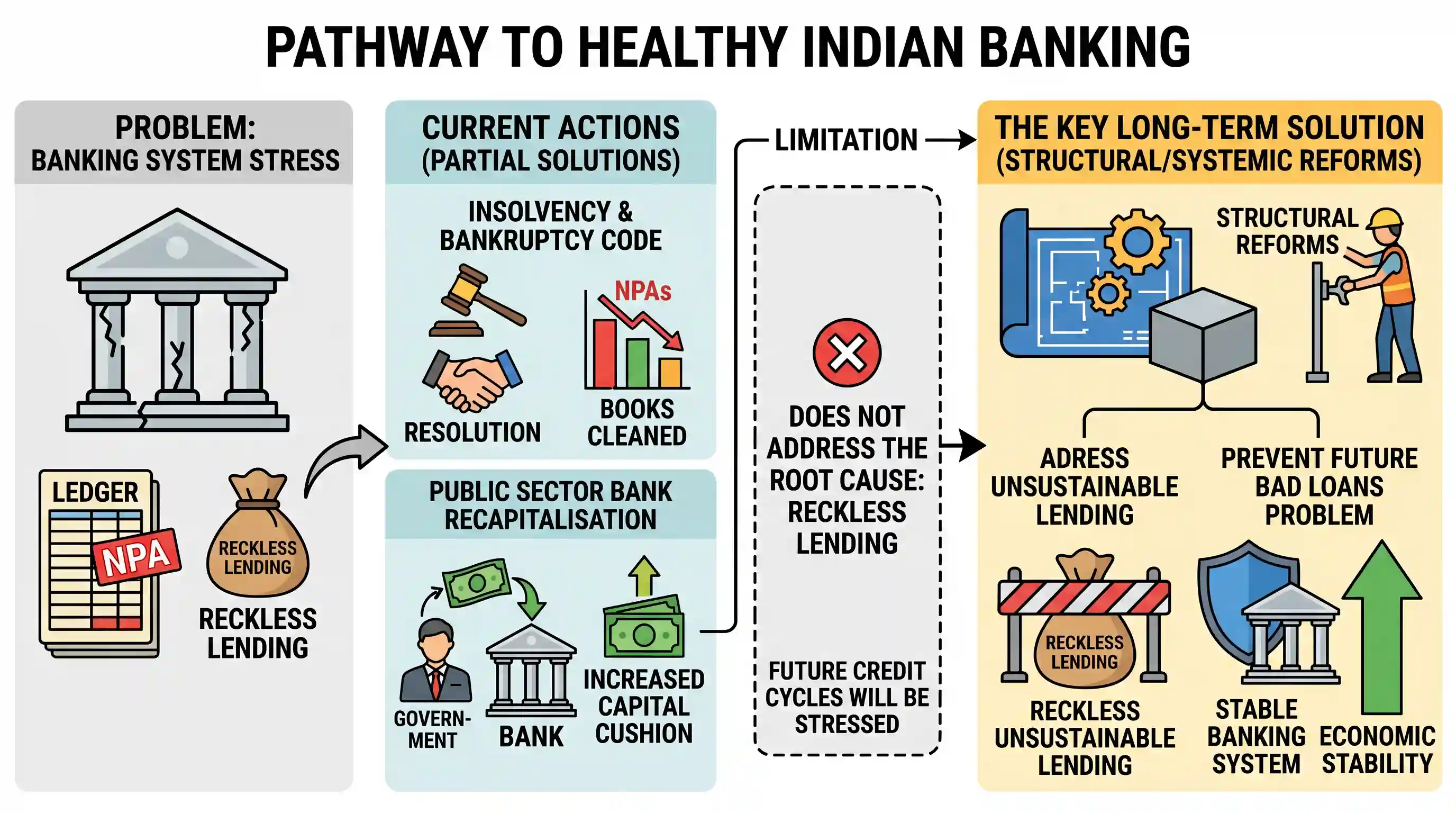
Read the following passage and answer the items that follow. Your answers to these items should be based on the passages only The resolution of bankruptcy cases of Indian banks under the Insolvency and Bankruptcy Code should help bring non- performing assets (NPA) situation under some control. Despite the slow pace of resolutions by the National Company Law Tribunal, the Code can be helpful in cleaning up bank books in future credit cycles. The recapitalisation of public sector banks too can help increase the capital cushion of banks and induce them to lend more and boost economic activity. But bad debt resolution and recapitalisation are only a part of the solution as they, by themselves, can do very little to rein in reckless lending that has pushed the Indian banking system to its current sorry state. Unless there are systemic reforms that address the problem of unsustainable lending, future credit cycles will continue to stress the banking system. Which one of the following statements best reflects the most logical, rational and practical suggestion implied by the passage given above?

- ALending by the banks should be closely monitored and regulated by the Central Government
- BInterest rates should be kept low so as to induce banks to lend more, promote credit growth and thereby boost economic activity
- CMerger of many banks into a few large banks alone is the long-term solution to make them viable and prevent their bad performance
- DIndian banking system requires structural as a long-term solution for bad loans problemCorrect
Explanation
The passage states that while immediate measures like bankruptcy resolution and recapitalisation help, they are "only a part of the solution." It explicitly says, "Unless there are systemic reforms that address the problem of unsustainable lending, future credit cycles will continue to stress the banking system."
Let's analyze the options:
A) Lending by the banks should be closely monitored and regulated by the Central Government. While monitoring and regulation might be part of systemic reforms, the passage emphasizes "systemic reforms" to address "unsustainable lending," which is broader than just central government monitoring. It doesn't specify the agency or the exact mechanism, just the need for systemic change.
B) Interest rates should be kept low so as to induce banks to lend more, promote credit growth and thereby boost economic activity. The passage mentions recapitalisation helping banks lend more, but immediately warns that these measures alone cannot rein in reckless lending. Promoting more lending (especially if reckless) by keeping interest rates low would contradict the passage's call to address "unsustainable lending."
C) Merger of many banks into a few large banks alone is the long-term solution to make them viable and prevent their bad performance. The passage does not mention bank mergers at all. This is an external idea not supported by the text.
D) Indian banking system requires structural as a long-term solution for bad loans problem. This option directly aligns with the passage's conclusion. "Systemic reforms" in the passage are synonymous with "structural" changes. The passage clearly states that these reforms are necessary to address "unsustainable lending" and prevent future stress in the banking system, which is a "long-term solution for bad loans problem." The passage highlights that current solutions are only partial and deeper changes are needed to tackle the root cause of reckless lending.
Therefore, option D best reflects the most logical, rational, and practical suggestion implied by the passage.
Related questions
More UPSC Prelims practice from the same subject and topic.
- Prelims 2021CSATReading Comprehension
India faces a challenging immediate future in energy and climate policy- making. The problems are multiple: sputtering fossil fuel production capabilities; limited access to electricity and modern coo…
- Prelims 2021CSATReading Comprehension
There are reports that some of the antibiotics sold in the market are fed to poultry and other livestock as growth promoters. Overusing these substances can create superbugs, pathogens that are resist…
- Prelims 2021CSATReading Comprehension
Policymakers and media have placed the blame for skyrocketing food prices on a variety of factors, including high fuel prices, bad weather in key food producing countries, and the diversion of land to…
- Prelims 2021CSATReading Comprehension
A central message of modern development economics is the importance of income growth, by which is meant growth in Gross Domestic Product (GDP). In theory, rising GDP creates employment and investment …
- Prelims 2021CSATReading Comprehension
Researchers simulated street lighting on artificial grassland plots containing pea- aphids, sap- sucking insects, at night. These were exposed to two different types of light - a white light similar t…
- Prelims 2021CSATReading Comprehension
Approximately 80 percent of all flowering plant species are pollinated by animals, including birds and mammals, but the main pollinators are insects. Pollination is responsible for providing us with a…