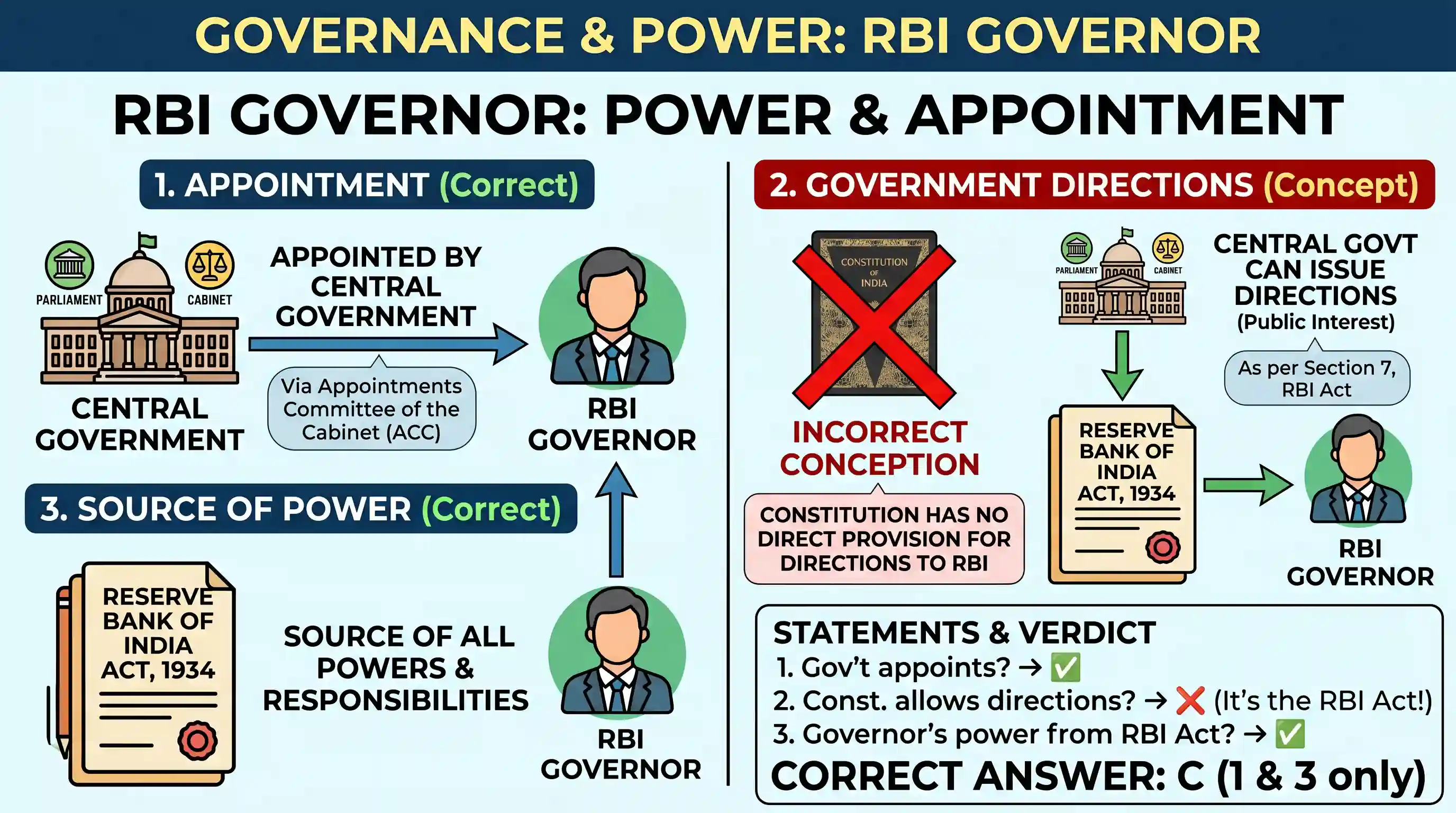
Consider the following statements: 1. The Governor of the Reserve Bank of India (RBI) is appointed by the Central Government. 2. Certain provisions in the Constitution of India give the Central Government the right to issue directions to the RBI in public interest. 3. The Governor of the RBI draws his power from the RBI Act. Which of the above statements are correct?

- A1 and 2 only
- B2 and 3 only
- C1 and 3 onlyCorrect
- D1, 2 and 3
Explanation
Statement 1: The Governor of the Reserve Bank of India (RBI) is appointed by the Central Government. This is a fundamental aspect of the RBI's governance structure, with the appointment being made by the Appointments Committee of the Cabinet (ACC).
Statement 2: While the Central Government does have powers to issue directions to the RBI in public interest (e.g., under Section 7 of the RBI Act, 1934), these provisions are laid down in the Reserve Bank of India Act, 1934, which is a statutory law, not directly in the Constitution of India. The Constitution lays down the framework of the state, but specific operational details for statutory bodies like the RBI are governed by acts of Parliament.
Statement 3: The powers, functions, and responsibilities of the Governor of the RBI, as well as the overall framework for the RBI's operations, are derived from the Reserve Bank of India Act, 1934. This Act defines the RBI's mandate and the authority of its top management.
Therefore, statements 1 and 3 are correct.
Related questions
More UPSC Prelims practice from the same subject and topic.
- Prelims 2021GS1polity-and-governance
With reference to casual workers employed in India, consider the following statements : 1. All casual workers are entitled for Employees Provident Fund coverage. 2. All casual workers are entitled for…
- Prelims 2021GS1polity-and-governance
With reference to the Union Government, consider the following statements : 1. N. Gopalaswamy Iyengar Committee suggested that a minister and a secretary be designated solely for pursuing the subject …
- Prelims 2021GS1polity-and-governance
Consider the following statements : 1. In India, there is no law restricting the candidates from contesting in one Lok Sabha election from three constituencies. 2. In 1991 Lok Sabha Election, Shri Dev…
- Prelims 2021GS1polity-and-governance
Consider the following statements : 1. 'Right to the City' is an agreed human right and the UN-Habitat monitors the commitments made by each country in this regard. 2. 'Right to the City' gives every …
- Prelims 2021GS1polity-and-governance
With reference to India, consider the following statements : 1. When a prisoner makes out a sufficient case, parole cannot be denied to such prisoner because it becomes a matter of his/her right. 2. S…
- Prelims 2021GS1polity-and-governance
At the national level, which ministry is the nodal agency to ensure effective implementation of the Scheduled Tribes and Other Traditional Forest Dwellers (Recognition of Forest Rights) Act, 2006?