With reference to Indian economy, demand-pull inflation can be caused/ increased by which of the following? 1. Expansionary policies 2. Fiscal stimulus 3. Inflation-indexing wages 4. Higher purchasing power 5. Rising interest rates Select the correct answer using the code given below.

- A1, 2 and 4 onlyCorrect
- B3, 4 and 5 only
- C1, 2, 3 and 5 only
- D1, 2, 3, 4 and 5
Explanation
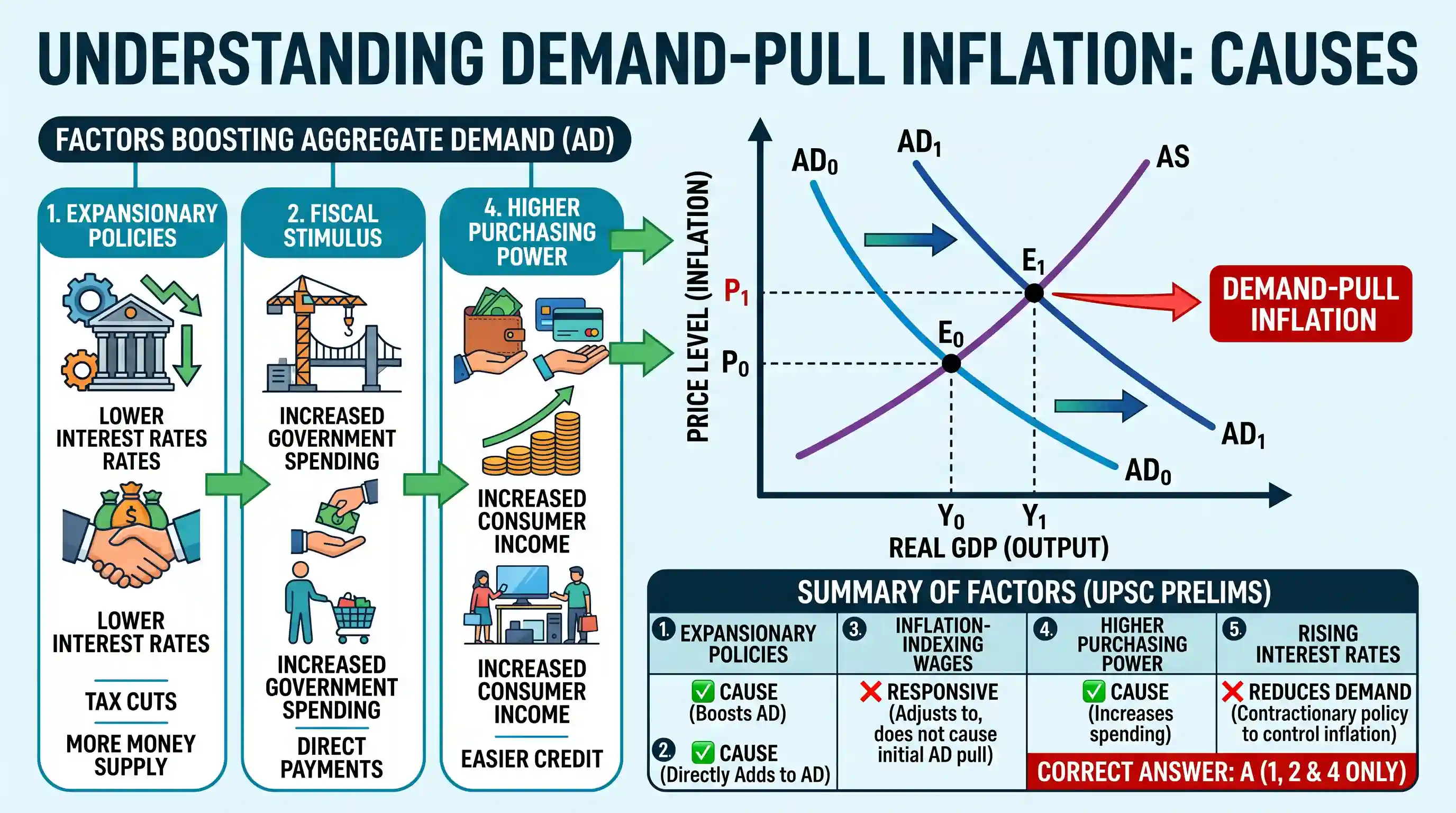
Demand-pull inflation occurs when aggregate demand in an economy outpaces the aggregate supply of goods and services, leading to a rise in prices.
-
Expansionary policies: Both expansionary fiscal policies (e.g., increased government spending, tax cuts) and expansionary monetary policies (e.g., lower interest rates, increased money supply) aim to stimulate aggregate demand. When demand increases significantly beyond the economy's productive capacity, it leads to demand-pull inflation. This is correct.
-
Fiscal stimulus: A fiscal stimulus package, which involves increased government spending or tax cuts, directly injects money into the economy and boosts aggregate demand. This can certainly cause or increase demand-pull inflation if not managed properly. This is correct.
-
Inflation-indexing wages: Inflation-indexing wages means that wages automatically adjust upwards with inflation. This is typically a response to existing inflation, aimed at protecting the real income of workers. While it can contribute to a wage-price spiral (a type of cost-push inflation) and perpetuate inflation, it's not a primary cause of demand-pull inflation stemming from an initial excess of aggregate demand. This is incorrect as a primary cause of demand-pull inflation.
-
Higher purchasing power: When consumers have higher purchasing power (e.g., due to increased incomes, easier credit), they tend to demand more goods and services. If this increased demand cannot be met by the existing supply, it will push prices up, leading to demand-pull inflation. This is correct.
-
Rising interest rates: Rising interest rates are a contractionary monetary policy tool used by central banks to curb inflation. Higher interest rates make borrowing more expensive, discouraging investment and consumption, thereby reducing aggregate demand. Therefore, rising interest rates would tend to reduce, not cause or increase, demand-pull inflation. This is incorrect.
Hence, factors 1, 2, and 4 can cause or increase demand-pull inflation.
Related questions
More UPSC Prelims practice from the same subject and topic.
- Prelims 2021GS1economy
Which among the following steps is most likely to be taken at the time of an economic recession?
- Prelims 2021GS1economy
Consider the following statements: Other things remaining unchanged, market demand for a good might increase if 1. price of its substitute increases 2. price of its complement increases 3. the good is…
- Prelims 2021GS1economy
With reference to Urban Cooperative Banks' in India, consider the following statements : 1. They are supervised and regulated by local boards set up by the State Governments. 2. They can issue equity …
- Prelims 2021GS1economy
Indian Government Bond Yields are influenced by which of the following? 1. Actions of the United States Federal Reserve 2. Actions of the Reserve Bank of India 3. Inflation and short-term interest rat…
- Prelims 2021GS1economy
Consider the following : 1. Foreign currency convertible bonds 2. Foreign institutional investment with certain conditions 3. Global depository receipts 4. Non-resident external deposits Which of the …
- Prelims 2021GS1economy
Consider the following statements : The effect of devaluation of a currency is that it necessarily 1. improves the competitiveness of the domestic exports in the foreign markets 2. increases the forei…