What is blue carbon?

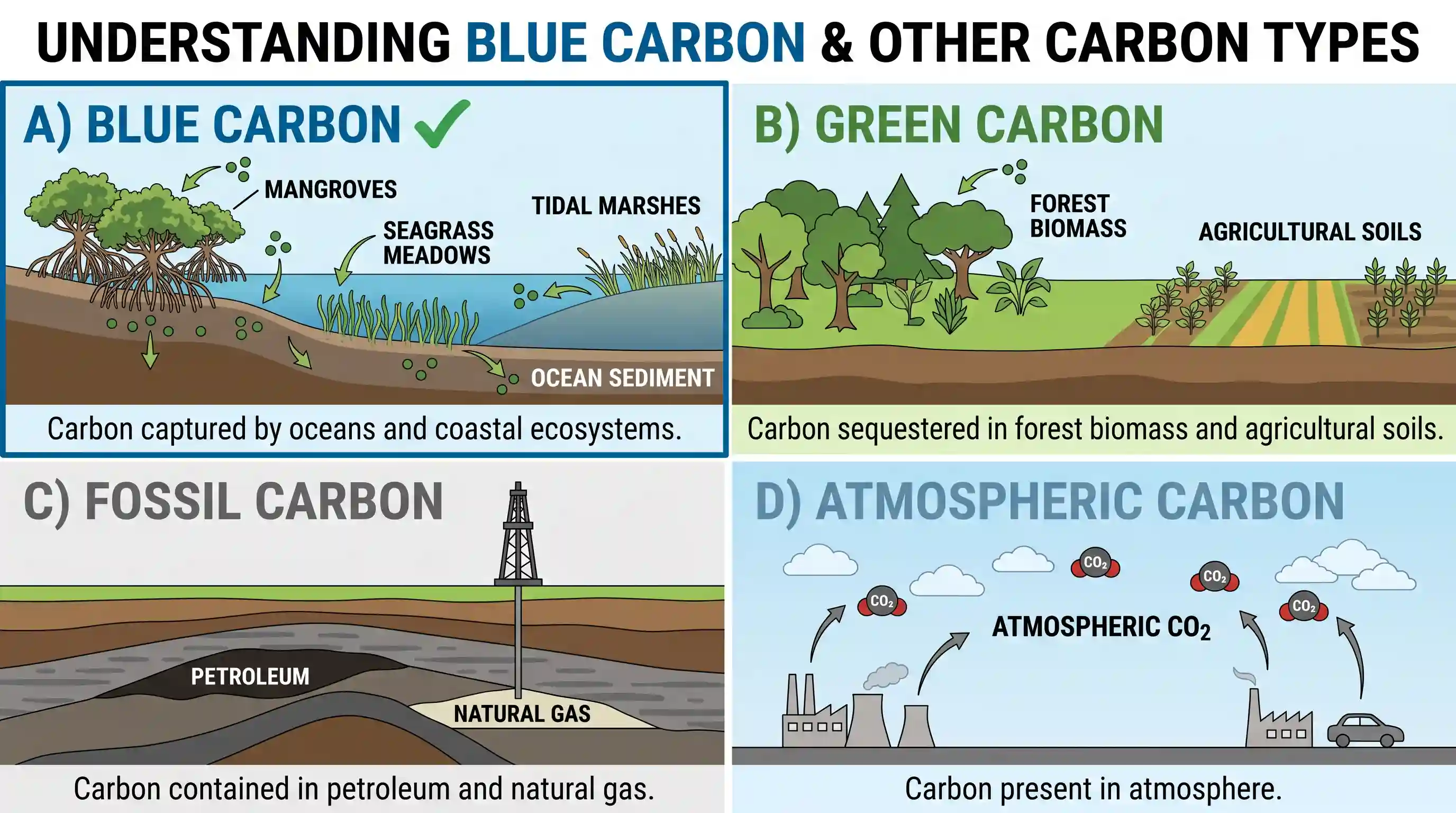
- ACarbon captured by oceans and coastal ecosystemsCorrect
- BCarbon sequestered in forest biomass and agricultural soils
- CCarbon contained in petroleum and natural gas
- DCarbon present in atmosphere
Explanation
Blue carbon refers to the carbon that is captured and stored by the world's ocean and coastal ecosystems. These ecosystems include tidal marshes, mangrove forests, seagrass meadows, and sometimes even deep-sea sediments. These 'blue carbon' ecosystems are highly efficient at sequestering carbon from the atmosphere and oceans, acting as significant carbon sinks. They play a crucial role in mitigating climate change by removing and storing large amounts of atmospheric carbon dioxide.
Options B, C, and D describe other forms of carbon or carbon reservoirs: carbon in forest biomass and agricultural soils is often referred to as 'green carbon'; carbon contained in petroleum and natural gas refers to fossil carbon; and carbon present in the atmosphere is atmospheric carbon dioxide.
Therefore, blue carbon specifically refers to carbon captured by oceans and coastal ecosystems.
Related questions
More UPSC Prelims practice from the same subject and topic.
- Prelims 2021GS1geography
'R2 Code of Practices' constitutes a tool available for promoting the adoption of
- Prelims 2021GS1geography
Why is there a concern about copper smelting plants? 1. They may release lethal quantities of carbon monoxide into environment. 2. The copper slag can cause the leaching of some heavy metals into envi…
- Prelims 2021GS1geography
In the nature, which of the following is/are most likely to be found surviving on a surface without soil? 1. Fern 2. Lichen 3. Moss 4. Mushroom Select the correct answer using the code given below.
- Prelims 2021GS1geography
Consider the following kinds of organisms : 1. Copepods 2. Cyanobacteria 3. Diatoms 4. Foraminifera Which of the above are primary producers in the food chains of oceans?
- Prelims 2021GS1geography
Consider the following animals : 1. Hedgehog 2. Marmot 3. Pangolin To reduce the chance of being captured by predators, which of the above organisms rolls up/roll up and protects/ protect its/their vu…
- Prelims 2021GS1geography
With reference to the 'New York Declaration on Forests', which of the following statements are correct? 1. It was first endorsed at the United Nations Climate Summit in 2014. 2. It endorses a global t…