In the nature, which of the following is/are most likely to be found surviving on a surface without soil? 1. Fern 2. Lichen 3. Moss 4. Mushroom Select the correct answer using the code given below.

- A1 and 4 only
- B2 only
- C2 and 3Correct
- D1, 3 and 4
Explanation
This question asks about organisms that can survive on surfaces without soil, often as pioneer species in ecological succession.
-
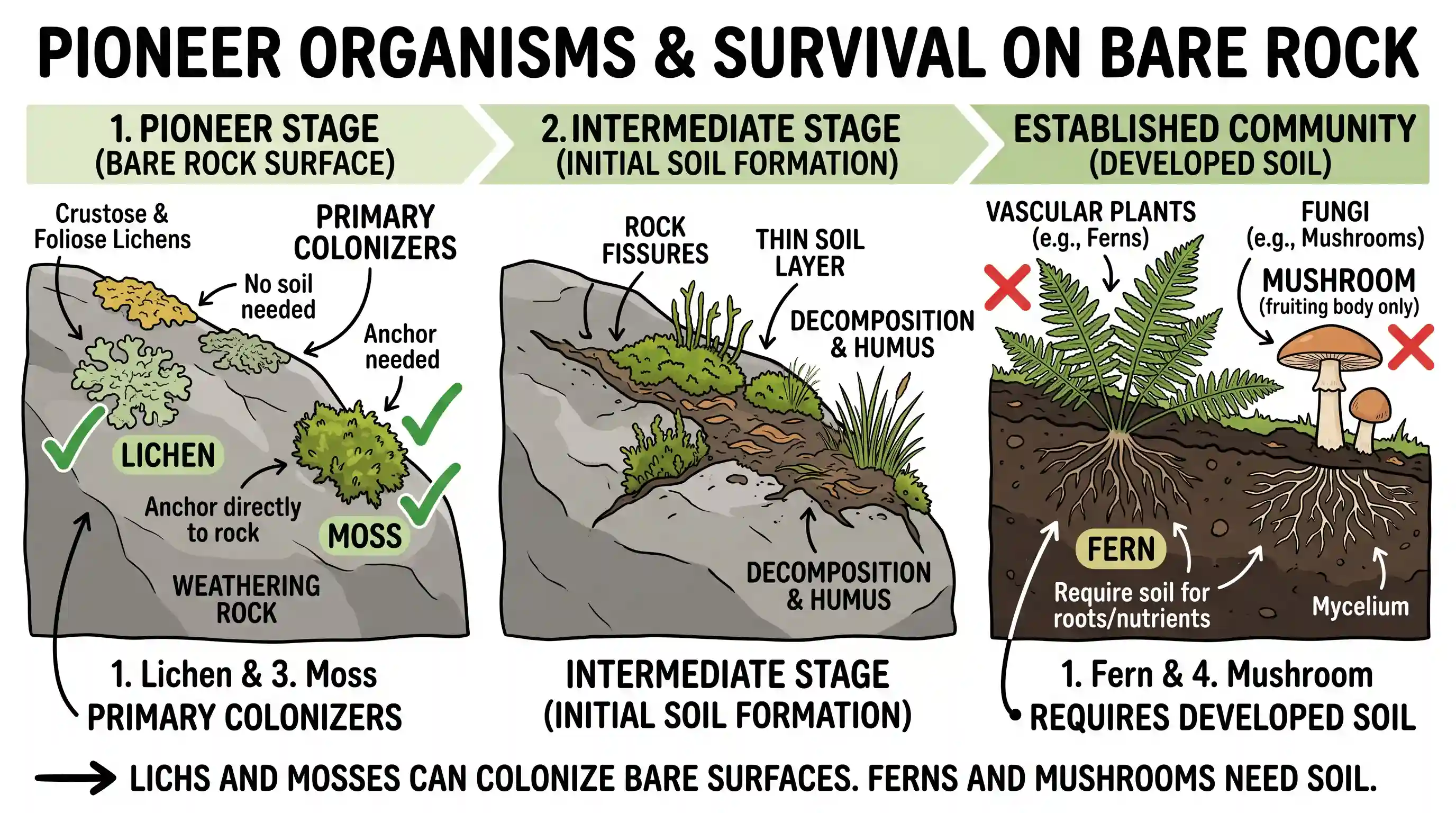
Fern: Ferns are vascular plants that typically require soil for their roots to anchor and absorb water and nutrients. While some grow on rocks or tree trunks as epiphytes, they generally need some accumulation of organic matter or moisture, not purely bare, dry surfaces without soil.
-
Lichen: Lichens are symbiotic organisms (a fungus and an alga or cyanobacterium) that are well-known as pioneer species. They can grow directly on bare rock surfaces, tree bark, and other harsh substrates where no soil is present. They obtain nutrients from the air and rain and contribute to the weathering of rocks, initiating soil formation. This is correct.
-
Moss: Mosses are non-vascular plants (bryophytes) that are often found growing on rocks, tree bark, and other surfaces with minimal or no soil. They absorb water and nutrients directly from their surroundings (rain, atmospheric moisture). They thrive in damp conditions and are important in early succession. This is correct.
-
Mushroom: Mushrooms are the fruiting bodies of fungi. Most fungi are decomposers that obtain nutrients by breaking down organic matter. While some fungi grow on dead wood, the fungal mycelial network typically requires a substrate rich in organic material. They are generally not found surviving directly on bare inorganic surfaces without soil or organic debris, unlike lichens and mosses.
Therefore, lichens and mosses are most likely to be found surviving on a surface without soil.
Related questions
More UPSC Prelims practice from the same subject and topic.
- Prelims 2021GS1geography
'R2 Code of Practices' constitutes a tool available for promoting the adoption of
- Prelims 2021GS1geography
Why is there a concern about copper smelting plants? 1. They may release lethal quantities of carbon monoxide into environment. 2. The copper slag can cause the leaching of some heavy metals into envi…
- Prelims 2021GS1geography
What is blue carbon?
- Prelims 2021GS1geography
Consider the following kinds of organisms : 1. Copepods 2. Cyanobacteria 3. Diatoms 4. Foraminifera Which of the above are primary producers in the food chains of oceans?
- Prelims 2021GS1geography
Consider the following animals : 1. Hedgehog 2. Marmot 3. Pangolin To reduce the chance of being captured by predators, which of the above organisms rolls up/roll up and protects/ protect its/their vu…
- Prelims 2021GS1geography
With reference to the 'New York Declaration on Forests', which of the following statements are correct? 1. It was first endorsed at the United Nations Climate Summit in 2014. 2. It endorses a global t…