In the context of hereditary diseases, consider the following statements : 1. Passing on mitochondrial diseases from parent to child can be prevented by mitochondrial replacement therapy either before or after in vitro fertilization of egg. 2. A child inherits mitochondrial diseases entirely from mother and not from father. Which of the statements given above is/are correct?

- A1 only
- B2 only
- CBoth 1 and 2Correct
- DNeither 1 nor 2
Explanation
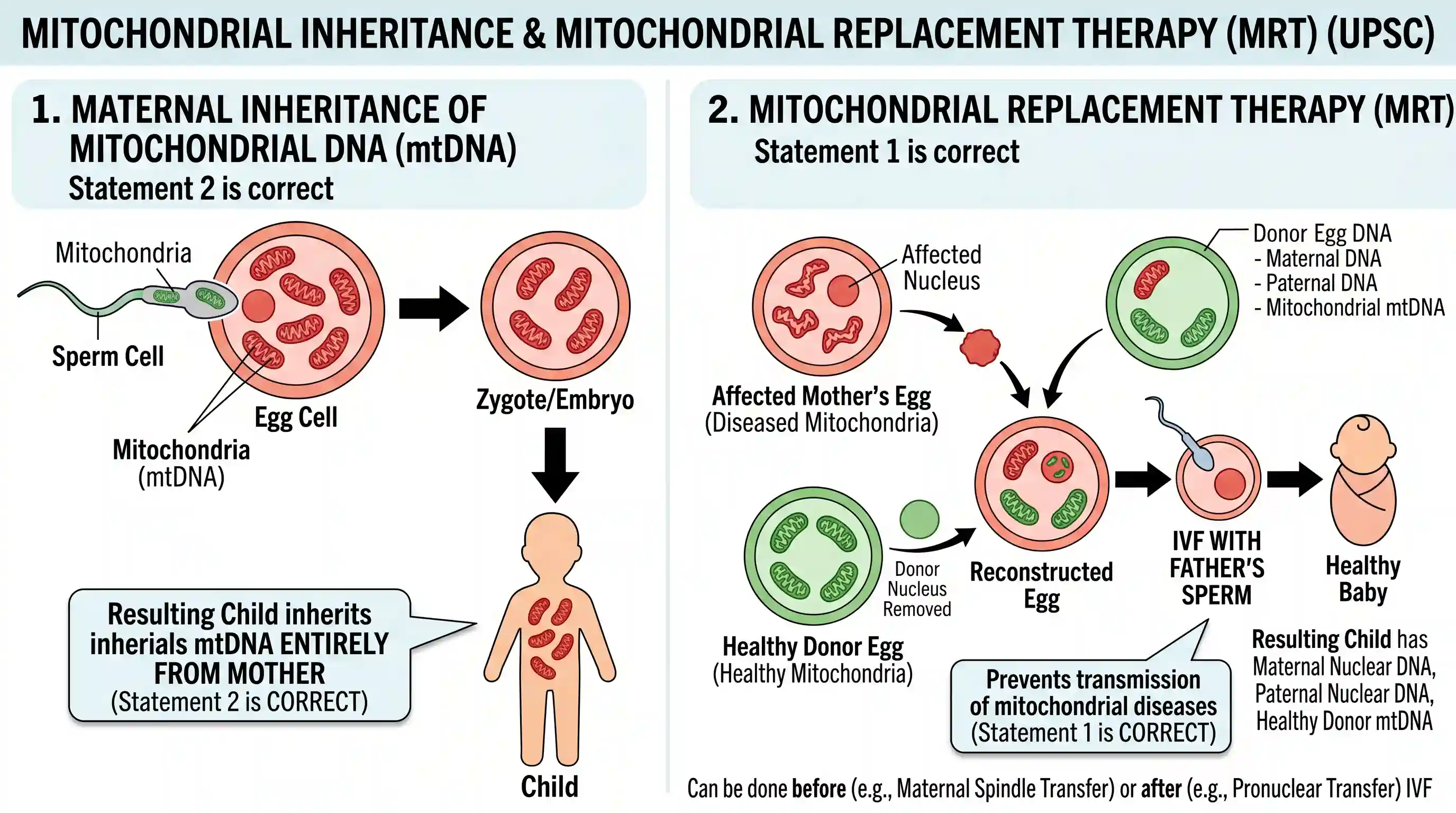
Statement 1 is correct: Mitochondrial replacement therapy (MRT) is a set of techniques aimed at preventing the transmission of mitochondrial diseases from a mother to her child. These techniques involve replacing a mother's unhealthy mitochondria with healthy ones from a donor egg. This can be performed either before (e.g., maternal spindle transfer) or after (e.g., pronuclear transfer) in vitro fertilization (IVF) of the egg, or even at the embryo stage.
Statement 2 is correct: Mitochondria are organelles within cells that contain their own DNA (mtDNA), separate from the nuclear DNA. During human reproduction, the egg cell contributes the vast majority, if not all, of the mitochondria to the zygote. Sperm cells contribute very few, if any, functional mitochondria to the embryo. Therefore, a child inherits mitochondrial diseases exclusively from the mother, not from the father.
Related questions
More UPSC Prelims practice from the same subject and topic.
- Prelims 2021GS1science-and-technology
With reference to recent developments regarding 'Recombinant Vector Vaccines', consider the following statements : 1. Genetic engineering is applied in the development of these vaccines. 2. Bacteria a…
- Prelims 2021GS1science-and-technology
Bollgard I and Bollgard II technologies are mentioned in the context of
- Prelims 2021GS1science-and-technology
Consider the following statements : 1. Adenoviruses have single-stranded DNA genomes whereas retroviruses have double-stranded DNA genomes. 2. Common cold is sometime caused by an adenovirus whereas A…
- Prelims 2021GS1science-and-technology
Which one of the following is used in preparing a natural mosquito repellent?
- Prelims 2021GS1science-and-technology
In a pressure cooker, the temperature at which the food is cooked depends mainly upon which of the following? 1. Area of the hole in the lid 2. Temperature of the flame 3. Weight of the lid Select the…
- Prelims 2021GS1science-and-technology
Consider the following : 1. Bacteria 2. Fungi 3. Virus Which of the above can be cultured in artificial/synthetic medium?