The digits 1 to 9 are arranged in three rows in such a way that each row contains three digits, and the number formed in the second row is twice the number formed in the first row; and the number formed in the third row is thrice the number formed in the first row. Repetition of digits is not allowed. If only three of the four digits 2, 3, 7 and 9 are allowed to use in the first row, how many such combinations are possible to be arranged in the three rows?

- A4
- B3
- C2Correct
- D1
Explanation
The problem requires finding a 3-digit number (let's call it N) such that:
- N, 2N, and 3N are all 3-digit numbers.
- All nine digits used across N, 2N, and 3N must be distinct and from 1 to 9 (no repetition, no 0s).
- The three digits forming N must be a subset of three digits chosen from {2, 3, 7, 9}.
Let's analyze the conditions:
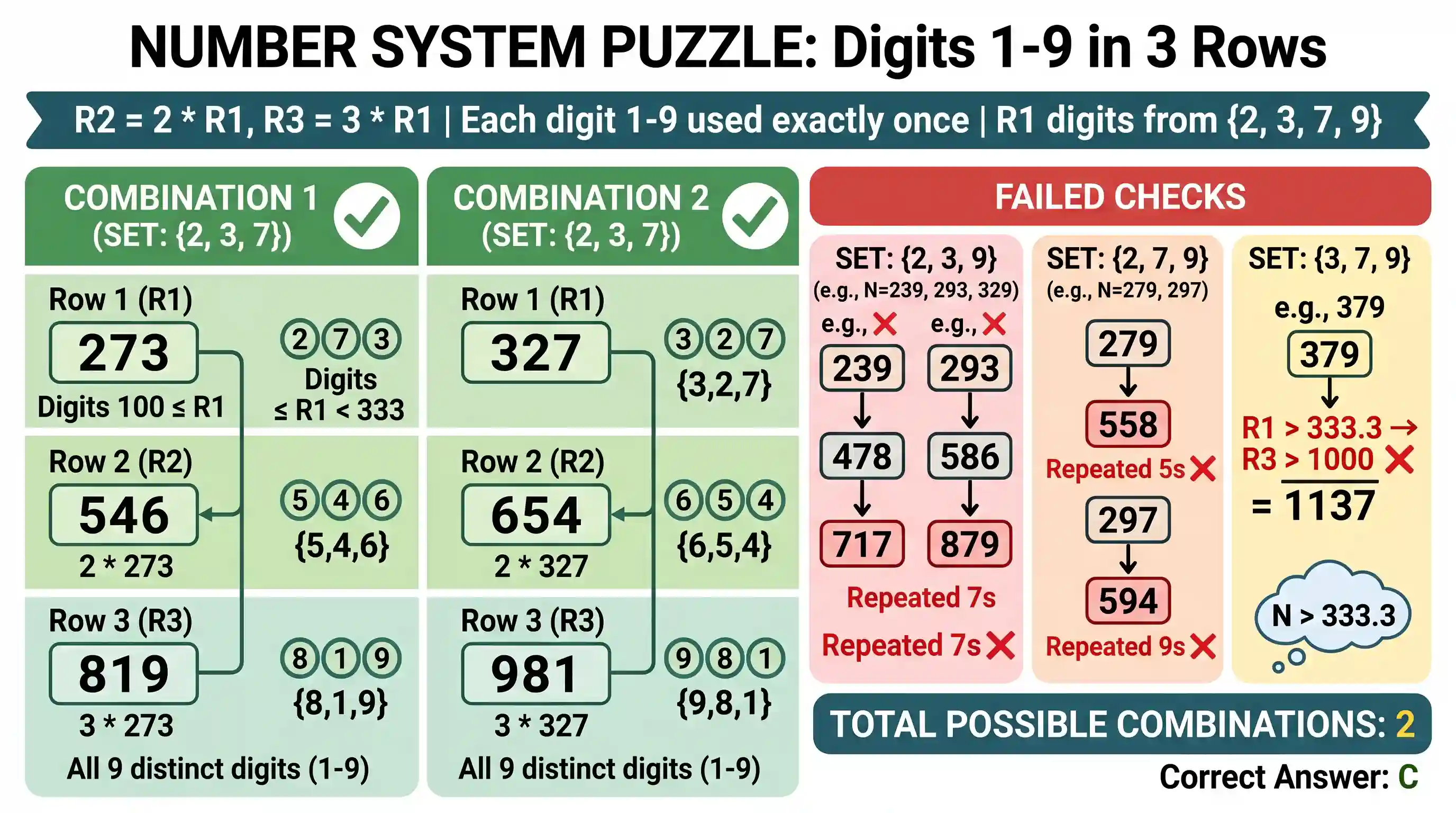
- Range for N: Since 3N must be a 3-digit number, 3N = 100. Thus, 100 333), etc., do not work.
Case 2: Digits for N are {2, 3, 9}
- N = 239: 2N = 478, 3N = 717 (digit 7 repeated). Invalid.
- N = 293: 2N = 586, 3N = 879 (digits 8 and 9 repeated). Invalid.
- N = 329: 2N = 658, 3N = 987 (digits 8 and 9 repeated). Invalid.
- Other permutations like 392 (N > 333) do not work.
Case 3: Digits for N are {2, 7, 9}
- N = 279: 2N = 558 (digit 5 repeated). Invalid.
- N = 297: 2N = 594 (digit 9 repeated). Invalid.
- Other permutations like 729 (N > 333) do not work.
Case 4: Digits for N are {3, 7, 9}
- All permutations of these digits (e.g., 379, 397) result in N > 333. Invalid.
Only two combinations satisfy all the conditions: N=273 and N=327.
The final answer is C) 2.
The final answer is C.
Related questions
More UPSC Prelims practice from the same subject and topic.
- Prelims 2022CSATQuantitative Aptitude
An Identity Card has the number ABCDEFG, not necessarily in that order, where each letter represents a distinct digit (1, 2, 4, 5, 7, 8, 9 only). The number is divisible by 9. After deleting the first…
- Prelims 2022CSATQuantitative Aptitude
Which number amongst 2⁴⁰, 3²¹, 4¹⁸ and 8¹² is the smallest?
- Prelims 2022CSATQuantitative Aptitude
How many 3-digit natural numbers (without repetition of digits) are there such that each digit is odd and the number is divisible by 5?
- Prelims 2022CSATQuantitative Aptitude
Consider the Question and two Statements given below : Question : Is x an integer? Statement- 1 : x / 3 is not an integer. Statement- 2 : 3 xis an integer. Which one of the following is correct in res…
- Prelims 2022CSATQuantitative Aptitude
How many seconds in total are there in x weeks, x days, x hours, x minutes and x seconds?
- Prelims 2022CSATQuantitative Aptitude
A person X wants to distribute some pens among six children A, B, C, D, E, and F. Suppose A gets twice the number of pens received by B, three times that of C, four times that of D, five times that of…