An Identity Card has the number ABCDEFG, not necessarily in that order, where each letter represents a distinct digit (1, 2, 4, 5, 7, 8, 9 only). The number is divisible by 9. After deleting the first digit from the right, the resulting number is divisible by 6. After deleting two digits from the right of original number, the resulting number is divisible by 5. After deleting three digits from the right of original number, the resulting number is divisible by 4. After deleting four digits from the right of original number, the resulting number is divisible by 3. After deleting five digits from the right of original number, the resulting number is divisible by 2. Which of the following is a possible value for the sum of the middle three digits of the number?

- A8Correct
- B9
- C11
- D12
Explanation
Here's a step-by-step breakdown to solve the problem:
-
Available Digits: The letters A, B, C, D, E, F, G represent distinct digits from {1, 2, 4, 5, 7, 8, 9}. There are 7 digits and the number has 7 positions, so all digits are used exactly once.
-
Divisibility by 9 (ABCDEFG): A number is divisible by 9 if the sum of its digits is divisible by 9. The sum of the given digits (1+2+4+5+7+8+9) is 36, which is divisible by 9. This rule is always satisfied.
-
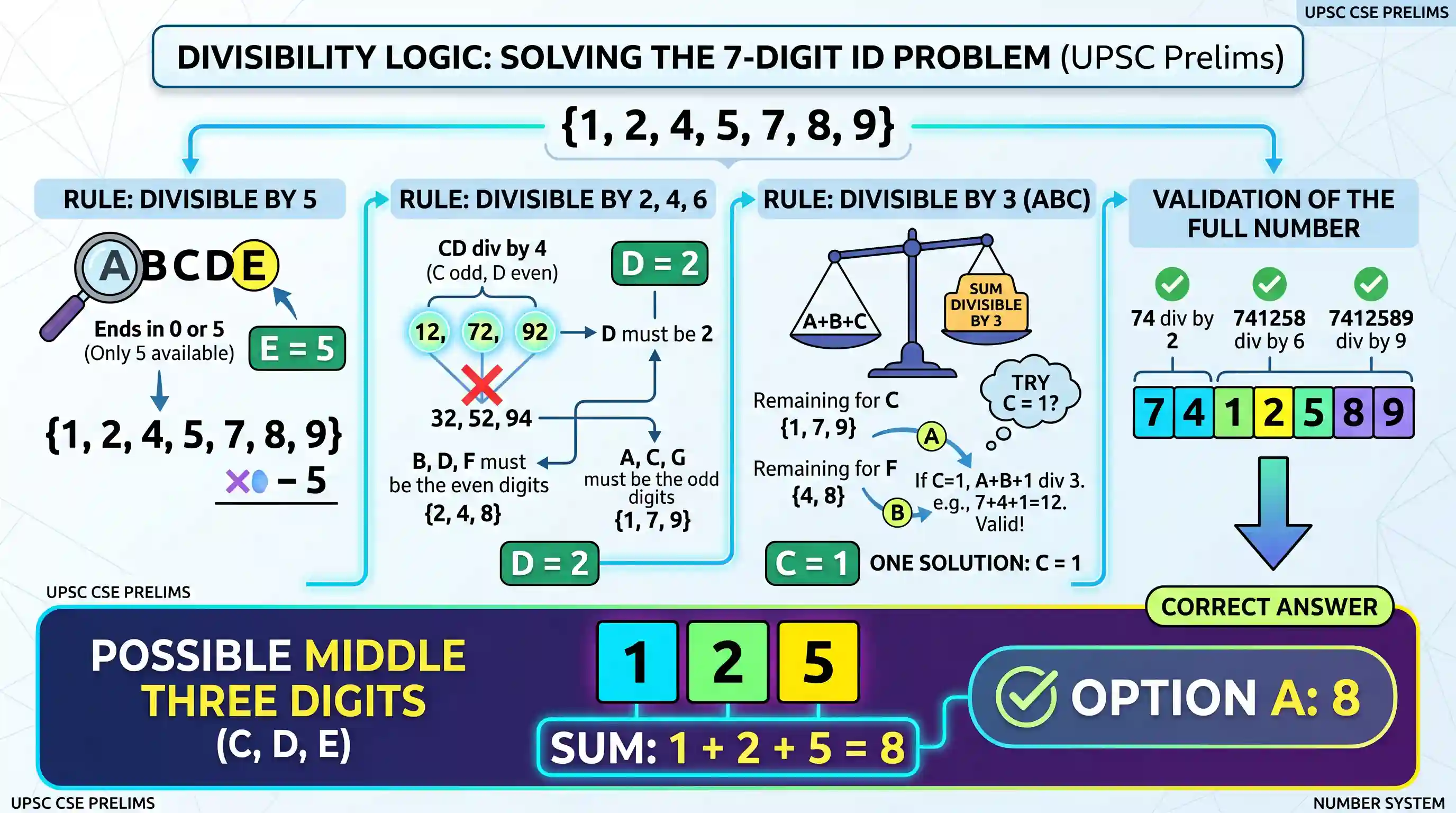
Divisibility by 5 (ABCDE): After deleting two digits from the right, ABCDE is divisible by 5. This means the last digit E must be 0 or 5. Since 0 is not in the available digits, E must be 5. So, E = 5.
-
Divisibility by 2 (AB): After deleting five digits from the right, AB is divisible by 2. This means B must be an even digit. So, B is from {2, 4, 8}.
-
Divisibility by 6 (ABCDEF): After deleting one digit from the right, ABCDEF is divisible by 6. This means F must be an even digit (for divisibility by 2) and the sum of its digits (A+B+C+D+E+F) must be divisible by 3. So, F is from {2, 4, 8}. Since B and F must be distinct digits, they are two different even digits from {2, 4, 8}. The third even digit from {2, 4, 8} must be D, A, C, or G.
-
Divisibility by 4 (ABCD): After deleting three digits from the right, ABCD is divisible by 4. This means the number formed by the last two digits, CD, must be divisible by 4.
- We know E=5. B and F are distinct even digits from {2, 4, 8}.
- Consider D:
- If D is an odd digit (from {1, 7, 9}): For CD to be divisible by 4, C must be an even digit. The only available even digit for C would be the 'third even digit' (the one not used by B or F). Let's test possible C and D combinations:
- If C=2: 21 (no), 27 (no), 29 (no).
- If C=4: 41 (no), 47 (no), 49 (no).
- If C=8: 81 (no), 87 (no), 89 (no). None of these result in a number divisible by 4. This means D cannot be odd.
- Therefore, D must be the 'third even digit' from {2, 4, 8}. This implies that {B, F, D} = {2, 4, 8}.
- Consequently, {A, C, G} must be the odd digits {1, 7, 9}.
- If D is an odd digit (from {1, 7, 9}): For CD to be divisible by 4, C must be an even digit. The only available even digit for C would be the 'third even digit' (the one not used by B or F). Let's test possible C and D combinations:
- Now, C is odd ({1, 7, 9}) and D is even ({2, 4, 8}). Let's re-check CD divisible by 4:
- If D=2: C=1 => 12 (divisible by 4); C=7 => 72 (divisible by 4); C=9 => 92 (divisible by 4).
- If D=4: C=1 => 14 (no); C=7 => 74 (no); C=9 => 94 (no).
- If D=8: C=1 => 18 (no); C=7 => 78 (no); C=9 => 98 (no).
- So, D must be 2. And C can be 1, 7, or 9.
- Summary so far: E=5, D=2. {B, F} = {4, 8}. {A, C, G} = {1, 7, 9}.
-
Divisibility by 3 (ABC): After deleting four digits from the right, ABC is divisible by 3. This means A+B+C must be divisible by 3. Let's test the possible values for C:
- Case C=1:
- We have C=1, D=2, E=5.
- {B, F} = {4, 8}. {A, G} = {7, 9}.
- If B=4: A+B+C = A+4+1 = A+5.
- If A=7: A+5 = 7+5 = 12 (divisible by 3). This is a valid partial sequence (A=7, B=4, C=1, D=2, E=5).
- Remaining digits: F must be 8 (from {4,8}), G must be 9 (from {7,9}).
- The full number is 7412589.
- Let's check the divisibility by 6 for ABCDEF (741258): F=8 (even, so divisible by 2). Sum of digits (7+4+1+2+5+8 = 27) is divisible by 3. So 741258 is divisible by 6. This number is valid.
- The middle three digits are C, D, E, which are 1, 2, 5. Their sum is 1+2+5 = 8.
- If A=7: A+5 = 7+5 = 12 (divisible by 3). This is a valid partial sequence (A=7, B=4, C=1, D=2, E=5).
- Case C=1:
The sum of the middle three digits (C+D+E) is 8, which is option A. Since the question asks for a "possible value", and we found one, we can conclude. (For completeness, other combinations lead to invalid numbers or sums not in the options).
The final answer is A) 8.
Related questions
More UPSC Prelims practice from the same subject and topic.
- Prelims 2022CSATQuantitative Aptitude
Which number amongst 2⁴⁰, 3²¹, 4¹⁸ and 8¹² is the smallest?
- Prelims 2022CSATQuantitative Aptitude
The digits 1 to 9 are arranged in three rows in such a way that each row contains three digits, and the number formed in the second row is twice the number formed in the first row; and the number form…
- Prelims 2022CSATQuantitative Aptitude
How many 3-digit natural numbers (without repetition of digits) are there such that each digit is odd and the number is divisible by 5?
- Prelims 2022CSATQuantitative Aptitude
Consider the Question and two Statements given below : Question : Is x an integer? Statement- 1 : x / 3 is not an integer. Statement- 2 : 3 xis an integer. Which one of the following is correct in res…
- Prelims 2022CSATQuantitative Aptitude
How many seconds in total are there in x weeks, x days, x hours, x minutes and x seconds?
- Prelims 2022CSATQuantitative Aptitude
A person X wants to distribute some pens among six children A, B, C, D, E, and F. Suppose A gets twice the number of pens received by B, three times that of C, four times that of D, five times that of…