With reference to the Indian economy, consider the following statements: 1. If the inflation is too high, Reserve Bank of India (RBI) is likely to buy government securities. 2. If the rupee is rapidly depreciating, RBI is likely to sell dollars in the market. 3. If interest rates in the USA or European Union were to fall, that is likely to induce RBI to buy dollars. Which of the statements given above are correct?

- A1 and 2 only
- B2 and 3 onlyCorrect
- C1 and 3 only
- D1, 2 and 3
Explanation
Let's evaluate each statement:
-
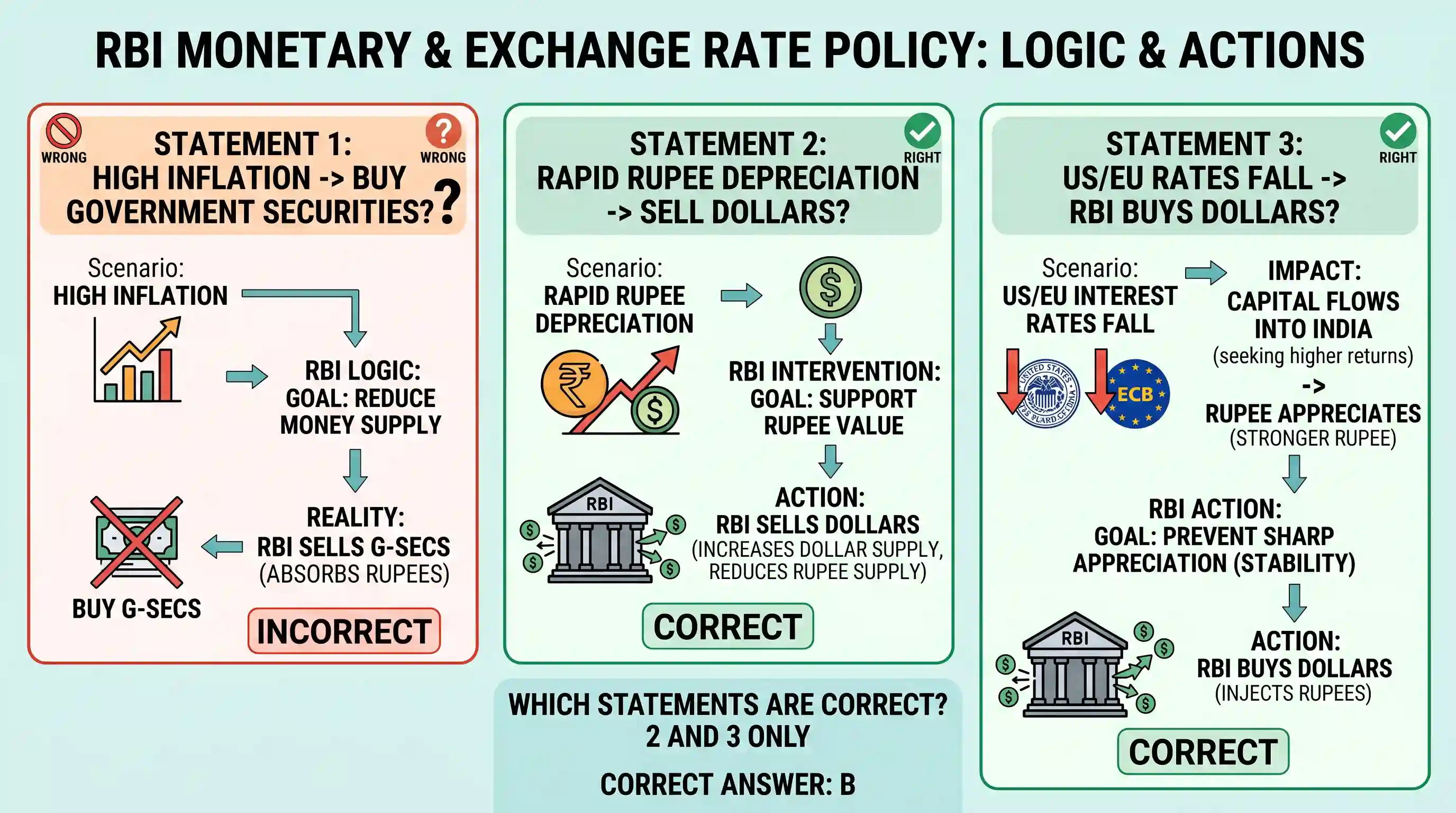
If the inflation is too high, Reserve Bank of India (RBI) is likely to buy government securities: To control high inflation, RBI typically aims to reduce the money supply in the economy. Buying government securities (Open Market Operations - OMOs) injects liquidity into the system, which would worsen inflation. Instead, RBI would sell government securities to absorb liquidity. Therefore, statement 1 is incorrect.
-
If the rupee is rapidly depreciating, RBI is likely to sell dollars in the market: When the rupee depreciates rapidly, it means the rupee is losing value against the dollar. To arrest this depreciation and strengthen the rupee, RBI can intervene in the foreign exchange market by selling dollars from its foreign exchange reserves. This increases the supply of dollars and reduces the supply of rupees, thereby supporting the rupee's value. Therefore, statement 2 is correct.
-
If interest rates in the USA or European Union were to fall, that is likely to induce RBI to buy dollars: A fall in interest rates in the USA or EU would make investments in those regions less attractive for global investors. This could lead to capital (dollars) flowing out of those economies and into economies like India, where returns might be relatively higher. An increased inflow of dollars into India would put upward pressure on the rupee (rupee appreciation). To prevent a sharp appreciation of the rupee, which could hurt exports, RBI might intervene by buying dollars from the market, thus injecting rupees and maintaining exchange rate stability. Therefore, statement 3 is correct.
Related questions
More UPSC Prelims practice from the same subject and topic.
- Prelims 2022GS1economy
With reference to the Indian economy, what are the advantages of "Inflation-Indexed Bonds (IIBs)"? 1. Government can reduce the coupon rates on its borrowing by way of IIBs. 2. IIBs provide protection…
- Prelims 2022GS1economy
Consider the following statements : 1. In India, credit rating agencies are regulated by Reserve Bank of India. 2. The rating agency popularly known as ICRA is a public limited company. 3. Brickwork R…
- Prelims 2022GS1economy
With reference to the 'Banks Board Bureau (BBB)', which of the following statements are correct? 1. The Governor of RBI is the Chairman of BBB. 2. BBB recommends for the selection of heads for Public …
- Prelims 2022GS1economy
With reference to Convertible Bonds, consider the following statements: 1. As there is an option to exchange the bond for equity, Convertible Bonds pay a lower rate of interest. 2. The option to conve…
- Prelims 2022GS1economy
In India, which one of the following is responsible for maintaining price stability by controlling inflation?
- Prelims 2022GS1economy
"Rapid Financing Instrument" and "Rapid Credit Facility" are related to the provisions of lending by which one of the following?