Consider the following statements: 1. A bill amending the Constitution requires a prior recommendation of the President of India. 2. When a Constitution Amendment Bill is presented to the President of India, it is obligatory for the President of India to give his/her assent. 3. A Constitution Amendment Bill must be passed by both the Lok Sabha and the Rajya Sabha by a special majority and there is no provision for joint sitting. Which of the statements given above are correct?

- A1 and 2 only
- B2 and 3 onlyCorrect
- C1 and 3 only
- D1, 2 and 3
Explanation
Let's analyze the statements regarding a bill amending the Constitution:
-
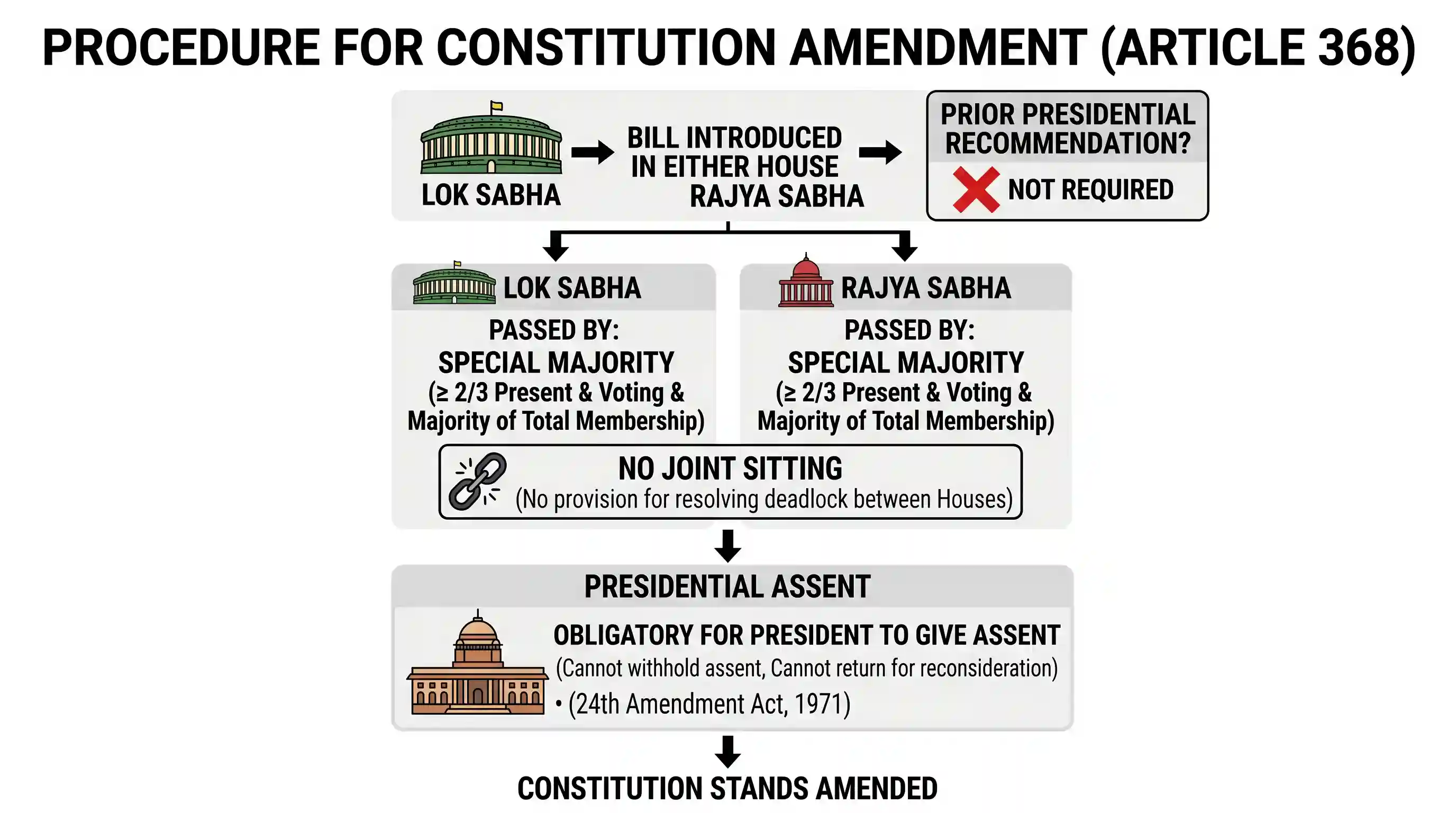
A bill amending the Constitution requires a prior recommendation of the President of India: A Bill for the amendment of the Constitution (under Article 368) can be introduced in either House of Parliament without the prior recommendation of the President. This is a key distinction from certain other types of bills (e.g., Money Bills). Therefore, statement 1 is incorrect.
-
When a Constitution Amendment Bill is presented to the President of India, it is obligatory for the President of India to give his/her assent: The 24th Constitutional Amendment Act of 1971 made it obligatory for the President to give assent to a Constitution Amendment Bill, meaning the President cannot withhold assent or return the bill for reconsideration. This statement is correct.
-
A Constitution Amendment Bill must be passed by both the Lok Sabha and the Rajya Sabha by a special majority and there is no provision for joint sitting: A Constitution Amendment Bill must be passed by each House of Parliament by a special majority (i.e., a majority of the total membership of the House and a majority of not less than two-thirds of the members of that House present and voting). There is no provision for a joint sitting of both Houses to resolve a deadlock over a Constitution Amendment Bill; if one House rejects the bill or proposes amendments not acceptable to the other, the bill fails. This statement is correct.
Related questions
More UPSC Prelims practice from the same subject and topic.
- Prelims 2022GS1polity-and-governance
Consider the following statements: 1. The Constitution of India classifies the ministers into four ranks viz. Cabinet Minister, Minister of State with Independent Charge, Minister of State and Deputy …
- Prelims 2022GS1polity-and-governance
With reference to anti-defection law in India, consider the following statements: 1. The law specifies that a nominated legislator cannot join any political party within six months of being appointed …
- Prelims 2022GS1polity-and-governance
With reference to the "G20 Common Framework", consider the following statements: 1. It is an initiative endorsed by the G20 together with the Paris Club. 2. It is an initiative to support Low Income C…
- Prelims 2022GS1polity-and-governance
Consider the following statements: 1. Pursuant to the report of H.N. Sanyal Committee, the Contempt of Courts Act, 1971 was passed. 2. The Constitution of India empowers the Supreme Court and the High…
- Prelims 2022GS1polity-and-governance
With reference to India, consider the following statements: 1. Government law officers and legal firms are recognised as advocates, but corporate lawyers and patent attorneys are excluded from recogni…
- Prelims 2022GS1polity-and-governance
Which of the following is/are the exclusive power(s) of Lok Sabha ? 1. To ratify the declaration of Emergency 2. To pass a motion of no-confidence against the Council of Ministers 3. To impeach the Pr…