Consider the following statements: 1. Pursuant to the report of H.N. Sanyal Committee, the Contempt of Courts Act, 1971 was passed. 2. The Constitution of India empowers the Supreme Court and the High Courts to punish for contempt of themselves. 3. The Constitution of India defines Civil Contempt and Criminal Contempt. 4. In India, the Parliament is vested with the powers to make laws on Contempt of Court. Which of the statements given above is/are correct?

- A1 and 2 only
- B1, 2 and 4Correct
- C3 and 4 only
- D3 only
Explanation
Let's evaluate each statement:
-
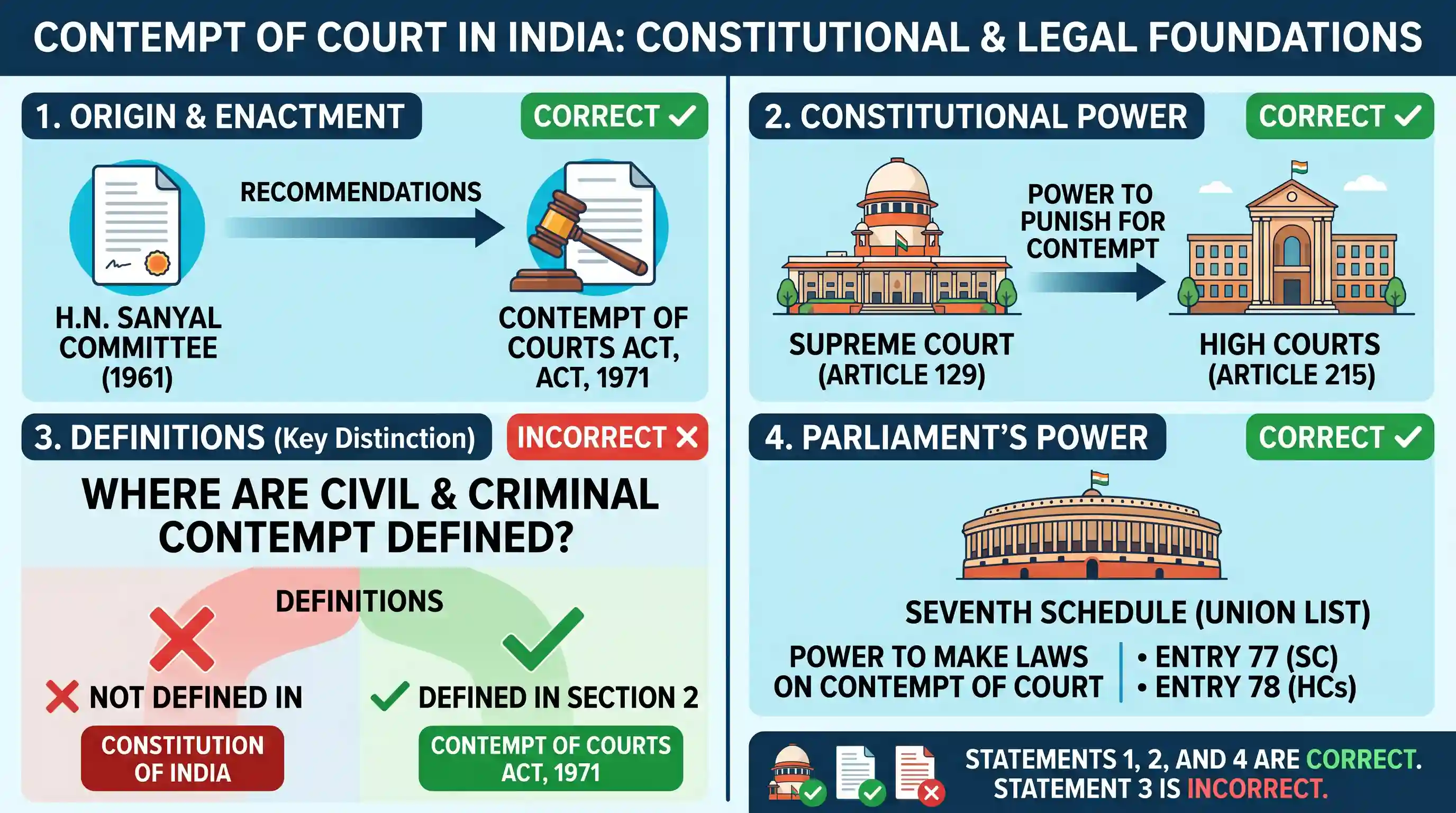
Pursuant to the report of H.N. Sanyal Committee, the Contempt of Courts Act, 1971 was passed: The H.N. Sanyal Committee was constituted in 1961 to examine the law relating to contempt of court. Based on its recommendations, the Contempt of Courts Act was enacted in 1971. This statement is correct.
-
The Constitution of India empowers the Supreme Court and the High Courts to punish for contempt of themselves: Article 129 of the Constitution declares the Supreme Court to be a court of record and vests it with the power to punish for its contempt. Similarly, Article 215 states that every High Court shall be a court of record and shall have all the powers of such a court, including the power to punish for contempt of itself. This statement is correct.
-
The Constitution of India defines Civil Contempt and Criminal Contempt: The Constitution of India does not define civil contempt and criminal contempt. These definitions are provided in Section 2 of the Contempt of Courts Act, 1971. This statement is incorrect.
-
In India, the Parliament is vested with the powers to make laws on Contempt of Court: Article 122 of the Constitution of India implicitly empowers Parliament to make laws for regulating the practice and procedure of the courts. Additionally, Entry 77 and Entry 78 of the Union List (List I of Seventh Schedule) give Parliament the power to make laws relating to the Supreme Court and High Courts, including their powers and jurisdiction. The Contempt of Courts Act, 1971, is an example of Parliament exercising this power. This statement is correct.
Related questions
More UPSC Prelims practice from the same subject and topic.
- Prelims 2022GS1polity-and-governance
With reference to the writs issued by the Courts in India, consider the following statements: 1. Mandamus will not lie against a private organisation unless it is entrusted with a public duty. 2. Mand…
- Prelims 2022GS1polity-and-governance
With reference to the "G20 Common Framework", consider the following statements: 1. It is an initiative endorsed by the G20 together with the Paris Club. 2. It is an initiative to support Low Income C…
- Prelims 2022GS1polity-and-governance
With reference to India, consider the following statements: 1. Government law officers and legal firms are recognised as advocates, but corporate lawyers and patent attorneys are excluded from recogni…
- Prelims 2022GS1polity-and-governance
Consider the following statements: 1. A bill amending the Constitution requires a prior recommendation of the President of India. 2. When a Constitution Amendment Bill is presented to the President of…
- Prelims 2022GS1polity-and-governance
Consider the following statements: 1. The Constitution of India classifies the ministers into four ranks viz. Cabinet Minister, Minister of State with Independent Charge, Minister of State and Deputy …
- Prelims 2022GS1polity-and-governance
Which of the following is/are the exclusive power(s) of Lok Sabha ? 1. To ratify the declaration of Emergency 2. To pass a motion of no-confidence against the Council of Ministers 3. To impeach the Pr…